Before shopping went digital, it was personal—filled with small joys, strange rituals, and places that made even running errands feel like an adventure.

Add VegOut to your Google News feed. 
Let’s be honest, shopping used to be a whole thing.
Not just a quick “add to cart” moment between Zoom calls, but an event. You’d plan for it. You’d go out with friends or family, maybe grab a snack on the way, and wander through aisles for hours. There was joy in touching things, hearing music play in the background, and seeing people instead of pixels.
Boomers didn’t just shop; they made memories doing it.
Now, those memories live mostly in stories told over dinner, when someone inevitably says, “You kids don’t know what you missed.” And they’re kind of right.
So, here’s a nostalgic tour through eight stores boomers still miss and the rest of us never really got to experience.
1. Blockbuster Video
Before Netflix had its famous “ta-dum,” Friday nights had the sound of a VHS case snapping shut.
Blockbuster was the ultimate weekend ritual. Families piled into minivans, grabbed snacks, and wandered the aisles debating whether to go with Jurassic Park or Mrs. Doubtfire. It was slow, social, and a little magical.
There was something about holding a physical copy of your movie that made the night feel special. And if you were lucky enough to snag a “new release” before they sold out, it felt like winning the lottery.
Then streaming came along and convenience killed the experience. Sure, we gained unlimited access, but we lost that anticipation, the shared excitement of picking the perfect movie together.
Blockbuster didn’t just rent films; it rented moments of connection. And if you grew up after 2005, you missed that golden glow of the blue and yellow aisles forever.
2. Woolworth’s
Woolworth’s was basically the original “everything store.” It was where people could grab a pair of socks, a soda, and a frying pan all in one trip.
But what made Woolworth’s iconic wasn’t just what it sold; it was what it meant. It was a community hub before that was even a buzzword. Shoppers would sit at the lunch counter, gossip with the waitresses, and eat grilled cheese sandwiches that cost less than a dollar.
My grandmother still swears the root beer floats there were unmatched. She says it with the same conviction I use when defending oat milk lattes.
By the time the 1990s rolled around, Woolworth’s couldn’t keep up with the rise of big-box stores. It quietly disappeared, but its influence stuck. Every time you grab lunch inside a Target café or Walgreens, you’re living a tiny echo of the Woolworth’s era, when shopping still had a heartbeat.
3. Toys “R” Us
If you were a kid in the ’80s or ’90s, Toys “R” Us was a full-blown fantasy land. The colorful aisles stretched endlessly, filled with action figures, dolls, bikes, and board games. Parents dreaded it, kids begged for it, and everyone left slightly overstimulated.
It wasn’t just about buying toys; it was about being in a world made entirely for fun.
I remember hearing stories about the giant Geoffrey the Giraffe statues outside and the chaos of the holiday rush. Apparently, if you weren’t careful, you could lose a small sibling in the Nerf gun section for twenty minutes.
Then came the online shopping era. Amazon and Walmart’s digital catalogs made it impossible for big toy stores to compete. Toys “R” Us filed for bankruptcy in 2018, taking a piece of collective childhood joy with it.
Even now, millennials can’t hear “I don’t wanna grow up, I’m a Toys ‘R’ Us kid…” without getting misty-eyed.
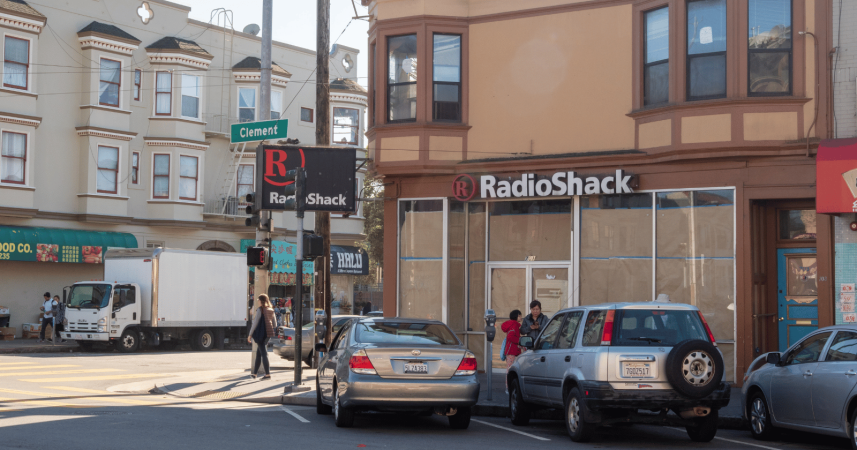
4. RadioShack
If your dad ever built something that involved a soldering iron and a lot of swearing, there’s a 99% chance RadioShack supplied the parts.
This was the ultimate DIY tech store. You could buy resistors, transistors, batteries, walkie-talkies, basically anything that made electronics tick.
The employees were walking encyclopedias of cables and adapters. You could go in with nothing more than a confused look and a broken gadget, and somehow leave with everything you needed to fix it.
RadioShack thrived in an age when people wanted to understand their devices. But as technology became sleeker and less repairable, curiosity lost to convenience.
Journalist Adam Gopnik once wrote, “Technology’s progress often leaves behind the very curiosity that built it.” RadioShack’s story proves that. We gained better tech but lost the joy of tinkering.
5. Borders
If you ever wanted to feel like the main character in a ’90s rom-com, Borders was the place.
It wasn’t just a bookstore; it was a vibe. Dim lighting, mellow jazz, and the smell of freshly brewed coffee drifting from the in-store café. You could spend hours browsing, reading, or pretending to work on your novel while sipping a latte.
Borders was one of the first major retailers to make books feel cool again. It was social and introspective all at once. You’d meet people in the aisles, chat about favorite authors, and maybe even discover something unexpected.
But when Amazon introduced cheaper online books and e-readers, Borders couldn’t keep up. It filed for bankruptcy in 2011, and its closure left a cultural hole.
Now, scrolling through e-books on a Kindle just doesn’t feel the same. There’s something about holding a real book, flipping through crisp pages, and wandering aimlessly in a store filled with stories.
6. Tower Records
Before Spotify playlists and Apple Music algorithms, discovering new music required effort and passion.
Tower Records was the temple of that experience. Its aisles were lined with vinyls, CDs, posters, and music magazines. You could spend hours flipping through records, chatting with employees who actually knew their stuff, and maybe even catch a live in-store performance.
Music wasn’t background noise back then; it was an identity. People built their personalities around what they listened to, and Tower Records was where those personalities took shape.
As NPR once put it, “Tower’s fall wasn’t about music dying; it was about music changing from something you owned to something you streamed.”
Today, vinyl’s having a comeback, sure, but walking into a Tower Records on a Friday night? That was its own kind of magic.
7. The Limited
Before fast fashion took over, The Limited was where women went to build their “grown-up” wardrobes. Think power blazers, silk blouses, and pencil skirts, all with a little bit of flair.
It was the store that made professionalism look stylish. Every boomer woman I know has a memory tied to it, her first job interview outfit, a special date-night dress, or that one sale that made her feel like she’d struck gold.
By the 2010s, The Limited couldn’t compete with online trends and cheaper alternatives. It shut down in 2017, and with it went a little piece of mall culture.
When I see Instagram boutiques advertising “minimalist capsule wardrobes,” I can’t help but laugh. We’re just reinventing The Limited, minus the mall fountain and soft pop soundtrack.
8. KB Toys
If Toys “R” Us was Disneyland, KB Toys was the carnival that popped up in your local mall.
It was smaller, louder, and somehow more chaotic. Every shelf was jam-packed with toys, games, and those battery-operated demo gadgets that never, ever stopped making noise.
Walking into KB Toys was like entering sensory overload in the best way. Kids loved it because everything felt within reach, literally. Parents loved it because it was small enough to escape quickly.
KB Toys thrived in the mall’s golden era but couldn’t survive the shift to e-commerce. By 2009, it was gone, leaving behind a generation of nostalgic adults who still remember its bright red logo and slightly sticky floors.
They tried to relaunch it in 2018, but it didn’t stick. You can’t recreate chaos like that, it’s organic.
The heart of it all
When you really think about it, these stores weren’t just about what you bought; they were about how you felt while buying it.
There was a slower kind of joy in it. You made plans to go shopping. You talked to people. You touched things before you bought them. Shopping wasn’t passive; it was an experience that engaged all your senses.
Today, our shopping carts live online. They’re neat, fast, and completely impersonal. It’s great for efficiency, but it also means we’ve lost the tiny, spontaneous connections that used to make shopping feel human.
A clerk recommending a record. A stranger complimenting your book choice. A kid throwing a tantrum in the toy aisle (okay, maybe we don’t miss that part).
Boomers may romanticize the past, sure, but they’re not wrong about this one. Those stores gave people more than products; they gave them stories, laughter, and community.
And maybe, just maybe, the reason we’re all so nostalgic for them, even if we never lived through them, is because they represent something our digital world can’t replicate: presence.
So next time you order something online, maybe take a moment to slow down. Visit a local bookstore. Browse a thrift shop. Chat with the person behind the counter.
Because someday, we’ll be the ones saying, “You kids don’t know what you missed.”