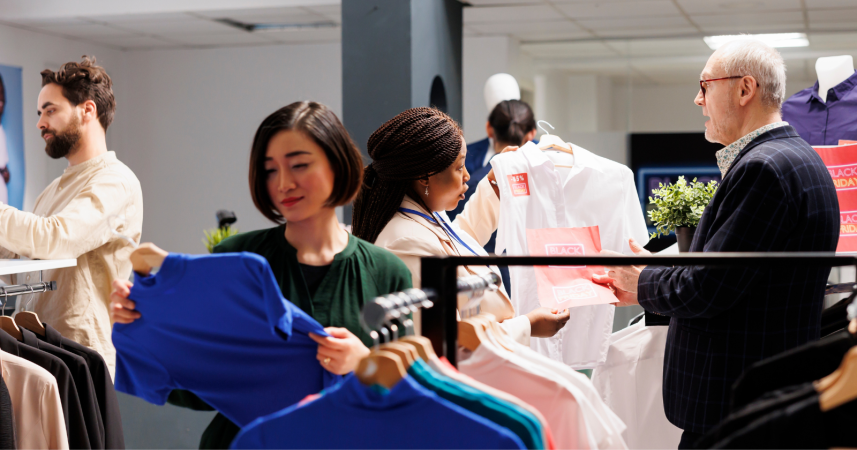
Black Friday has a way of revealing what people value, how they handle pressure, and where they fall on the spectrum of scarcity and abundance.
Black Friday is a wild cultural event if you think about it. It is the one day of the year when almost everyone drops their usual habits and slips into full consumer mode. Some people treat it like a strategy game. Others treat it like a sport. A few treat it like a spiritual awakening.
But here is the funny part. The way someone behaves on Black Friday reveals far more than their shopping preferences. It quietly exposes their real social class. Not their income. Not their job title. Their class. As in, their relationship with money, scarcity, abundance, and self control.
I learned this during my years working in luxury hospitality. You see everything when you work in that world. The guests who tip before they even order. The guests who complain loudly about not getting a window table. The ones who treat the staff like equals, and the ones who act like the staff is invisible. All of it signals class, sometimes unintentionally.
Black Friday works the same way. The patterns show you how someone thinks, what they value, and how they move through life. So let’s dive into eight Black Friday behaviors that quietly reveal more than most people realize.
1) You treat discounts as a bonus, not a lifeline
One of the biggest tells is how people psychologically approach sales. Some obsess over the discount itself. They look at the percentage off like oxygen. Others see discounts as a pleasant surprise rather than something to chase.
In luxury F&B, I used to watch people spend two hundred dollars on dinner without blinking, then refuse a free dessert because it did not appeal to them.
That taught me something. When you make decisions from preference instead of scarcity, your whole energy shifts.
On Black Friday, class shows up in the ability to stick to your taste. If you buy something because you genuinely want it and the discount just happens to sweeten the deal, you move differently. You are not reacting to the sale. You are choosing intentionally.
And that is a very different vibe from letting the sale dictate what you buy.
2) You do not sprint for the doorbusters
Here is a simple truth. Running, pushing, or acting frantic over a limited number of heavily discounted items does not scream confidence. It screams scarcity mindset.
When you grow up around people who value quality and patience, you learn that the best things rarely require frantic grabs. You also learn that if something is meant for you, it will still be there. Or you will find a better version later.
Watching the doorbuster chaos online is like watching a social experiment. Who rushes. Who lunges. Who fights for a toaster like it is oxygen.
But the people who stroll in calmly, grab what they planned to buy, and leave without fanfare send a very different signal. They do not need to wrestle for deals. They are not governed by panic.
They are anchored in their own pace.
3) You stick to a plan instead of shopping emotionally
One thing I learned in hospitality is that emotional decision making shows up everywhere. A frustrated diner makes impulsive choices. A confident diner makes deliberate ones. The same carries into shopping.
On Black Friday, lower class signaling is all about reacting. Higher class signaling is all about intention.
Some people walk in with a list. A simple one. Maybe even written on their phone. They already know what they want and why they want it. They have thought it through. They are not swayed by flashy displays or “only 7 left” countdowns.
Others shop the way people binge eat after a stressful week. Pure emotion, no strategy.
When you choose from clarity instead of impulse, it shows discipline, boundaries, and a strong relationship with money. And you walk out with fewer regrets.
4) You understand the difference between value and cheapness
This is a big one. People who focus solely on the lowest price signal a scarcity mindset. People who focus on value signal discernment.
And I do not mean expensive equals classy. I mean understanding when something is actually worth the money.
Working in fine dining taught me a lot about this. Some guests knew exactly why a thirty dollar pasta was priced that way. Fresh ingredients. Time consuming preparation. Craft. Technique. Others saw the price and assumed it was pretentious.
Same with Black Friday. Two people can buy a discounted item for totally different reasons. One is chasing cheapness. The other is recognizing value.
Knowing the difference is a quiet class marker.
5) You avoid showing off your haul online

This one is subtle, but it says a lot. People who feel the need to post every item they bought often buy for external validation. People who purchase for themselves do not need to broadcast it.
Think about it. Truly confident people do not show off every win. Whether it is a promotion, a trip, or a well cooked steak, they enjoy it privately until there is a reason to share.
If someone films a “Black Friday haul” with thirty items spread across the floor, you can almost feel the insecurity.
People with higher class energy share selectively. They curate. They choose moments worth talking about instead of dumping everything publicly.
It is the difference between signal and noise.
6) You behave calmly with staff even when the store is chaotic
If you want to know someone’s real social class, watch how they treat staff during peak chaos.
I spent years working in restaurants on the busiest nights of the year. New Year’s Eve. Mother’s Day brunch. Valentine’s Day dinner. The difference in behavior between high class and low class customers was night and day.
High class people stayed calm. They asked politely. They understood delays. They treated the staff like actual human beings.
Low class energy showed up as impatience, entitlement, and raised voices.
Black Friday is similar. You have crowds, stress, long lines, and limited stock. The people who handle it with composure stand out.
Class is not about money. It is about how you act when things are inconvenient.
7) You do not buy things you cannot afford just because they are discounted
Credit card debt spikes after Black Friday for a reason. The psychology of sale culture preys on fear of missing out, scarcity, and the desire to belong. A lot of people end up buying things they cannot comfortably afford simply because the price looks irresistible.
But true class is in restraint.
It is in the ability to say no even when something is tempting. It is in choosing financial stability over the thrill of a bargain.
I once read a line in a business book that stuck with me. It said, “Luxury is comfort, not strain.” If something puts you under pressure, it is not a luxury. Even at 70 percent off.
Knowing when to walk away is a quiet power move.
8) You buy with long term thinking
People with higher class energy understand longevity. They buy clothes they can wear for years. Cookware that will age well. Electronics that will not break in six months. They ask questions like, “Will this still make sense next year?”
Meanwhile, people who shop for the rush care about the high of the purchase, not the lifespan of the item.
This is the linking point that signals the last behavior. If you have the ability to slow down, zoom out, and think beyond the dopamine hit, you automatically show a higher level of maturity and self awareness.
I had a mentor in hospitality who taught me this idea without saying it directly. He used to walk me through wine cellars explaining how real value was always long term. The bottles meant to age. The ingredients meant to develop. The meals meant to be savored slowly.
Black Friday works the same way. If you buy things designed to last, you will naturally stand apart from the frenzy around you.
Final thoughts
Black Friday has a way of revealing what people value, how they handle pressure, and where they fall on the spectrum of scarcity and abundance. It is not about wealth. It is about mindset. It is about how someone shows up when the world gets chaotic and the temptations get loud.
If you want to develop higher class habits, look at your approach to desire, discipline, and spending. Ask yourself what you are actually chasing when you shop. Is it the deal, the validation, the thrill, or something deeper?
The way you answer that question says far more than any purchase ever could.
Which of these behaviors felt the most familiar to you?
What’s Your Plant-Powered Archetype?
Ever wonder what your everyday habits say about your deeper purpose—and how they ripple out to impact the planet?
This 90-second quiz reveals the plant-powered role you’re here to play, and the tiny shift that makes it even more powerful.
12 fun questions. Instant results. Surprisingly accurate.