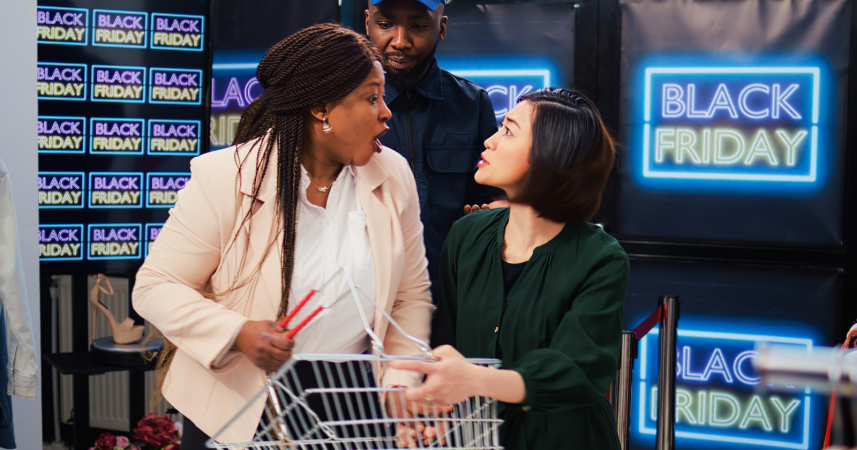
My years folding shirts and working registers taught me more about consumer manipulation than any psychology textbook ever could.

Add VegOut to your Google News feed. 
I worked retail through my late teens and early twenties. Nothing glamorous, just a part-time gig at a store in Sacramento that helped pay for gas and the occasional concert ticket.
Back then, Black Friday was already chaos, but nothing like what it has become. And even in those earlier days, I picked up on things. The way managers would hype up deals that weren't that special. The inventory tricks. The manufactured urgency.
Years later, after diving deep into behavioral psychology and decision-making research, I started connecting the dots. Those retail experiences weren't just about folding shirts and working a register. They were a masterclass in consumer manipulation.
Here are eight secrets I learned from those years on the floor, backed by what I've since discovered about how this whole system really works.
1) Those "doorbuster" deals are designed to manipulate you
Here's the thing about doorbusters. They're not really about giving you a great deal.
Stores stock maybe five of that insanely cheap TV. Five. In a store that'll see thousands of shoppers.
The real strategy? Get you through the door at 5 a.m., and once you're there, surrounded by deals and decision fatigue, you'll buy other stuff. Probably stuff you don't need.
We were actually instructed to place those limited doorbusters right next to higher-priced alternatives. Customer comes in for the $200 TV that's already gone, suddenly the $400 one right there doesn't seem so bad. It worked every single time.
It's brilliant, really. And it works.
2) Many "Black Friday specials" are just manufactured for the day
This one I didn't fully understand until years after I left retail, when I started reading more about consumer behavior and retail psychology.
The electronics we sold on Black Friday sometimes had slightly different model numbers than what we carried the rest of the year. Same brand, same box design, but something felt off about the specs.
Turns out, major brands manufacture cheaper versions specifically for Black Friday. Same logo, lower quality components. They're not selling you last year's model at a discount. They're selling you a version that was built to hit a specific price point.
That TV might have fewer HDMI ports or less advanced picture processing. That laptop might have less RAM or a slower processor.
The differences are subtle enough that most people won't notice in the store, but significant enough that you're not getting the same quality as the regular line. It's a way to offer those jaw-dropping discounts without actually losing money on premium products.
3) Prices get inflated before the sale
I've spent enough time reading about behavioral economics to know this one is particularly sneaky.
Retail experts tracked prices and found that retailers increase the "normal" price of items in the days before Black Friday. Some items saw price increases of 8% to 23% just before the sale.
So when you see "Was $100, Now $50," that $100 might've been $85 last week. The discount looks deeper than it actually is. And our brains love that feeling of getting a deal, even when the math doesn't quite add up.
4) The deals often aren't that unique
Here's something I noticed early on: we ran big sales constantly. Black Friday just had better marketing. Better signage. More urgency. Crowds lined up at the door.
But the actual discounts? We'd done 40% off or 50% off multiple times throughout the year. Sometimes we'd run the exact same promotion in September, and nobody camped out overnight for it.
The difference was the story around it. Black Friday has this mythology built up. People think it's the one day a year when retailers practically give stuff away. So they show up.
The numbers back this up too. According to Retail Dive, many retailers (such as Wal-Mart, Best Buy and Target) simply repeat Black Friday deals from the previous year. Same product. Same discount. Just repackaged as this year's "must-have deal."
And those sales don't really end on Friday. Most extend through the weekend. Some run into the following week.
In other words, the urgency is theater. If you miss Black Friday, you probably didn't miss anything.
5) There's often no difference between Thursday and Friday deals
By the time I left retail, stores were just starting to open on Thanksgiving. I dodged that bullet, thankfully.
But I've talked to people who worked those shifts, and here's what they noticed: the deals were identical. Same prices on Thursday evening as Friday morning. The only difference was the crowd size and which day you had to miss with your family.
Stores realized they could capture shoppers before their competitors did, so they kept pushing opening times earlier and earlier. Some started at midnight. Then 10 p.m. Then Thanksgiving evening. All with the same deals they'd be running the next day anyway.
If you shop early, you might avoid the worst chaos and still get the same discount. But stores won't advertise that because they want both crowds. More foot traffic, more opportunities to sell.
The best part? Many of these "limited time" Black Friday deals also show up online days before the actual event. So you don't even need to leave your house to get the same price.
6) That "while supplies last" anxiety is intentional
Scarcity sells. Always has.
The entire doorbuster model is built on making you feel like you're going to miss out. Limited quantities. Limited time. Door opens at 5 a.m., deal ends at 7 a.m. Get there or lose out forever.
This taps into something primal. When we think something is scarce, we want it more. Even if we didn't want it that much in the first place.
Retailers create artificial urgency by limiting not just quantities but time windows. Some deals only last two hours.
The truth is they could easily stock more. They could run the sale longer. But then you'd have time to think about whether you actually need it.
Decision-making under pressure is almost always worse decision-making. You buy things you don't need because you're afraid of regret. Not the regret of wasting money, but the regret of missing the deal.
That's the emotion they're selling. Not the TV. The feeling that you won something.
7) The back room is mostly empty
This was my favorite game to play, honestly. Customer demands I "check the back" for an item.
So I'd disappear into the stockroom, maybe reorganize some boxes for 30 seconds, check my phone, then come back empty-handed with an apologetic look.
Because here's the truth: there is no magical back room full of hidden inventory. Especially not on Black Friday. We stocked everything we had out front because management knew exactly how many people were coming and exactly what they'd be looking for.
The back room was for receiving shipments and storing fixtures, not hoarding secret inventory. If it's not on the floor, it doesn't exist. Period.
But customers don't want to believe that. They're convinced we're holding out on them. So we'd play along, take a little break from the chaos, and deliver the same answer every time. Some workers would literally just stand in the back and stare at the wall for a minute. Same result.
8) Workers are surviving, not thriving
This might be the most important one.
Behind every Black Friday transaction is a person who's been on their feet for hours, dealing with aggressive customers, missing time with family, and often working for regular pay despite the chaos.
Studies show retail workers experience significantly increased stress, decreased wellbeing, and higher absenteeism around Black Friday. Some stores see employee anxiety so high that people call in sick just to avoid the day.
I think about this when I'm clicking "add to cart" from my couch. Someone, somewhere, is packing that order in a warehouse that's probably running at three times normal capacity.
The human cost of convenience doesn't show up on the receipt.
Conclusion
Black Friday isn't going anywhere. The deals will keep coming, the crowds will keep forming, and retailers will keep perfecting their strategies.
But maybe knowing what's happening behind the scenes changes how you approach it. Maybe you shop a few days later when the same deals are still running. Maybe you skip the doorbusters that were never really available anyway.
Or maybe you just remember there's a person on the other end of that transaction who's probably having a rougher day than you are.
Either way, shop smart. Question the urgency. And don't believe everything the sale sign tells you.
If You Were a Healing Herb, Which Would You Be?
Each herb holds a unique kind of magic — soothing, awakening, grounding, or clarifying.
This 9-question quiz reveals the healing plant that mirrors your energy right now and what it says about your natural rhythm.
✨ Instant results. Deeply insightful.

Jordan Cooper
Jordan Cooper is a pop-culture writer and vegan-snack reviewer with roots in music blogging. Known for approachable, insightful prose, Jordan connects modern trends—from K-pop choreography to kombucha fermentation—with thoughtful food commentary. In his downtime, he enjoys photography, experimenting with fermentation recipes, and discovering new indie music playlists.
More Articles by Jordan