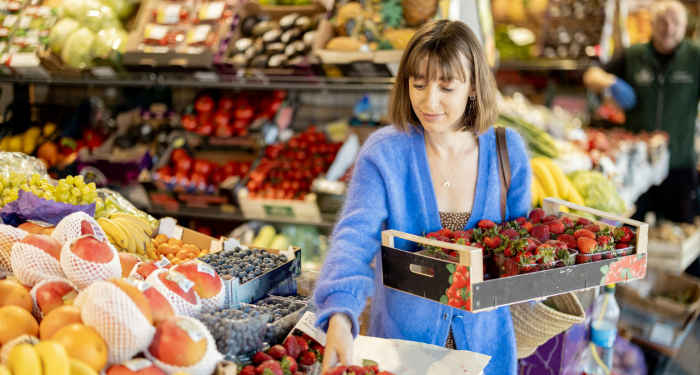
Seven quiet cart shifts—less churn, more rhythm—that say you’re buying back time, taste, and sanity, not just groceries.

Add VegOut to your Google News feed. 
We don’t just shop for food — we shop for the kind of life we think we’re building.
Carts tell stories.
In my travel brain, they’re like carry-ons at the gate: you can guess the trip by what’s inside.
If your cart has quietly shifted from “stretch every coupon” to “protect my time, energy, and taste buds,” you’ve likely left the old middle-class mindset (optimize for price-per-ounce) and stepped into value thinking (optimize for outcomes).
It’s not about spending more. It’s about spending smart on things that pay you back all week.
Here are the subtle signals your cart is sending.
1. Your list is short on purpose
Middle-class autopilot loves variety for variety’s sake: seven different dinners, seven random jars.
You, however, shop like a tiny bistro — tight menu, great execution.
Your list repeats: a grain, a bean, a protein, leafy greens, seasonal veg, eggs or tofu, good bread, a sauce rotation. It’s a capsule pantry, not a chaos pantry.
The flex is in the remix. Chickpeas show up as soup on Monday, smashed toast on Wednesday, and salad protein on Friday. Rice becomes a bowl, then fried rice, then stuffed peppers.
You’re not boring — you’re fluent. And because you’re repeating hits, you actually finish what you buy.
Less waste. More rhythm. Fewer 6 p.m. panics.
2. You buy fewer things—but better anchors
Your cart looks minimalist, not empty: a peppery olive oil, crusty sourdough, lemons, herbs you’ll actually use, coffee you’re excited to drink, greens that taste like something.
These are not “treats”; they’re anchors that make Tuesday taste like you have your life together.
You’ve escaped the false-economy trap where cheap-but-meh food turns into leftovers that no one touches. Better staples mean you snack less, order out less, and enjoy more.
Cost-per-delight, cost-per-use — your math grew up. You don’t need five mediocre condiments; you need two great ones you drain to the last drop.
3. You budget for ease where it prevents chaos
There’s a line item in your head called “don’t spiral.”
It pays for washed greens, precut veg, cooked lentils, rotisserie-adjacent plant proteins—whatever turns 40 minutes of ambition into 10 minutes of inevitable.
Old rules say never buy convenience — your rule says buy the 10% that prevents the $35 emergency delivery.
This isn’t laziness. It’s design.
You’re buying back decision energy for when it matters. Tuesday-night-you thanks you. So does Thursday-morning-you when there’s a ready lunch that isn’t sadness in a box.
4. You shop the global aisle (and the market) like a local
You treat the “international” shelf as a treasure chest, not a novelty act: gochujang, tahini, coconut milk, rice noodles, whole spices.
Cheaper, better, more versatile than the wellness-branded dupes.
Add a farmers’ market run or the produce guy who tells you which figs want one more day on the counter. Seasonality sets half your menu for you.
This isn’t performative — it’s pragmatic.
A spoon of harissa makes whatever-veg-you-have taste intentional. A bag of rice noodles plus frozen veg equals a five-minute dinner with actual personality.
You’re shopping for outcomes — speed, flavor, repeatability — not logos.
5. You ignore “deals” that don’t fit your plan
Endcap theatrics—limited time! family size!—don’t move you. You glance at the unit price, ingredients, and your list, then keep walking.
That’s it. No drama.
If a “deal” requires three extra purchases or a new storage system, it’s not a deal; it’s a hobby.
You also choose store brand where it’s a match and splurge where it matters (olive oil, coffee, cheese, a spice refresh).
Quiet money is selective. You’re not signaling status with packaging; you’re signaling sanity with taste and follow-through.
6. You shop for future-you (and guests), not just now-you
There’s a hospitality shelf in your brain: sparkling water, good tea, dark chocolate, olives, crackers, maybe a “company pasta.”
Not because you’re hosting a gala—because you like being the person who can say, “Stay for a bit, I’ve got you.”
You also think in weeks, not minutes. You buy ingredients that scale across days—a grain you cook once and use three ways, a sauce that lands on bowls and sandwiches, veg that can be raw today and roasted tomorrow. You keep one “break-glass” dinner (frozen dumplings, jarred artichokes, fail-proof soup) for nights when everyone’s human.
That’s not middle-class scrimping—it’s grown-up grace.
7. Your cart carries systems, not just stuff
Tucked between tomatoes and tofu are the quiet upgrades: freezer-safe containers so leftovers are a promise, not a myth; zip-top reusables; parchment so roasting is frictionless; a fresh pepper mill because seasoning is half the meal.
Maybe you toss in fresh herbs every week because they’re the cheapest makeover on earth.
These aren’t “extras.” They turn cooking into a glide path. You’re building an environment where the default is good.
Systems are the real flex—because systems keep working when your willpower clocks out.
Final thoughts: the richest cart buys you back
When I land somewhere new, I judge a city by its markets.
What’s fresh? What’s affordable? How do people eat on a Tuesday?
Your cart can do the same diagnostic for your life. If it’s light on novelty and heavy on anchors, if it protects weeknights and makes guests easy, if it buys time as deliberately as it buys tomatoes — you’ve shifted out of middle-class autopilot and into a calmer class entirely: the one where your groceries serve your days, not the other way around.
You didn’t “upgrade” to fancier. You upgraded to kinder—to your schedule, your palate, your future self.
The labels on the jars matter less than the story your cart tells: less churn, more rhythm; less proving, more living. That story tastes good.