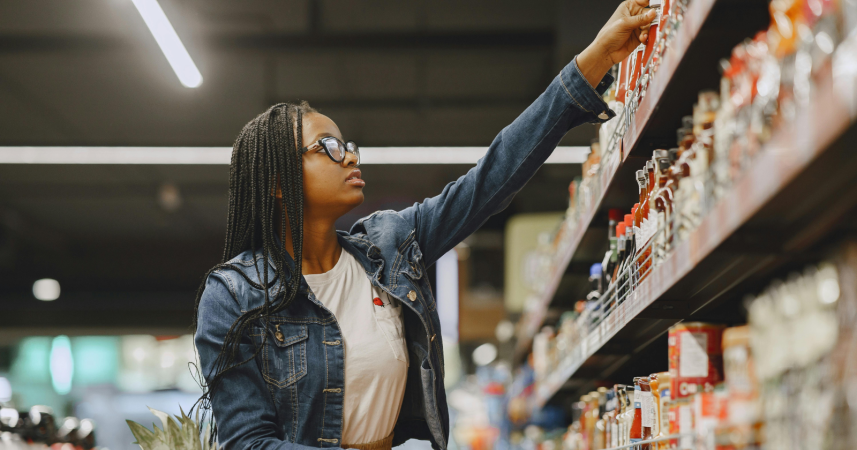
The brands we choose aren't just about taste or price - they're signals about which economic world we inhabit.

Add VegOut to your Google News feed. 
I was unpacking groceries at my partner's parents' house a few years ago when I noticed something odd. Their pantry was full of brands I'd never heard of. Organic this, artisanal that, local everything. Not a single product I recognized from growing up.
Meanwhile, my own family's pantry in Sacramento was stocked with names everyone knows. Kraft, Heinz, Coca-Cola. The same brands you'd find in any working-class kitchen across America.
That's when I started paying attention to the invisible class markers hiding in plain sight on grocery store shelves. The brands we choose aren't just about taste or price. They're signals about which economic world we inhabit.
Upper-middle-class families don't usually announce they're avoiding certain brands. They just quietly select alternatives, building entire shopping routines around products the working class has never encountered.
Here are ten household brands that reveal this divide more clearly than income statements ever could.
1) Wonder Bread and similar mass-market white bread
Working-class families buy Wonder Bread or whatever white bread is on sale. It's soft, it lasts forever, and kids like it. It's what sandwiches are made with.
Upper-middle-class families buy artisanal sourdough from local bakeries or at minimum, whole grain bread from Whole Foods. They avoid processed white bread like it's poisonous, talking about gluten quality and preservatives.
The price difference is stark. Wonder Bread costs maybe $2.50. A loaf from the local bakery costs $7 or more. That's not a casual price gap when you're feeding a family.
But upper-middle-class families have absorbed the message that processed white bread is low-class and unhealthy. They'd rather spend the extra money than be seen buying it.
2) Kraft Singles and processed cheese
Kraft Singles were a staple in my house growing up. Grilled cheese, cheeseburgers, quick snacks. That's what cheese meant to us.
Upper-middle-class families buy actual cheese. Blocks of cheddar, wheels of brie, fresh mozzarella. They might not even consider Kraft Singles as real cheese. They talk about cheese like it's wine, discussing origins and aging processes.
The working class sees cheese as cheese. The upper-middle-class sees Kraft Singles as a processed food product that vaguely resembles cheese. This distinction matters to them in ways that seem excessive to everyone else.
3) Folgers and Maxwell House coffee
Working-class families drink Folgers or Maxwell House. Big cans that last forever, brewed in basic coffee makers. Coffee is coffee, and these brands are reliable and affordable.
Upper-middle-class families have completely abandoned these brands. They buy whole beans from specialty roasters, grind them fresh, and use expensive brewing equipment. Or they stop at craft coffee shops and spend $5 per cup.
My parents still drink Folgers every morning and think the whole craft coffee movement is pretentious nonsense. My partner's parents have a $400 espresso machine and buy beans from a local roaster at $18 per bag.
Same beverage, completely different universes.
4) Tide and mainstream laundry detergent
Tide is the default laundry detergent for working-class families. It's effective, widely available, and frequently on sale. You buy it in huge bottles at Walmart or Target.
Upper-middle-class families increasingly avoid it in favor of eco-friendly alternatives. Seventh Generation, Method, or some local brand you've never heard of. They pay significantly more for products that are supposedly better for the environment and gentler on skin.
The working class doesn't see the point. Tide works. It's been working for decades. Paying double for laundry detergent that does the same thing feels wasteful.
But for upper-middle-class families, it's about values signaling as much as cleaning clothes. What brand you buy communicates where you stand on environmental issues.
5) Coca-Cola and Pepsi
Working-class families buy Coke and Pepsi by the case, especially when they're on sale. Soda is a staple, something you always have in the fridge.
Upper-middle-class families have largely eliminated soda from their homes. Maybe they'll have sparkling water or kombucha, but conventional soda has become somewhat taboo.
When they do buy it, it's treated as an occasional indulgence rather than a household staple. Their kids drink water or milk, not Coke with dinner.
This shift happened gradually, as health consciousness became a class marker. The working class still drinks soda freely. The upper-middle-class treats it like cigarettes, something you might do but shouldn't admit to regularly.
6) Stouffer's and other frozen dinners
Frozen dinners saved my parents countless times when they were too tired to cook. Stouffer's lasagna, Hungry-Man dinners, frozen pizzas. Quick, filling, and cheap.
Upper-middle-class families avoid the frozen dinner aisle almost entirely, except maybe for some upscale brands like Amy's or organic options. They meal prep, they cook from scratch, they order from restaurants. But they don't microwave Stouffer's.
There's judgment embedded in this avoidance. Frozen dinners signal that you either don't have time to cook properly or don't prioritize nutrition. Either way, it's low-class.
The working class sees frozen dinners as practical solutions. The upper-middle-class sees them as evidence of poor life management.
7) Suave and VO5 hair products
Suave shampoo and conditioner, VO5, these are working-class bathroom staples. They're cheap, they work fine, and you can buy them anywhere.
Upper-middle-class families use salon brands or specialty products. Aveda, Bumble and bumble, products recommended by their stylist. They'll easily spend $30 on a bottle of shampoo.
The working class finds this absurd. It's shampoo. It cleans your hair. Spending $30 on it when Suave costs $3 seems like pure pretension.
But upper-middle-class families have learned to see drugstore hair products as damaging or ineffective. Whether that's true or marketing is beside the point. The class distinction is real.
8) Oscar Mayer and other processed lunch meat
Oscar Mayer bologna, deli-sliced turkey and ham in plastic packages, these are lunchbox staples for working-class kids. Quick sandwiches, easy protein, affordable.
Upper-middle-class families buy deli meat freshly sliced from the counter or avoid processed meat entirely. They're concerned about nitrates, preservatives, and quality. They pack their kids' lunches with organic turkey or hummus and vegetables.
The price and time difference adds up quickly. Oscar Mayer is grab-and-go and costs $4. Freshly sliced deli meat requires a trip to the counter and costs $8-12 per pound.
Working-class families make the practical choice. Upper-middle-class families make the "healthier" choice, even though the health benefits are debatable.
9) Hidden Valley Ranch dressing
Ranch dressing is beloved by the working class. Hidden Valley on everything: salads, vegetables, pizza, chicken wings. It's a condiment that makes food taste better.
Upper-middle-class families increasingly make their own dressings or buy expensive artisanal versions. Buying bottled ranch dressing has become quietly declassé.
At restaurants, ordering ranch dressing can actually mark you as working-class to servers and other diners. Upper-middle-class people order vinaigrettes or ask what the chef recommends.
It's a small thing, but these small things accumulate into clear class markers.
10) Lunchables and pre-packaged snacks
Lunchables were special treats when I was growing up. Pre-packaged convenience that felt fun and easy. Working-class parents still pack them in lunches regularly.
Upper-middle-class parents won't touch them. They pack bento boxes with homemade snacks, cut fruit, and carefully portioned items. Lunchables represent everything they're trying to avoid: processed food, excessive packaging, nutritional emptiness.
The time investment alone reveals the class divide. Working-class parents are often working multiple jobs or long hours. Lunchables are practical. Upper-middle-class parents have the time and resources to prepare elaborate lunch boxes.
Neither approach is wrong, but they signal completely different economic realities.
Conclusion
These brand preferences aren't random or purely about taste. They're class markers as clear as what car you drive or what neighborhood you live in.
Working-class families prioritize affordability, convenience, and familiarity. They buy brands they've known their whole lives, brands that work and don't break the budget.
Upper-middle-class families prioritize quality signals, health consciousness, and environmental values. They can afford to pay premium prices for products that align with their worldview.
Neither group is better or worse. But pretending these distinctions don't exist doesn't help anyone. The brands in your pantry tell a story about economic class, whether you realize it or not.
Next time you're at the grocery store, pay attention to what's in other people's carts. You'll start seeing the invisible lines that separate economic worlds living side by side.
Just launched: Laughing in the Face of Chaos by Rudá Iandê
Exhausted from trying to hold it all together?
You show up. You smile. You say the right things. But under the surface, something’s tightening. Maybe you don’t want to “stay positive” anymore. Maybe you’re done pretending everything’s fine.
This book is your permission slip to stop performing. To understand chaos at its root and all of your emotional layers.
In Laughing in the Face of Chaos, Brazilian shaman Rudá Iandê brings over 30 years of deep, one-on-one work helping people untangle from the roles they’ve been stuck in—so they can return to something real. He exposes the quiet pressure to be good, be successful, be spiritual—and shows how freedom often lives on the other side of that pressure.
This isn’t a book about becoming your best self. It’s about becoming your real self.