A surprising number of everyday mall habits reveal more about your upbringing than you might think.

Add VegOut to your Google News feed. 
The mall has a funny way of holding up a mirror.
You walk in for socks and suddenly you're face to face with every belief you ever absorbed about money, value, and what counts as a “treat.”
It’s subtle, but if you grew up lower middle class, certain instincts kick in—and you barely notice them until you're standing in line, comparing carts.
This isn’t about nostalgia or guilt. It’s about awareness.
Our upbringing shapes more than how we budget—it shapes how we think, behave, and even how we experience places like the mall.
Let’s break down six moments where your lower middle class programming might still be running the show.
1. You look at the price tag before the style
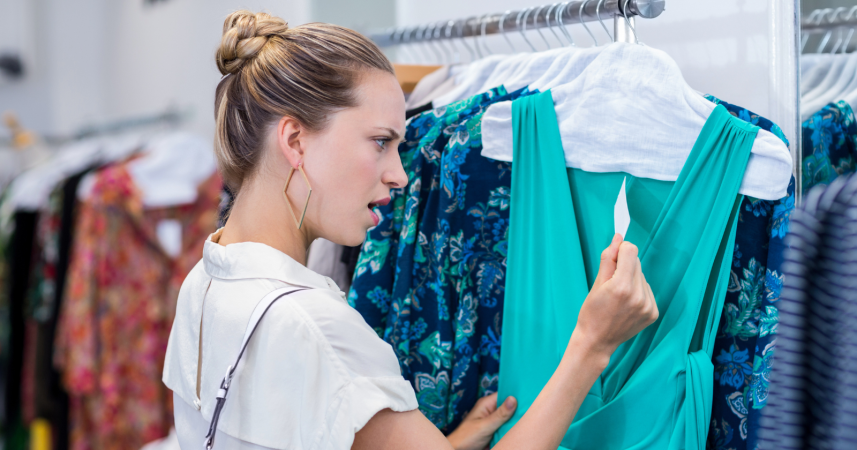
The hanger barely makes it off the rack before you're flipping the tag.
Not to see the size. Not to check the brand. Just the number.
If it’s affordable, then you ask yourself if you like it. That’s the order. Cost first, feelings later.
I still catch myself doing it with items I don’t even want. Like the habit runs deeper than desire.
Growing up, I knew not to get attached to anything on display until I checked the tag. That mindset still lingers, even when I can technically afford it now.
Turns out, a lot of high-earners don’t drop the frugal habits either. As Thomas C. Corley found, “64% of the millionaires described the homes they own as ‘modest.’…55% buy used cars.”
So yeah, starting with the price tag? It’s a feature, not a flaw.
2. You pause before buying food at the mall
The smell of soft pretzels, fried chicken, and teenage freedom hits you hard.
But you don't move. You do math.
Can I wait until I get home? Didn’t I already eat out this week? Is it worth twelve bucks for a plastic tray and sodium?
When I was a teen, food court meals weren’t casual. They were budgeted. Split fries and shared soda were the norm. You didn’t eat at the mall unless you planned it.
That hesitation comes from a deeper place. Growing up, food wasn’t part of the mall experience unless it was planned. If you bought food, it was a treat—and you felt it.
Even now, I get a flash of guilt when I order something impulsively. Like I’m breaking some invisible rule.
And it's not just me. Research backs this up. “Financial worries can hit low-income people's thinking skills as hard as losing a full night’s sleep—or taking a 13-point drop in IQ.”
So yeah, second-guessing your food court splurge? That’s the programming talking.
3. You feel out of place in luxury stores
You walk in. You freeze up.
Suddenly your posture feels off. Your shoes seem louder. You second-guess your face.
You’re not shoplifting. You’re not being rude. But you still feel like you don’t belong.
There’s an internal script that runs when you’re in a place that screams "excess." Your brain says, “Look, not touch. Smile, not speak. Don’t knock anything over.”
I’ve felt that invisible tension dozens of times—like I’m a guest at a party I wasn’t really invited to. Even when dressed for it, even when I could afford something, I felt like an imposter.
The irony? Most people who can afford luxury avoid flaunting it. According to Experian Automotive, “61% of households earning over $250,000 don’t drive luxury brands—they drive Hondas, Toyotas, and Fords.”
Which just goes to show: the ones spending loudest aren’t always the wealthiest. And the ones who look like they don’t belong? Might just be smart with money.
4. You make a beeline for the clearance section
Doesn’t matter how sleek the front display looks. If you were raised lower middle class, you know the good stuff is in the back.
You head straight to the messy racks. The ones with lopsided hangers and neon tags. That’s where the hunt begins.
Shopping was never just about getting what you wanted. It was about stretching what little you had. A shirt for $8 instead of $28? That was a win. That was pride.
To this day, I get a little dopamine hit when I score something on deep discount. It’s not about needing the item—it’s about the thrill of beating the system.
Even when I tell myself, "Don’t buy just because it’s cheap," I still check the clearance. It’s like brushing your teeth. Automatic.
5. You compare your cart to everyone else's
You're in line at checkout, holding one item.
The person in front of you has four bags and a smoothie. The kid behind you has two pairs of shoes and an iced coffee. And suddenly, you're scanning.
Not judging—just noticing. Wondering. How are they affording all that? Are they buying for someone else? Did they hit payday?
It’s not envy. It’s the internal calculator that never turns off. You were trained to measure and monitor. Not just your own spending, but others' too.
I’ve been that person silently tallying someone else’s haul, not out of malice, but out of curiosity. Because growing up, you saw shopping as a strategy game. A challenge. A test of what you could get away with.
And even when your budget grows, the comparison habit stays.
6. You hesitate to treat yourself
You pick up the jacket. It fits. It’s on sale. You love it.
Still, you hesitate.
You hear the internal committee: Do you need this? Isn’t this kind of indulgent? What if something unexpected happens next week?
I can’t count how many times I’ve left a store, walked a full lap, and returned 20 minutes later to talk myself into a purchase.
Treating yourself always felt conditional. Like you needed a reason, or a milestone, or a coupon.
Recently I read Laughing in the Face of Chaos by Rudá Iandê, and one line stuck with me:
“When we let go of the need to be perfect, we free ourselves to live fully—embracing the mess, complexity, and richness of a life that’s delightfully real.”
His insights reminded me that self-denial, when chronic, becomes a cage. And sometimes, buying something you love is the most honest thing you can do.
Final thoughts
These mall moments aren’t random. They’re patterns. Echoes.
They reflect how you were raised, what your family prioritized, and what your nervous system still remembers.
And that’s not a bad thing. Lower middle class values often instill grit, resourcefulness, and gratitude.
But at some point, you also get to choose.
You get to buy the good fries without guilt. Walk into the nice store without shrinking. Splurge a little without spiraling.
Because treating yourself isn’t a betrayal of your roots. It’s a sign you’ve grown.
And the clearance rack will always be there, waiting.
What’s Your Plant-Powered Archetype?
Ever wonder what your everyday habits say about your deeper purpose—and how they ripple out to impact the planet?
This 90-second quiz reveals the plant-powered role you’re here to play, and the tiny shift that makes it even more powerful.
12 fun questions. Instant results. Surprisingly accurate.