How a Depression-era formula became the dessert I'm asked to bring everywhere.
My aunt Patricia makes exactly three comments when she tastes food. "Interesting" means she hates it. "Not bad" means it's fine. "You need to write this down" means she's already planning when you'll make it again.
She said the third thing about my carrot cake last Easter, right before asking for the recipe. I watched her transcribe it into her yellow recipe binder, the one she's kept since 1973, between her grandmother's pound cake and something called "Sally's Surprise Salad." Then I mentioned the cake was vegan.
She looked at me like I'd just revealed I was in witness protection.
"But I ate three pieces," she said, as if veganism were contagious through cream cheese frosting.
The accidental discovery
I didn't set out to veganize carrot cake. I was making it for my friend Sarah's birthday, forgot I'd run out of eggs, and remembered this thing my grandmother used to say about "wacky cake"—Depression-era desserts that used vinegar and baking soda instead of eggs. During the 1930s, when eggs cost more than most families could spare, home bakers discovered chemistry could replace expensive ingredients.
The science made sense. Acid plus base equals lift. The oil was already there. Carrot cake is basically quickbread in party clothes anyway.
What I didn't expect was that it would be better than the regular version. Not different-but-acceptable. Not surprisingly-good-for-vegan. Actually better. The texture was somehow more tender. The carrots stayed suspended instead of sinking. The spices seemed brighter, like someone had turned up their volume.
I've now made this cake dozens of times. I've brought it to potlucks, birthdays, one funeral, and three breakups. No one has ever asked if it's vegan. They ask for seconds.
Why this works when it shouldn't
Here's what traditional carrot cake asks eggs to do: bind, leaven, and add moisture. Here's what's already doing those jobs: oil (moisture), flour (binding), and the chemical reaction between vinegar and baking soda (leavening). The eggs were just middle management.
The real secret is the hot water. You add it at the end, after everything else is mixed. It looks wrong—the batter is thin, almost pourable. That's exactly right. The hot water partially gelatinizes the flour starches, creating an incredibly tender crumb that makes people use that word we all pretend to hate about cake.
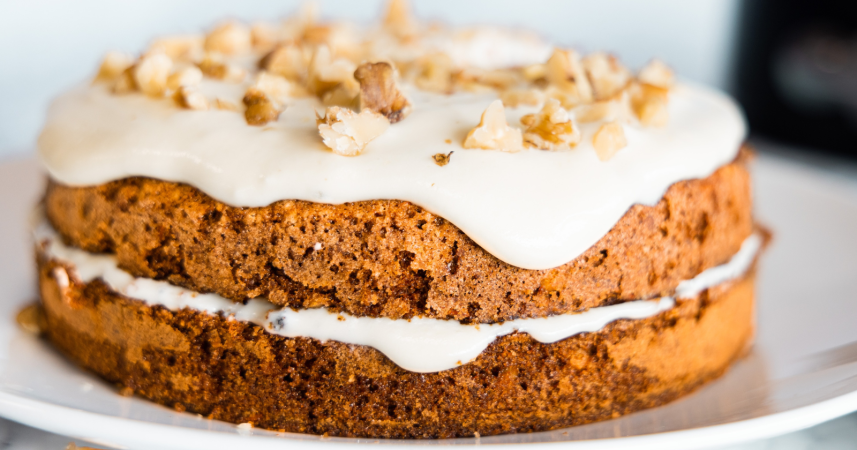
The Accidental Vegan Carrot Cake Makes one 9x13 pan, two 9-inch rounds, or 24 cupcakes
For the cake:
- 2 cups all-purpose flour
- 2 cups sugar
- 2 teaspoons baking soda
- 2 teaspoons cinnamon
- 1 teaspoon salt
- 1½ cups vegetable oil (or any neutral oil)
- 2 teaspoons vanilla
- 2 cups grated carrots (about 4 medium, use small holes on box grater)
- 1 cup chopped walnuts (optional but correct)
- ½ cup raisins (divisive but I'm pro)
- 4 teaspoons white vinegar
- 2 cups hot water (just off the boil, about 200°F)
For the frosting (makes enough for generous coverage; halve for lighter touch):
- 8 oz vegan cream cheese (Kite Hill or Violife work best)
- ½ cup vegan butter, softened
- 4 cups powdered sugar
- 2 teaspoons vanilla
- Pinch of salt
Heat oven to 350°F. Grease your pan. Don't use parchment—this cake likes to climb the sides.
Mix flour, sugar, baking soda, cinnamon, and salt in a large bowl. Make a well in the center. Add oil and vanilla to the well. Stir until just combined—it'll look too thick. That's fine. Fold in carrots, walnuts, and raisins. Add vinegar and stir briefly.
Now the weird part: Pour in the hot water. The batter will look too thin. It's supposed to. Pour into your prepared pan and bake: 35-40 minutes for 9x13, 25-30 minutes for rounds, 18-20 minutes for cupcakes. Test with a toothpick—it should come out clean.
For the frosting: Beat cream cheese and butter until fluffy. Add powdered sugar gradually. Beat in vanilla and salt. Spread on completely cooled cake like you're spackling a wall—thick and without apology.
Storage: Keeps covered at room temperature for 2 days, refrigerated for up to a week. Freezes beautifully for up to 3 months.
The sociology of secret vegan dessert
I've watched this cake create the same conversation at seventeen different gatherings. Someone takes a bite. They go back for seconds. They find me in the kitchen.
"Is this your grandmother's recipe?" "Sort of." "It's incredible. My mom made something similar but never this good." "Thank you." "What's your secret?"
This is where I have to decide whether to tell them.
If I say it's vegan, the conversation shifts. Suddenly we're discussing almond milk and whether honey is ethical and their cousin who went plant-based and won't shut up about it. The cake becomes political. It stops being about the cake.
If I don't say it's vegan, they write down the recipe and text me three days later: "Wait, there's no EGGS?"
The great cream cheese situation
Let's address the frosting problem directly. Vegan cream cheese used to be terrible. It tasted like someone described cheese to an alien who'd never experienced dairy or joy. But Kite Hill figured something out with cultured almonds, and Violife did something with coconut that doesn't taste like coconut, and now we have options that work.
The frosting won't be identical to dairy cream cheese frosting. It will be its own thing, which happens to be delicious. It's slightly less tangy, a little more neutral, which lets the cake's spices come through more. Patricia—keeper of the yellow recipe binder—says she actually prefers it. "Less cloying," she said, which from her is basically a Nobel Prize.
What we talk about when we talk about cake
Recently, I made it for a new neighbor who just moved in. She's going through a divorce, has two kids, looks exhausted in that specific way of someone managing too much alone. I didn't mention the cake was vegan. I didn't mention anything except that sometimes cake helps and this one freezes well.
She texted me at 11 PM: "My kids ate vegetables in dessert form and asked for more. What kind of sorcery is this?"
I sent her the recipe. She sent back a string of question marks when she got to the hot water part, then a voice memo of her laughing. "No eggs? NO EGGS?"
Her kids have requested it for their birthday cake. Both of them. They don't know it's vegan either. They just know it's the cake from the nice lady next door, the one their mom can actually make because it's basically foolproof, the one that tastes like comfort even when comfort's hard to find.
That's the best kind of recipe—the kind that does its job without announcing itself, that feeds people without ideology, that shows up and delivers exactly what's needed. Even if what's needed is just really good cake.
Patricia called yesterday. Her book club wants me to teach them how to make it. "Tell them the truth about the eggs?" I asked.
"After they taste it," she said. "Some revelations need proper timing."