The difference between “fine” tofu and “actually craveable” tofu? Ten minutes under a skillet.
There are recipes you flirt with and recipes you end up texting from the grocery aisle because they’ve quietly become your weeknight ride-or-die.
This tofu stir-fry is the latter.
Seventeen rounds in, I still look forward to it.
It started as “let me throw veggies in a pan and hope for the best.” It evolved into a dependable ritual that saves me when I’m hungry, low on executive function, and not trying to spend $18 on takeout.
Along the way, it taught me a bunch about how tiny choices compound—on the stove and in life.
Let’s cook and learn.
1. Start with a non-negotiable
Every ritual needs a single decision that removes a dozen later decisions.
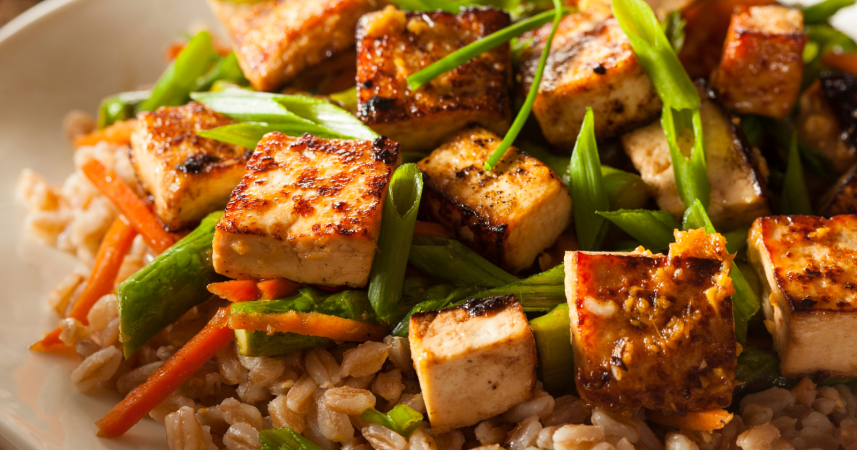
For this dish, my non-negotiable is the tofu: extra-firm, pressed, cut into bite-size rectangles, and pan-crisped until it squeaks a little when it hits the bowl.
I don’t bargain with that.
If the store is out of extra-firm, I’ll skip the stir-fry and make something else. That one boundary keeps quality consistent and stress low.
2. Press like you mean it
I used to skip pressing tofu because I was impatient.
Then I realized those ten minutes with a heavy skillet on top are the difference between “soft, fine, okay” and “golden, structured, actually-craveable.”
I wrap the tofu in a clean kitchen towel, set it under a pan, add a can or two for weight, and let gravity do its thing.
While it presses, I chop a red onion, mince garlic and ginger, and cue up the playlist I overuse when I need momentum.
Pressing isn’t glamorous. But a lot of good things aren’t. It’s the kind of small prep step that pays you back all week—exactly the kind of trade-off I try to make more often.
3. Season the tofu before the pan
I toss the pressed tofu with a whisper of soy sauce or tamari, a pinch of cornstarch, and a splash of neutral oil.
The cornstarch creates micro ridges that crisp on contact. The soy gets flavor into the interior early. You don’t need much—just enough to tint the edges.
Then I heat a skillet until it’s properly hot. Not “I put my hand near it and it feels warm.” Hot-hot. The kind of hot that makes the first cube sizzle like a tiny round of applause.
I lay the pieces down and don’t touch them for a minute.
That one minute of doing nothing? It’s the difference between a good sear and a tofu scramble you didn’t ask for.
4. Build a sauce you can remember
I like sauces I can make from muscle memory.
Here’s mine—equal parts soy sauce and water, a little maple syrup, a touch of rice vinegar, grated ginger and garlic, a few shakes of chili flakes or a drip of chili crisp.
If I have toasted sesame oil, a half-teaspoon at the end. If I want it glossy, a teaspoon of cornstarch whisked in.
That’s it. I can assemble it while the tofu crisps. No measuring spoons, no stress. Once you’ve got a baseline, it’s easy to riff: add orange zest, swap in gochujang, throw in peanut butter, you name it.
5. Treat vegetables like co-stars, not extras
I rotate what’s in season or in my fridge: broccoli, snap peas, red peppers, carrots, shiitakes, baby bok choy.
Two rules keep it clean:
-
Cut things to similar sizes so they cook together.
-
Stagger the cook. Dense veggies first, delicate ones last.
Onion goes in after the tofu is crisped and set aside. Then the carrots and broccoli stems. Then peppers and mushrooms. Greens and peas near the end. Salt each stage lightly so the vegetables taste like themselves.
I’ve mentioned this before but cooking is a confidence engine. When you can turn a crisper-drawer mystery into dinner, the rest of your day feels more solvable.
6. Use heat like a dial, not an on/off switch
Burners are not binary.
I run this dish like a DJ—heat up to sear, down to soften, up again to reduce the sauce at the end. If the pan smokes, I splash in a tablespoon of water and scrape the fond. If the veggies threaten to go limp, I pull them early and reunite everyone at the end.
Tiny adjustments prevent big mistakes. That’s true in the pan and in most projects worth doing.
7. Sauce last, and don’t drown it
When the vegetables are crisp-tender, the tofu goes back in. The sauce follows. I simmer a minute to thicken. Then I kill the heat and finish with that kiss of sesame oil and maybe a squeeze of lime.
Here’s the trick I learned on batch six or seven: restraint.
If you pour all the sauce in and it looks like a soup, you’ve gone too far. Start with half. Toss. Taste. Add more only if the stir-fry needs it. Flavor should cling to every piece, not pool at the bottom.
I spoon the stir-fry over rice or chewy noodles, scatter scallions, toasted sesame seeds, and whatever crunch lives in my pantry—roasted peanuts, panko crisped in a dry pan, or crushed nori sheets.
That last 30 seconds of texture play makes dinner feel “restaurant” without doing anything complicated.
8. Make it yours with one signature twist
I like a “house move”—a small element that makes the dish unmistakably yours.
Sometimes that’s a spoon of white miso dissolved into the sauce for umami.
Other times it’s a charred lemon half squeezed over the top. Lately, it’s been black vinegar for a deep, malty tang that makes Tuesday feel like Friday.
Your move could be fresh basil torn in, a swirl of tahini, or a handful of cilantro stems chopped fine.
Pick one and repeat it often enough that your friends ask, “What is that?”
9. Respect leftovers (they’re a time machine)
Stir-fry reheats like a champ. If I’m already cooking, I double the tofu and vegetables, keep the sauce on the side, and portion a second bowl for lunch tomorrow.
When future-you opens the fridge and finds that container, it’s like somebody put an extra hour in your day. That’s not an exaggeration. It’s the exact feeling that keeps me batch-cooking even when I’m tired.
Pro move: reheat in a skillet with a splash of water and a fresh garlic clove to wake it up. Add a handful of greens to make it feel new again.
10. Keep the ritual lightweight
I used to collect elaborate recipes like souvenirs. Fun for the weekend, brutal on a Wednesday night. This stir-fry stays because the friction is low.
The steps are simple:
Press tofu. Crisp it. Sauté vegetables in waves. Add sauce. Finish with acid and something crunchy.
The cleanup is equally low: one cutting board, one big pan, one bowl for the sauce.
When a habit is easy to start and quick to recover from, you repeat it. Repeatable things build better weeks.
11. Let the dish teach you bigger things
Cooking this seventeen times hasn’t just made me faster with a knife. It’s nudged my thinking.
It taught me that constraints are creative—use what’s in the fridge, stay within a handful of pantry staples, and you end up with more variety, not less. It taught me that flavor is often timing (when you add the garlic) and texture (how dry your tofu is) more than it is rare ingredients.
And it reminded me that consistency isn’t boring when you’re paying attention. Each round is a micro-experiment with heat, order, or finishing touches.
Once you understand the basic elements of flavor and seasoning, you can cook anything. That’s the north star here. Salt, fat, acid, heat—and the confidence to play with them.
12. The quick-start recap (so you actually try it)
Here’s the bare-bones version you can riff on tonight:
Press a block of extra-firm tofu for 10–15 minutes. Cut into rectangles. Toss with a splash of soy or tamari, a teaspoon of cornstarch, and a little neutral oil.
Whisk a quick sauce: 2 tablespoons soy or tamari, 2 tablespoons water, 1 tablespoon maple syrup, 1 tablespoon rice vinegar, 1 clove grated garlic, 1 teaspoon grated ginger, chili flakes to taste. Optional: 1 teaspoon cornstarch for gloss, ½ teaspoon toasted sesame oil to finish.
Heat a large skillet over medium-high until hot. Add the tofu in a single layer. Sear until golden on two sides, flipping gently. Remove to a plate.
Add a bit more oil if needed. Sauté onion, then hard veg (carrot, broccoli stems), then medium (peppers, mushrooms), then delicate (snap peas, greens). Salt lightly at each stage.
Return tofu to the pan. Pour in sauce a bit at a time, tossing until everything’s lacquered. Simmer 30–60 seconds to thicken. Finish with sesame oil and lime. Serve over rice or noodles. Top with scallions, sesame seeds, and crunch.
Make it yours with one signature twist, and don’t forget to save a portion for tomorrow.
13. Why I’m still not sick of it
Because it checks every box I care about right now. It’s plant-forward without preaching. It’s fast without feeling like a compromise. It’s forgiving. It’s customizable. It tastes like I cooked on purpose, not in panic.
More than anything, it’s a small, repeatable win that ripples outward. When I eat well on a random weekday, I write better, think clearer, and have more patience for everything else life throws at me.
Seventeen times in, I’m still excited to make it. Odds are, I’ll be excited on the eighteenth.
If you try this, tweak it. Swap the vegetables. Lean into spice or keep it mellow. Put your stamp on it. Then run it back next week and notice how it gets easier, tastier, and more yours each time.
That’s the real recipe.
What’s Your Plant-Powered Archetype?
Ever wonder what your everyday habits say about your deeper purpose—and how they ripple out to impact the planet?
This 90-second quiz reveals the plant-powered role you’re here to play, and the tiny shift that makes it even more powerful.
12 fun questions. Instant results. Surprisingly accurate.