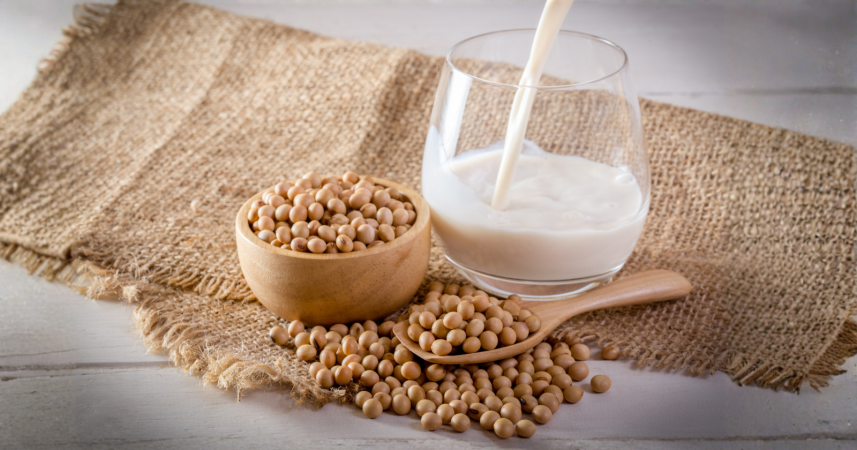
The plant-based milk in your fridge might be doing more environmental damage than you think—and it’s not the one you’ve been warned about.

Add VegOut to your Google News feed. 
I’m standing at my kitchen counter, frothing up what used to feel like the most virtuous choice on the shelf: a splash of creamy soy milk for my morning coffee.
But here’s the knot in my stomach—every carton of that familiar vegan staple is tethered to a commodity chain that’s bulldozing irreplaceable rainforest. And most days, we don’t give it a second thought.
The feel-good carton that hides a rainforest footprint
Soy milk won its cult status because it’s lactose-free, protein-rich, and—let’s be honest—tastes pretty dreamy in a latte. Yet the same humble soybean is still a headline act in Amazon deforestation.
Since the Amazon Soy Moratorium took effect in 2008, direct forest loss for soy has dropped to just 0.2% of all clearing—proof the policy works—but new state-level bills now threaten to strip away the tax incentives that kept the moratorium alive.
If those protections crumble, the chainsaws come roaring back.
How soy milk got tangled in Amazon politics
The soybean rush didn’t start with oat-milk-loving urbanites; it started with global demand for cheap livestock feed. Roughly three-quarters of the world’s soy crop still fattens cattle, chickens, and fish.
But buyers don’t label a truckload of beans “feed” or “barista blend.” Whether the shipment ends up in a feedlot or a vegan cappuccino, it likely grew on the same industrial farms pushing ever deeper into tropical frontiers.
Greenpeace calls the moratorium “proof of what can be accomplished when civil society and companies work together,” a fragile proof now hanging by a political thread.
“Isn’t deforestation mostly a meat problem?”
Absolutely—meat is still the heavyweight. But that doesn’t let plant-based consumers off the hook. When any of us buys soy milk from suppliers who ignore land-clearing, we reinforce demand for the commodity mix fueling the crisis. Think of it like communal debt. Even if your portion is small, you’re still co-signing the loan.
Why our brains gloss over invisible costs
Before writing full-time, I spent years poring over balance sheets. Numbers lure smart people into magical thinking: a cost seems to disappear just because it’s parked in a separate column.
Psychologists call the pattern moral licensing—we earn virtue points (“vegan milk!”) and subconsciously spend them on whatever’s convenient (“ignore sourcing”). Layer on the green-halo effect—the bias that “plant-based” automatically equals “planet-friendly”—and it’s no wonder soy milk slides under our ethical radar.
The data reality check
Progress is real, but reversible. Satellite monitoring shows the moratorium curbed Amazon soy deforestation even as production quadrupled on already-cleared land.
Pressure is rising. Proposed Brazilian laws would gut incentives for compliant farms, opening the door to “dirty” soy.
Commodity overlap is messy. The Nature Conservancy warns that soy, along with beef and palm oil, remains a leading driver of global forest loss—responsible for roughly an eighth of worldwide climate emissions.
If we keep sipping without scrutiny, we become silent shareholders in that expansion.
Europe just raised the stakes
Last year the EU adopted Regulation 2023/1115, better known as the deforestation-free products rule. Starting December 30, 2024, companies selling soy (and six other high-risk commodities) in Europe must prove every batch is forest-safe and traceable to the plot of land where it was grown.
The law is already shaking supply chains. A Reuters letter leak showed industry groups begging Brussels for a delay while they scramble to build compliance systems. Lawmakers refused, stressing that forests can’t wait for perfect paperwork.
For those of us outside Europe, the regulation is a signal flare: consumer scrutiny is now a market force as real as the Chicago Board of Trade.
The domino effect on Indigenous rights
Forest loss isn’t just a carbon story; it’s a people story. Indigenous territories in the Amazon overlap with some of the most biodiverse land on Earth.
When those trees fall, traditional livelihoods fracture—often under violent pressure.
Members of the Munduruku and Uru-Eu-Wau-Wau nations have testified in Brazil’s Congress that soy encroachment brings illegal roads, land grabs, and conflict. If we endorse soy grown on freshly cleared land, we’re unintentionally voting for that social fallout.
So what can one latte-lover do?
A question to carry into your next café order: What would it look like to treat soy sourcing the same way we treat recycling—an everyday habit we no longer overthink?
1. Audit your go-to brands
Flip the carton. Certifications such as ProTerra, RTRS (Round Table on Responsible Soy), or EU “deforestation-free” badges mean someone is verifying the supply chain. Don’t see a logo? Spend sixty seconds firing off an email. Brands track those queries more closely than you’d guess.
2. Diversify your dairy swaps
Oat, hemp, pea, and even homemade sesame milk often carry lighter land-use footprints. Variety dilutes pressure on any single crop. Bonus: your smoothies get way more interesting.
3. Follow the money upstream
Publicly traded agribusiness giants release annual sustainability reports. A quick search for “deforestation-free commitment” plus the company name reveals whether your soy milk dollars flow through a clean or cloudy pipeline.
4. Connect the dots at your favorite café
Independent cafés love local roaster lore—ask where their soy comes from with the same curiosity you show about single-origin espresso. You might inspire the next barista competition to feature carbon-accounted milk pairings. Stranger things have happened.
5. Keep politics on speed-dial
Municipal pension funds, university endowments, and even city councils now pass resolutions on deforestation-linked investments. A two-sentence email urging them to review soy exposure takes minutes and multiplies your impact.
Psychological blind spots to watch for
I’m as guilty as anyone of self-soothing with “I’m just one person” logic. Here are the mental traps I try to flag:
-
Diffusion of responsibility. The more global a problem feels, the smaller our personal stake appears. Tactic: shrink the frame. Ask, What’s one action in my control before Friday?
-
Status-quo comfort. We stick with the carton we know because change requires cognitive effort. Tactic: make one experimental swap this week, not a lifetime commitment.
-
Confirmation bias. We seek information that coddles our habits. Tactic: read one article each month from a source that challenges your assumptions.
Rudá Iandê nails it in Laughing in the Face of Chaos: “We can’t heal a system we refuse to examine.” Reflection, then action—that’s the loop that rewires habits.
Could soy actually become forest-friendly?
Optimists aren’t naïve; we’re strategic.
Researchers at the University of São Paulo estimate Brazil has over 28 million hectares of degraded pasture already converted from forest. Redirecting soy expansion to those lands could meet global demand through 2050 without felling a single additional tree.
Satellite tech exists to monitor compliance in near-real time. Financing models for farmer transitions are maturing. The ingredients for a win are on the table; policy and consumer pressure decide whether they get mixed.
My own latte experiment
Last month I challenged myself to track every soy sip. Four cafés, two grocery brands, one overnight bus ride. The verdict?
Switching 60 % of those drinks to oat or hemp cut my soy usage in half—no flavor crisis, no bank-account meltdown. I still keep an emergency soy carton on hand, but the default has shifted. That tiny pivot feels good every single morning.
A latte-sized invitation
I’m not here to pry your soy creamer from clenched fists—mine’s still in the fridge. What I’m inviting (myself included) is a pause before the pour.
A pause to remember that rainforests store more carbon than every global airline emits in a year. A pause to picture the Indigenous communities whose territories double as the planet’s lungs. A pause to choose brands that treat “deforestation-free” as table stakes, not a marketing upgrade.
Will a single carton choice redraw Amazon policy? Of course not. But systems move when enough individual pivots tip the scales. Every breakfast is a fresh chance to nudge that lever.
So tomorrow morning, when the steam wand hisses, I’ll ask myself—does this sip honor the forests I hiked through last summer, the ones still standing because someone, somewhere, refused to settle for business-as-usual?
If the answer feels shaky, I’ll reach for a different carton—and maybe fire off one more email to my favorite brand asking about their soy supply chain.
Small acts, scaled. That’s how forests stay rooted and lattes stay guilt-free.