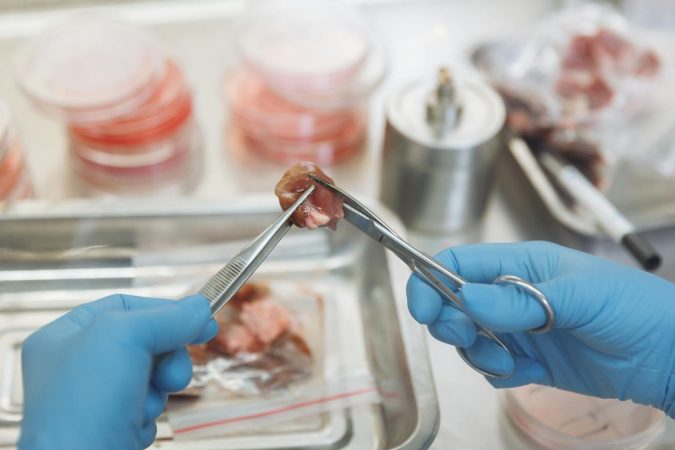
Stanford researchers have grown cultivated bovine fat tissue that mimics real butter's flavor and melt — no cows required. The breakthrough could reshape how we think about fat in the plant-based and cultivated food space.

Add VegOut to your Google News feed. 
Researchers at Stanford University have developed cultivated fat tissue that reportedly mimics the flavor and melt profile of animal-derived butter — produced entirely from cell cultures, no cows involved. The lab, led by bioengineering researchers working at the intersection of tissue engineering and food science, published findings showing that their cultivated fat cells can replicate the specific lipid compositions responsible for butter's rich, creamy taste and that satisfying way it melts on warm toast.
The key breakthrough here is fat, specifically. Most cultivated meat research has focused on muscle tissue — the protein component of a steak or a chicken breast. But anyone who's ever cooked knows that fat is where flavor lives. It's what makes a rib-eye taste different from a sirloin, and it's what gives butter that irreplaceable quality that plant-based alternatives have struggled to fully nail. The Stanford team zeroed in on adipose tissue, growing bovine fat cells in bioreactors and fine-tuning the nutrient media to encourage the cells to produce the exact fatty acid ratios found in traditional dairy butter. Early sensory panels found that tasters had difficulty distinguishing the cultivated fat from conventional butter in controlled settings.
The timing feels significant. The plant-based sector has been racing to close flavor gaps across the board — as we recently covered, Impossible Foods quietly reformulated its burger to the point where meat-eaters in blind tests actually preferred it to beef. Fat has always been the hardest piece of the puzzle. Coconut oil, shea butter, and other plant fats can get you partway there, but they carry their own flavor signatures that trained palates pick up on. Cultivated fat sidesteps the issue entirely by being, on a cellular level, the real thing.
There are still major hurdles between a Stanford lab and your grocery store's dairy aisle. Scaling bioreactor production to make cultivated butter cost-competitive with a $4 stick of Kerrygold remains an enormous challenge. Regulatory approval through the FDA and USDA — the same dual-agency framework that governs cultivated meat — would need to happen before any commercial launch. And consumer acceptance is its own question mark, though polling consistently shows that younger demographics are more open to cell-cultured products than previous generations.
The environmental math is compelling on paper. Dairy production accounts for roughly 3.4% of global greenhouse gas emissions according to the FAO, and butter is one of the most resource-intensive dairy products by weight. VegOut previously covered how climate scientists are now modeling food security scenarios for 2040 that project shortfalls even in wealthy nations. Cultivated fat production, if it scales efficiently, could dramatically reduce the land, water, and methane footprint associated with butter — a product the world consumes roughly 12 million metric tons of annually.
The Stanford team reportedly plans to explore applications beyond butter, including cultivated tallow and lard for baking and frying. If the approach works, it could reshape how food manufacturers think about fat as an ingredient. The plant-based industry has spent years engineering workarounds for animal fat's unique properties. A cultivated version that is animal fat — just grown differently — could change the entire conversation. For now, though, the butter is still in the bioreactor. And we're watching closely.
Feature image by Thirdman on Pexels
What’s Your Plant-Powered Archetype?
Ever wonder what your everyday habits say about your deeper purpose—and how they ripple out to impact the planet?
This 90-second quiz reveals the plant-powered role you’re here to play, and the tiny shift that makes it even more powerful.
12 fun questions. Instant results. Surprisingly accurate.