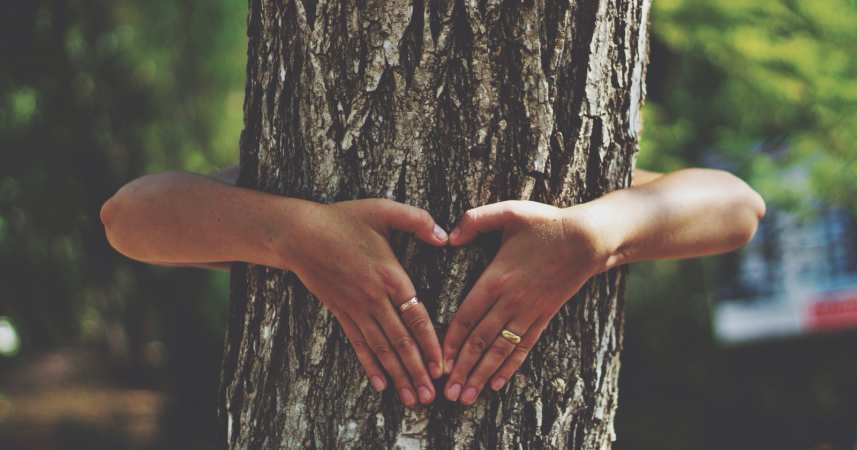
By refusing to let go of a tree for three days, one woman forced an entire country to confront the cost of environmental neglect.

Add VegOut to your Google News feed. 
When 22-year-old Truphena Muthoni wrapped her arms around a royal palm tree outside the Nyeri County Governor's office in December 2025, she embarked on what would become a defining moment in Kenya's environmental movement.
For three consecutive days, without food, water, or sleep, she maintained her embrace through rain, cold, and exhaustion. Her goal extended beyond personal endurance. The 72-hour vigil served as a silent protest against the destruction of Kenya's forests, a crisis that threatens the ecological foundation of East Africa's most populous nation.
Muthoni's feat officially broke the Guinness World Record for the longest marathon hugging a tree, surpassing the previous mark of 50 hours, 2 minutes, and 28 seconds set by Frederick Boakye of Ghana. The record confirmation came more than a month after her December 11 completion, validating both her physical achievement and the urgent environmental message she carried.
Yet the significance of Muthoni's action reaches far deeper than any record book. Her embrace symbolizes a desperate attempt to reconnect Kenya's citizens with the forests they're losing at an alarming rate.
This was her second world record attempt, having previously hugged a tree for 48 hours in Nairobi's Michuki Park in February 2025. The escalation from 48 to 72 hours reflected her growing conviction that mere symbolism would prove insufficient. The planet required proof of sustained commitment, not momentary gestures.
The scale of Kenya's forest crisis
The urgency driving Muthoni's protest stems from sobering realities. Kenya's forest cover has plummeted dramatically since independence, dropping from approximately 10% of the national territory in 1963 to roughly 6% today.
According to the UN Food and Agriculture Organization, Kenya lost approximately 2,850 square kilometers of tree cover between 2000 and 2020, with 80% of this loss occurring in primary humid forests like the Mau, Mount Kenya, and Aberdare ranges.
The numbers tell a story of persistent destruction. Kenya loses an estimated 103,368 hectares to deforestation annually, equivalent to 0.17% of the national area. Though reforestation efforts achieve about 90,477 hectares yearly, the net loss continues to mount. Between 1990 and 2015, the country experienced a 25% decline in forest cover, losing 824,115 hectares at a rate of 33,000 hectares per year.
These statistics translate into tangible consequences. Mountain forests capture and recycle water, regulating local climate patterns and feeding rivers that sustain millions. The deforestation of the Aberdare Range has directly impacted Lake Naivasha, whose water levels have declined as the forests no longer retain moisture or generate the rainfall that once nourished its feeder streams.
In the Mara River basin, savannah, grassland, and shrubland decreased by 27% between the 1970s and early 2000s as agricultural land use doubled, triggering a 7% increase in flooding in lower regions and a staggering 387% expansion of wetlands.
The drivers of deforestation remain consistent: agricultural expansion, particularly for commercial crops like tea and wheat; demand for charcoal fuel driven by poverty; illegal logging of valuable timber species; and settlement pressure from a growing population.
Small-scale farmers employ slash-and-burn methods to clear land for cattle and crops, while selective logging targets species like pencil cedar. Despite eviction efforts and replanting initiatives, illegal activities persist even in protected reserves.
More than trees at stake
Kenya's forests shelter extraordinary biodiversity. The nation's 37 million hectares of forest, woodland, bushland, and wooded grassland host 1,847 species of amphibians, birds, mammals, and reptiles, with 4% found nowhere else on Earth.
Among 6,505 types of vascular plants documented, 4.1% exist only in Kenya. Of the 1,131 tree species recorded, more than 13% face extinction threats from deforestation, climate change, and urbanization. Among 49 endemic tree species, 19 are endangered and eight are critically endangered.
The forests also serve as critical carbon sinks. When cleared or degraded, they release stored carbon dioxide, contributing to greenhouse gas emissions.
Kenya's government estimates that deforestation generates 48,166,940 tons of CO₂ annually, while forest degradation adds another 10,885,950 tons. For a nation vulnerable to climate change impacts, including alternating droughts and floods, the loss of these carbon storage systems compounds existing risks.
Elevated temperatures from deforestation have increased malaria transmission in western Kenyan highlands by altering breeding conditions for mosquito larvae. The loss of forests reduces soil fertility, triggers erosion, and undermines agricultural productivity in communities that depend on the land for survival. Water security for millions hangs in the balance as critical water towers deteriorate.
From record holder to national ambassador
Muthoni's dedication captured national attention in ways that policy documents and scientific reports could not.
During the 48-hour mark of her 72-hour challenge, she remained blindfolded for nearly three hours to advocate for the protection of people with disabilities from climate injustices.
Political figures including pan-Africanist PLO Lumumba and former Deputy President Rigathi Gachagua traveled to Nyeri to offer encouragement. Medical personnel monitored her throughout, while crowds gathered in support, transforming the county government compound into a stage for national environmental conversation.
The recognition following her feat reflected both its symbolic power and practical potential. President William Ruto appointed Muthoni as ambassador for Kenya's campaign to plant 15 billion trees, aiming to increase the nation's tree cover from 12% to 30% by 2032. She received the Head of State Commendation medal and a full scholarship to Mount Kenya University.
Her message resonated particularly with younger Kenyans, representing an emerging generation of environmental activists developing more engaging approaches to shift conservation from abstract policy to immediate, tangible action.
Muthoni framed her motivation clearly: "I want to inspire people to fall in love with nature and treat it with care. Conservation begins with love. Nowadays, there are many tree-planting initiatives, but people often replace indigenous forests with saplings, believing it is mitigation, yet it is not. We must first protect what we already have."
The challenge ahead
Whether Muthoni's symbolic action translates into substantive change for Kenya's forests remains an open question. Tree-planting campaigns have proliferated in recent years, but planting alone cannot reverse deforestation if the underlying drivers remain unaddressed.
Agricultural expansion continues in critical water towers. Poverty still drives reliance on charcoal fuel. Illegal logging persists despite enforcement efforts. Communities facing immediate survival needs struggle to prioritize long-term forest conservation.
The appointment of a 22-year-old activist as a national ambassador signals governmental recognition of the crisis and the power of youth engagement. Yet symbols and appointments must be backed by policy enforcement, resource allocation, community empowerment, and economic alternatives for those whose livelihoods currently depend on forest exploitation.
The real test will come in whether Kenya can halt the net loss of forest cover, restore degraded ecosystems, and secure the rights and participation of local communities in forest management.
Muthoni's 72 hours of endurance demonstrated that one person's commitment can spark national conversation. The harder question is whether that conversation can translate into the sustained collective action required to reverse decades of forest loss.
Kenya's trees, and the millions who depend on them, need more than symbolic gestures. They need the kind of endurance Muthoni showed, applied at every level of society, maintained not for 72 hours but for decades to come.
If You Were a Healing Herb, Which Would You Be?
Each herb holds a unique kind of magic — soothing, awakening, grounding, or clarifying.
This 9-question quiz reveals the healing plant that mirrors your energy right now and what it says about your natural rhythm.
✨ Instant results. Deeply insightful.

Jordan Cooper
Jordan Cooper is a pop-culture writer and vegan-snack reviewer with roots in music blogging. Known for approachable, insightful prose, Jordan connects modern trends—from K-pop choreography to kombucha fermentation—with thoughtful food commentary. In his downtime, he enjoys photography, experimenting with fermentation recipes, and discovering new indie music playlists.
More Articles by Jordan