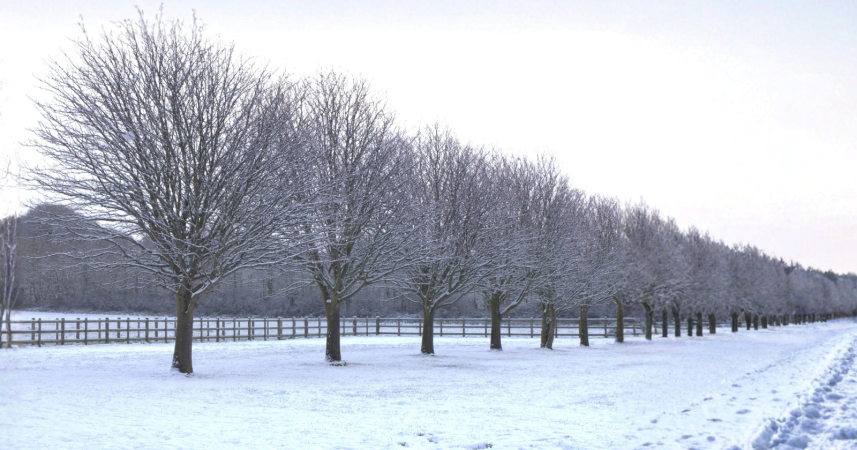
Call it frost cracking or nature’s gunfire: winter has a way of making trees scream.

Add VegOut to your Google News feed. 
Recent winter storms across North America have sparked viral social media posts warning of a dramatic phenomenon: exploding trees.
While the term conjures images of timber bursting apart like fireworks, the reality behind this winter weather occurrence is both more nuanced and scientifically fascinating than viral videos might suggest.
The phenomenon commonly referred to as "exploding trees" is more accurately called frost cracking or frost splitting. When temperatures plummet rapidly, particularly below negative 20 degrees Fahrenheit, trees experience intense internal stress that can cause their trunks to split vertically with a sound resembling a gunshot or explosion.
According to Michigan State University professor Bert Cregg, the process involves a battle between expanding ice and contracting wood fibers. As outer layers of bark and wood cool and contract faster than the inner core, the sap inside begins to freeze and expand. Eventually, the wood fibers can no longer withstand the tension, causing the tree to snap vertically in a millisecond, releasing massive potential energy as an audible shockwave.
Despite the alarming name, trees don't actually blow apart or send debris flying through the air. The Wisconsin Department of Natural Resources notes that the phenomenon remains extremely rare, and many forest health specialists report never witnessing an actual tree explosion despite decades of experience in cold climates.
What residents typically hear during extreme cold snaps are frost cracks: vertical splits that may span the length of a trunk but leave the tree standing and structurally intact.
The science of expansion and contraction
The physics behind frost cracking centers on water's unusual property of expanding when it freezes.
Tree sap, which contains water along with sugars and minerals, follows this same principle. During rapid temperature drops, the outer bark and sapwood layers cool significantly faster than the inner heartwood. This differential cooling creates opposing forces: the exterior contracts while attempting to shrink against an interior that's simultaneously expanding as moisture turns to ice.
Historical accounts document this phenomenon across centuries. In his 1683 writings, John Claudius Loudon described oak, ash, and walnut trees that were "miserably split and cleft" during a great frost, with cracks "attended with dreadful noises like the explosion of fire-arms."
Indigenous cultures recognized this winter occurrence long before scientific explanation: the Sioux and Cree peoples referred to the first new moon of the year as the "Moon of the Cold-Exploding Trees," while the Ainu language includes a specific term, nipusfum, for tree trunks bursting from frozen interior water.
The sound itself results from the incredible speed of the split. While tension builds gradually over hours of freezing temperatures, the actual release occurs in milliseconds. This rapid rupture of wood fibers creates a shockwave through the surrounding air that can be heard from significant distances, often startling residents who mistake the noise for gunfire or explosions.
Lightning strikes: a different kind of tree explosion
While frost cracks represent the winter version of exploding trees, lightning strikes offer a far more dramatic and genuinely explosive scenario.
When lightning courses through a tree, the results can be catastrophic. The electrical current, which can reach 300 million volts and generate temperatures of 50,000 degrees Fahrenheit, travels primarily through the water-conducting sapwood beneath the bark.
This intense heat instantly vaporizes sap and boils the water in the tree's cells, creating steam pressure that can make trunks burst violently.
According to the University of Maryland Extension, when lightning strikes deeply into a tree, the entire structure may blow apart. The resulting steam explosion can remove strips of bark or cause the trunk to shatter. Trees with high moisture content, such as ash and willow species, are particularly vulnerable to both lightning attraction and explosive damage.
However, if rainfall has thoroughly soaked the exterior of the tree, lightning may conduct through the outer wet layer rather than penetrating to the interior sapwood, potentially sparing the tree from serious harm.
Research from the Smithsonian Tropical Research Institute has revealed that some tree species have evolved remarkable resilience to lightning strikes. The almendro tree of Panama survives lightning with minimal damage, while the electrical current kills parasitic vines and nearby competitor trees. Scientists theorize this resilience stems from the species' superior electrical conductivity, which allows current to pass through with less heat generation and tissue damage.
Forest fires and the eucalyptus phenomenon
Wildfire conditions introduce yet another mechanism for tree explosions. During forest fires, extreme heat can boil the water and sap within trees, creating pressure-cooker conditions that lead to explosive rupture.
Eucalyptus trees present a particularly dramatic case: these species naturally produce volatile eucalyptus oils that, when vaporized by intense heat, create an explosive mixture with air. Laboratory tests and observations during Australian bushfires have documented eucalyptus trunks literally exploding when these oils ignite.
Aspen trees have similarly been observed exploding during wildfires, presenting serious risks to firefighters and smokejumpers working in affected areas.
Tree resilience and recovery
Remarkably, many trees survive frost cracks and even some lightning strikes. When temperatures warm, frost cracks often close as the wood expands, and trees attempt to heal the wound over time. Older trees may display vertical ridges along their trunks, evidence of frost cracks that have healed, reopened in subsequent winters, and healed again over many years.
Professional arborists recommend waiting a full growing season after any cold-weather damage to assess whether a tree will recover before making removal decisions.
According to Simon Peacock, an ISA-certified arborist with Green Drop Tree Care in Winnipeg, frost cracking occurs quite often in Prairie regions and affects thin-barked tree species most frequently. While the vertical splits can be extensive, they rarely compromise the tree's structural integrity enough to require removal.
Separating fact from viral fiction
The recent surge in social media posts about exploding trees demonstrates how scientific phenomena can be sensationalized through viral content.
While frost cracks, lightning strikes, and wildfire explosions are all documented occurrences, the dramatic imagery shared online often overstates the frequency and danger of these events. Frost cracks pose no risk to public safety, produce no flying debris, and occur far less commonly than viral warnings suggest.
The 2005 April Fools' Day hoax covered by National Public Radio, which claimed that uncollected maple sap caused pressure explosions, highlighted public fascination with this phenomenon while also demonstrating susceptibility to misinformation. The root pressure in maple trees measures approximately one standard atmosphere, entirely insufficient to cause explosive failure.
As extreme weather events become more frequent talking points, understanding the actual science behind phenomena like frost cracking helps separate legitimate winter hazards from exaggerated claims.
Trees remain remarkably resilient organisms capable of withstanding extraordinary environmental stresses, from Arctic temperatures to lightning strikes. The occasional crack and boom heard during severe cold snaps represents nature's way of relieving pressure, a survival mechanism that has allowed trees to endure millennia of harsh winters.