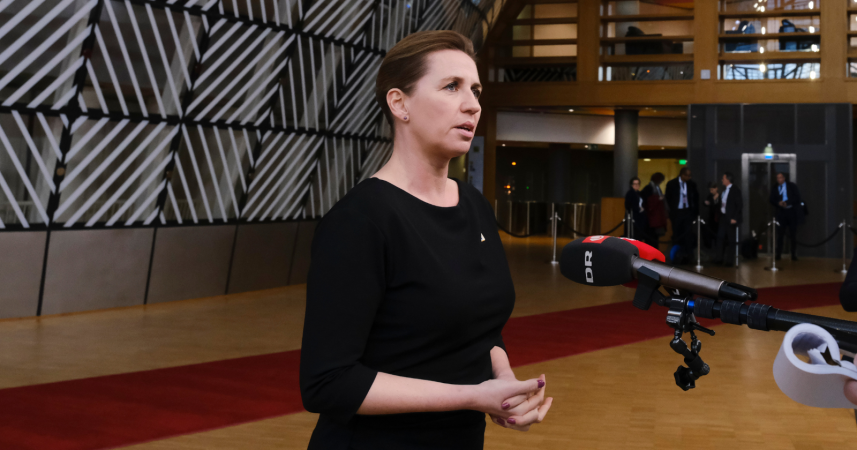
Denmark just put NATO on notice: touch Greenland, and the alliance is over.
Danish Prime Minister Mette Frederiksen delivered her starkest warning to date regarding President Donald Trump's repeated statements about acquiring Greenland, stating that any military action against the Arctic territory would effectively end the NATO alliance that has anchored transatlantic security since World War II.
The Danish leader's comments came as European capitals scrambled to respond to Trump's renewed interest in the mineral-rich island following the controversial U.S. military operation in Venezuela that captured President Nicolás Maduro over the weekend.
Speaking to Danish broadcaster TV2 on Monday, Frederiksen made clear the gravity of the situation. "If the United States chooses to attack another NATO country militarily, then everything stops," she said, "including our NATO and thus the security that has been provided since the end of the Second World War."
The prime minister's remarks represent a dramatic escalation in tone from previous Danish responses to Trump's territorial ambitions, signaling that Copenhagen now views the threat as potentially credible rather than rhetorical bluster.
From dismissal to crisis mode
The transformation in Denmark's response reflects how Trump's willingness to conduct a predawn military raid in Caracas has fundamentally altered European calculations about what the American president might actually attempt.
Political risk analysts describe the Danish government as being in "full crisis mode" over the situation. Mujtaba Rahman, managing director for Europe at Eurasia Group, argued in a recent LinkedIn post that "a possible U.S. intervention in Greenland is now the biggest source of risk to the transatlantic alliance and intra-NATO and intra-EU cohesion," potentially exceeding even the divisions created by Russia's invasion of Ukraine.
The Venezuelan operation demonstrated both operational capability and presidential willingness to use military force in ways that shocked traditional U.S. allies. When Trump declared on Air Force One that "we need Greenland from the standpoint of national security, and Denmark is not going to be able to do it," while mocking Danish defense efforts by claiming they had merely "added one more dog sled" to their arsenal, the comments carried a weight they might not have possessed just days earlier. His suggestion to reporters to "talk about Greenland in 20 days" has been interpreted by Danish officials as a concrete timeline rather than abstract speculation.
Strategic value driving American interest
Trump's fixation on Greenland stems from the island's significant strategic and economic value in an era of intensifying great power competition. Greenland sits at a crucial geographic position between Europe and North America, controlling access to key Arctic shipping routes that are becoming increasingly navigable as climate change accelerates ice melt.
The territory already hosts the Pituffik Space Base, a U.S. military installation established under a 1951 defense agreement that supports missile warning systems and space surveillance operations critical to American and NATO security architecture.
Beyond its military geography, Greenland possesses substantial reserves of rare earth minerals including lithium and titanium, elements essential for manufacturing computer chips, smartphones, and other advanced technologies. Of 34 minerals classified as critical by U.S. authorities, 31 are found in abundance across Greenland's terrain.
However, harsh weather conditions, lack of infrastructure, and respect for Indigenous Inuit traditions favoring sustainable resource use have limited mining operations to just two active sites despite numerous proposals submitted to Greenlandic authorities.
Trump's emphasis on resource control aligns with his broader transactional approach to international relations, recently demonstrated in his demand that Ukraine provide the United States with exclusive access to its mineral deposits. The president has framed Greenland as surrounded by threatening Russian and Chinese naval presence, though security experts dispute this characterization. Ulrik Pram Gad, a global security analyst at the Danish Institute for International Studies, noted in a recent report that while Russian and Chinese vessels do operate in Arctic waters, they remain far from Greenland's shores.
Europe rallies behind Denmark
The crisis has prompted an unusual display of European solidarity, with leaders across the continent issuing statements defending Danish sovereignty and warning against any use of force to alter borders.
British Prime Minister Keir Starmer declared that "only Greenland and the Kingdom of Denmark" could determine the territory's future. German Foreign Minister Johann Wadephul suggested NATO members should discuss strengthening Greenland's protection mechanisms. French foreign ministry officials emphasized that "borders cannot be changed by force" and expressed solidarity with Denmark.
Greenland's own Prime Minister Jens Frederik Nielsen rejected Trump's assertions emphatically, posting on social media that "enough is enough" and calling for an end to "fantasies about annexation." Nielsen has sought to reassure Greenland's 57,000 residents that an imminent takeover remains unlikely while acknowledging the need to take American statements seriously.
The Greenlandic government released its first independent foreign policy strategy in 2024, emphasizing the principle of "Nothing About Us Without Us" in decisions affecting the territory's future.
The diplomatic rift emerges at a particularly delicate moment for transatlantic relations. Denmark has been a reliable U.S. ally, recently approving legislation allowing American military bases on Danish mainland territory and purchasing American F-35 fighter jets. The U.S. already enjoys broad access to Greenland under existing agreements, leading some observers to question what additional control Trump seeks beyond what Washington already possesses.
Denmark's willingness to invoke the potential end of NATO over Greenland represents a dramatic break from decades of carefully managed alliance politics, suggesting European patience with American unpredictability may finally be reaching its limits as traditional assumptions about mutual defense commitments face their most serious test since the alliance's founding.
If You Were a Healing Herb, Which Would You Be?
Each herb holds a unique kind of magic — soothing, awakening, grounding, or clarifying.
This 9-question quiz reveals the healing plant that mirrors your energy right now and what it says about your natural rhythm.
✨ Instant results. Deeply insightful.

Jordan Cooper
Jordan Cooper is a pop-culture writer and vegan-snack reviewer with roots in music blogging. Known for approachable, insightful prose, Jordan connects modern trends—from K-pop choreography to kombucha fermentation—with thoughtful food commentary. In his downtime, he enjoys photography, experimenting with fermentation recipes, and discovering new indie music playlists.
More Articles by Jordan