Asia’s luxury menus are shifting for wealthy Chinese diners—more private rooms, tea pairings, refined seafood. Here’s how it changes your reservations, budgets, and choices.
The quiet revolution in Asia’s luxury dining rooms isn’t on Instagram — it’s in the room next door.
As high-net-worth Chinese travelers return to Japan, Singapore, Thailand, and beyond, restaurants and hotels are tuning their menus, beverage lists, and service choreography to a guest who values private space, precision, and cultural fluency over spectacle.
If you’re traveling in Asia this year, you’ll feel the shift even if you’re not part of a big, celebratory Chinese table. Fewer “greatest-hits” tasting menus built for Western palates — more seasonal seafood, wellness-leaning broths, tea pairings, and bilingual service that moves at banquet speed when required.
It’s not a fad. It’s a new baseline powered by real spend and a traveler who plans dinner the way they plan shopping: meticulously, socially, and with receipts.
Private rooms are becoming the default luxury, not the upsell
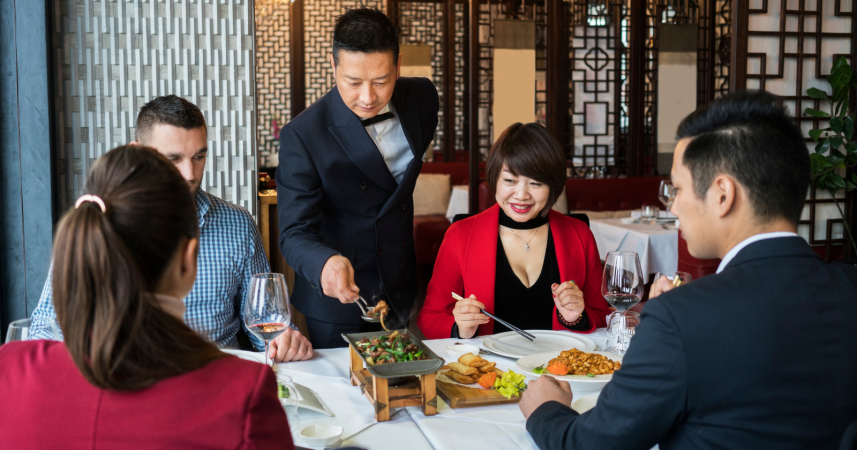
Ask any hotel F&B director what books first when a Chinese family or business group calls: a private room with a round table, good acoustics, and its own service rhythm. That preference is now shaping buildouts from Bangkok to Tokyo and Singapore.
You’ll see it in the floorplans—more sliding doors, more “for 8–12” salons, more set-menu pathways that let a host orchestrate the meal without micromanaging every course. And it’s not just Chinese restaurants; pan-Asian and European rooms are installing private spaces because demand spills over on weekends.
If you’re traveling as a group, this works in your favor: minimum spends are often lower in shoulder season, and kitchens are practiced at pacing large shared meals. (Scan any major city’s private-dining index and you’ll see the supply ballooning—what used to be rare is now table stakes.)
Traveler tip: If you want a private room, ask three things up front—minimum spend, latest seating time, and whether you can bring a bottle (baijiu or wine) and pay corkage. You’ll get a yes more often than you think.
Tea pairings and temperance menus are the new wine flight
A big, subtle change: beverage programs that used to speak in French nouns now speak in terroir-driven teas, sparkling teas, and “temperance” pairings.
Why?
Two reasons.
First, not every table wants alcohol with a multi-course dinner. Second, tea’s structure—tannins, aromatics, minerality—plays beautifully with seafood, soy, and umami-forward cooking.
Michelin-level restaurants from Beijing to Singapore now run tea sommeliers and non-alcoholic pairings that feel as crafted as wine; you’ll even find sparkling teas taking the aperitif slot. This isn’t virtue—it’s luxury in a different vocabulary, and Chinese diners have accelerated it by voting with wallets.
If you want a sense check, look for tasting menus that list vintage or origin next to Oolong or Pu-erh the way they would a Burgundy.
Traveler tip: Ask for the tea or temperance pairing list even if it’s not on the printed menu. In many rooms it’s “available on request” and excellent.
Baijiu goes from banquet bottle to bar program
For years, Kweichow Moutai lived in banquet halls and gift boxes. Lately, it’s also showing up where you’d least expect it: in luxury hotel bars and tasting menus as a pairing element or cocktail base.
The distillate’s esteem inside China (and scarcity at the top end) makes it a flex in the right room; internationally, bar teams are learning to tame its estery punch into high-perspective sours and spritzes.
You’ll spot curated Moutai lists in Hong Kong and Macau and one-off cocktails in flagship properties across the region.
If you’re curious, ask the bar team how they’re using baijiu; a good program will have thought through glassware, dilution, and food pairing.
Traveler tip: If spirits aren’t your thing, you can still “taste the trend” via a small pour—well-trained staff will pour half-measures to let you learn without committing to a bottle.
Menus tilt toward premium seafood—with sustainability edits
Abalone, sea cucumber, fish maw—ingredients prized for texture and perceived tonic qualities—remain central to celebratory menus. But there’s been a visible ethics update: high-end hotels and banquet venues that once leaned on shark fin have dropped it, influenced by government bans at official functions and shifting guest expectations.
You’ll still see heritage textures on the table, but chefs increasingly build that luxury mouthfeel with sustainable species, long-simmered broths, and sea vegetables.
If you’re ordering a set menu and see shark fin as an option, the room will almost always have an equivalent “texture” course to swap in.
Traveler tip: If sustainability matters to you, ask how the kitchen builds gelatinous textures—good kitchens love to explain their craft. You’ll get a better dish and a clearer conscience.
Wellness and “light luxury” replace foie-heavy showpieces
A second adjustment: less butter bravado, more clarity.
Chefs cooking for Chinese guests talk about “light luxury”—precision-cooked seafood, crisp vegetables, broths with layered umami, and desserts that read fresh, not cloying.
That mirrors how many wealthy Chinese guests eat at home—tonic soups, seasonal produce, less overt dairy—and it’s spreading. Expect smaller courses, higher produce ratios, and optional low-sugar finishes.
For travelers, that means you can do a long, celebratory dinner and still feel human the next day. It also means multi-generational tables—common among Chinese travelers—find something for everyone without rewriting the menu.
Traveler tip: If you prefer plant-forward, say so early. Many luxury kitchens now keep tofu, mushrooms, and seasonal veg prepped for a parallel “light luxury” path even when it isn’t printed.
Service is faster, smarter, and social-first
Wealthy Chinese travelers plan on phones and settle bills the same way.
That digital posture is changing luxury service across Asia: QR code menus that are actually good, bilingual WeChat channels for pre-orders and deposits, and staff trained to move a shared, multi-dish meal at speed.
In parallel, the guest mix is shifting—more independent and boutique stays, not just international chains, and more last-minute, social-coordinated bookings.
Translation: you can snag serious meals at independent hotels and chef-driven rooms that aren’t on your usual chain radar—if you message them the way their best guests do.
Traveler tip: Don’t email. DM the restaurant on WeChat or Instagram, or use the hotel’s official chat to request sample menus and confirm deposits. You’ll get faster, clearer answers.
Japan and Singapore are the bellwethers
If you want to see the playbook first, watch Tokyo and Singapore.
Japan set records for visitor spending in 2024, with mainland Chinese guests topping the table; that much demand reshapes booking windows and omakase availability, and it pushes bilingual service and private-counter formats forward.
In Singapore, high-net-worth Chinese travelers have made five-star properties and chef’s tables a safe bet even mid-week; hotels respond with culturally fluent concierges, Lunar-festival menus outside of February, and tea programs that can go toe-to-toe with wine.
What breaks through there tends to ripple to Bangkok, Seoul, and Bali within a season.
Traveler tip: In Tokyo, book counters at lunch for the same chef with saner prices; in Singapore, ask for the tea pairing even at Western restaurants—sparkling tea and single-origin Oolongs are mainstream now.
Southeast Asia: warm welcome, warmer water—and visa ease
Thailand, Malaysia, and Singapore all leaned into visa-free or simplified entry to lure back Chinese travelers, and it worked.
The knock-on for diners is a boom in celebratory group bookings along the coasts and in city hotels, with kitchens getting sharper at pacing large tables, handling off-menu requests, and building bilingual set menus that travel well from wok to white tablecloth.
For you, that can mean better group dining even if you’re not Chinese—rooms are simply more practiced at scale again.
Traveler tip: Traveling with friends? Ask for a “banquet-style menu for sharing” even in non-Chinese restaurants. You’ll often unlock an unpublished pathway the kitchen already runs for groups.
What it means for your next trip (even if you’re not chasing luxury)
Three practical takeaways.
1) Book smarter. Private rooms and counters that used to be “maybe” are now “plan ahead,” especially on Friday/Saturday.
2) Read beverage lists differently. If a tea sommelier is on duty, that’s your sign to try a non-alcoholic pairing that meets the food where it lives.
3) Expect service to meet you on your phone. Lean into chat, deposits, and pre-orders. None of this is about copying someone else’s culture. It’s about recognizing who’s setting the cadence in Asia’s dining capitals right now and riding the current.
The bigger story is that Chinese diners aren’t just spending; they’re editing. They’re pushing menus toward sustainability over status symbols, clarity over heaviness, and privacy over performance.
As a traveler, you get the dividend: rooms designed for conversation, pairings that keep you sharp, and service that moves like a practiced ballet.
Luxury, recalibrated — not louder, just more precise.
If You Were a Healing Herb, Which Would You Be?
Each herb holds a unique kind of magic — soothing, awakening, grounding, or clarifying.
This 9-question quiz reveals the healing plant that mirrors your energy right now and what it says about your natural rhythm.
✨ Instant results. Deeply insightful.

Jordan Cooper
Jordan Cooper is a pop-culture writer and vegan-snack reviewer with roots in music blogging. Known for approachable, insightful prose, Jordan connects modern trends—from K-pop choreography to kombucha fermentation—with thoughtful food commentary. In his downtime, he enjoys photography, experimenting with fermentation recipes, and discovering new indie music playlists.
More Articles by Jordan