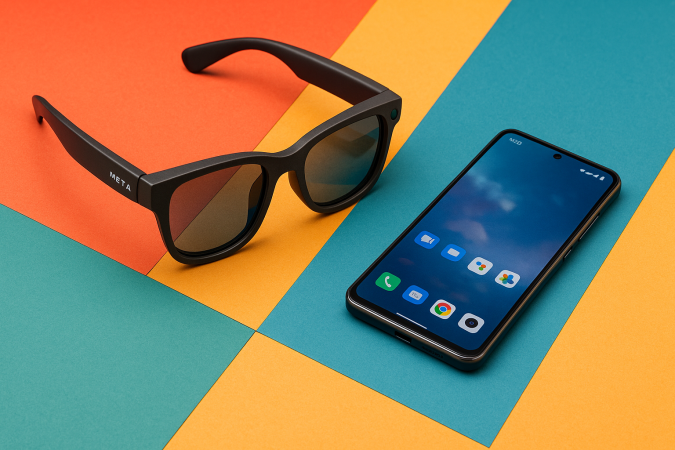
I’m testing Meta’s Hypernova next month: a glanceable HUD + silent sEMG wristband + fast AI that could replace constant phone checks.
I’m a sucker for devices that change posture, not just features.
Phones pulled our chins down for 17 years. Hypernova looks like it might tilt them back up.
Next month I’ll be testing Meta’s “Hypernova” specs — the company’s first consumer smart glasses with an integrated display — and I’m going in with a bold hypothesis: for a surprising slice of everyday life, these could out-phone the phone.
Not because they do more, but because they do the right things with less friction.
If the leaks and briefings hold, Hypernova marries a glanceable, in-lens HUD with a silent wristband for input, plus the on-demand AI Meta has been quietly training on our Ray-Ban era.
That combo—ambient screen + low-friction control + instant cognition—is exactly how you make rectangles in pockets feel redundant.
The bet isn’t on novelty — it’s on speed, posture, and presence. Phones won the last decade by collapsing many steps into one. Hypernova could win the next by collapsing one into zero.
What Hypernova is (and isn’t)
Quick lay of the land, minus the hype: Hypernova is reportedly Meta’s first pair of consumer smart glasses with a built-in display (a small monocular HUD in one lens), shipping with a neural wristband that reads micro-muscle signals (sEMG) for taps, swipes, and subtle type-like gestures.
Pricing chatter has settled around $800, with reveal expected at Meta Connect in mid-September, and shipments targeted shortly after. That price lands between “early-adopter splurge” and “mainstream maybe,” and—if accurate—undercuts the four-figure predictions that swirled earlier this year.
Early reporting also points to camera capture, app support, and touch/gesture control via the wristband as first-ship capabilities, with deeper AR later.
Why I think a heads-up phone beats a handheld phone
Phones are powerful, but every interaction starts with a ritual: fish out, unlock, decide, do.
Hypernova’s case for “phone replacement” rests on deleting that ritual for 60% of our daily checks. Imagine the common loop — glanceable tasks like directions, timers, transit ETAs, quick replies, identity checks (MFA codes), photo capture, hands-free search, and “what’s that building?” moments.
If a tiny optical overlay can show me the one line I need, and an imperceptible wrist twitch can confirm, I’m not just saving seconds — I’m preserving context.
My eyes stay on the crosswalk. My conversation doesn’t stall. I don’t fall down a notification well because I never unlocked a full-color playground.
Phone UIs seduce — HUD UIs conclude.
That difference matters in kitchens, taxis, subways, and meetings, where the cost of a phone check isn’t time — it’s presence.
Hypernova doesn’t win by doing everything — it wins by doing “just enough” without stealing the moment.
The silent wristband is the real breakthrough
The best display is useless without input that feels natural.
Voice is great until it isn’t — wind, crowds, privacy. Touch pads on frames are fine for a demo, clumsy in life.
sEMG wrist input (Meta has been demoing this for years) moves intent off your face and into tiny, private hand signals—think “pinch to click,” a micro-flick to scroll, or a whisper-quiet keyboard you “feel” rather than tap.
If Meta nails latency, false positives, and learnability, this becomes a stealth superpower:
- You can “type” a two-word reply on a packed train without announcing it to the car;
- You can start a navigation step with your hands full of groceries;
- You can pause an audio note in a meeting without looking like a cyborg.
Tom’s Guide’s reporting suggests that wrist-driven gestures are table stakes for Hypernova’s first wave, and the price chatter bundles the band in the box.
That’s not a sidekick — it’s the primary interface.
What “phone replacement” means in practice
Let’s define terms. I’m not predicting that Hypernova replaces a smartphone radio stack on day one.
I am predicting that for an increasing set of daily interactions, your first instinct shifts to the glasses — and your second is the phone you rarely reach.
Here’s the practical shape of that: you still carry a phone for camera depth, editing, long typing, heavy apps, and cellular fallback.
But your default loop — glance + micro-gesture — handles the high-frequency stuff:
- Heads-up turn cues pinned to the street; calendar joins;
- Two-factor codes materializing above your eye at checkout;
- Transit gate nudges; a quick “running 5 late” reply;
- Semantic search for the bus stop hours;
- Photo capture from your actual eye level, not your outstretched arm.
If Meta exposes enough “intents” to developers (not just “apps”), the phone becomes a background compute and connectivity slab—important, but hidden.
That’s how true platform shifts start: not with deletion, with demotion.
The hurdles Hypernova must clear (and how I’ll test them)
Battery is the obvious one.
A HUD you trust must last a waking day or fail gracefully.
The graceful version is a smart idle policy: the display sleeps, the mics sip power, the band remains ready, and you get 8–10 hours of “real” use before the case or a USB-C sips it back. Brightness and optics are next.
A monocular display must be legible outdoors and forgettable when off; if my eye keeps fishing for a ghost rectangle, I’ll rip the frames off.
Privacy and capture ethics are evergreen — Meta’s Ray-Ban work taught it hard lessons on LEDs and capture cues, and those need to carry forward here.
Finally, app grammar: if the UI feels like a shrunk phone, it fails; if it feels like “one-line answers” and “one-gesture verbs,” it sings.
My test plan next month is boring on purpose: live with Hypernova as my first-touch device for seven days—commutes, grocery runs, cooking, workouts, and meetings—and count how many phone unlocks I don’t do.
Why Meta, of all companies, might pull this off
Three reasons:
1. Distribution and muscle memory:
Meta already has millions of Ray-Ban smart glasses in the world, which means it has real data on comfort, microphones, capture, and daily abuse. (Barron’s reports over 2 million units sold to date, and a dominant share of the nascent category.)
2. AI “intent routers”
The company’s assistant is good at lightweight, low-latency answers, and the glasses form factor forces brevity — that’s an AI sweet spot.
3. Hardware partnerships
Pairing with a fashion house (Ray-Ban, and reports of Oakley-style sport frames on the roadmap) solves the “would you wear it?” question that killed earlier attempts.
If you want a quick market snapshot of why Meta’s leaning in, Barron’s explains how smart glasses now anchor its consumer AI strategy—and why a sub-$1,000 Hypernova is a calculated land-grab, not a vanity project.
The <$1,000 line is a strategy, not a spec
Price is a product feature, especially for new categories.
The early rumor range for a display-equipped Meta pair ran into the $1,300–$1,400 zone; recent coverage gathers around $800—including the wristband.
That’s not “cheap,” but it’s pointed: lower than a flagship phone, high enough to signal capability.
Heise and DigitalTrends both note the drop and the timing (Meta Connect next month), and Tom’s Guide frames the value in terms of included input and HUD — i.e., “this isn’t Ray-Ban Stories with vibes; it’s a real interface.”
Price also telegraphs intent: Meta doesn’t just want you to test Hypernova; it wants developers to target it.
If I can buy one pair for my everyday life and not feel like I’m beta-testing, I’ll build habits. Habits, not specs, are what replace phones.
What I’ll publish after testing
I’ll measure minutes saved and phone unlocks avoided, but I’ll also make the human report:
- Did people around me feel weird when I wore them?
- Did the wrist gestures disappear into my life or make me self-conscious?
- Did the HUD respect my eyes when I needed to be device-silent?
I’ll try groceries, transit, cooking, work calls, gym sessions, and travel. I’ll test low light, bright sun, rain, and loud streets. I’ll check whether the “AI at a glance” answers are single-line crisp or bloated.
And I’ll answer the only question that matters for replacement: when I forgot the glasses at home, did I miss them the way I miss my phone?
If yes, the future arrived in a quiet frame. If no, we’re still in the prequel — interesting, promising, but waiting on the one or two UX decisions that turn novelty into necessity.