The little-known 1968 project still stands today as a heritage-listed slice of Singapore in Australian territory.
Most Singaporeans have never heard of Poon Saan, but this neighbourhood sitting on a remote Australian island represents a forgotten chapter in HDB's history. In 1968, Singapore's Housing and Development Board constructed seven residential blocks on Christmas Island, marking its first-ever overseas project, according to Uchify.
The connection between Singapore and Christmas Island runs deep. Until 1958, the island was administered by Singapore before the United Kingdom transferred sovereignty to Australia. The transition came with a $20 million payment from the Australian government to Singapore as compensation for the loss of phosphate mining revenue, as documented by Wikipedia.
When phosphate mining expanded in the 1960s and 1970s, workers from across Southeast Asia flocked to the island. To house the growing workforce and relocate families from an older settlement called South Point, Christmas Island authorities partnered with HDB under the Asian Housing Programme. The result was a $2 million contract that sent 150 Singaporean workers to construct seven blocks in the Poon Saan area.
The Straits Times recognised the project's significance in 1969, describing it as the first time Singapore's professional services had been applied overseas. Poon Saan, which means "halfway up the hill" in Cantonese, became a milestone achievement for the young housing authority.
What the blocks look like today
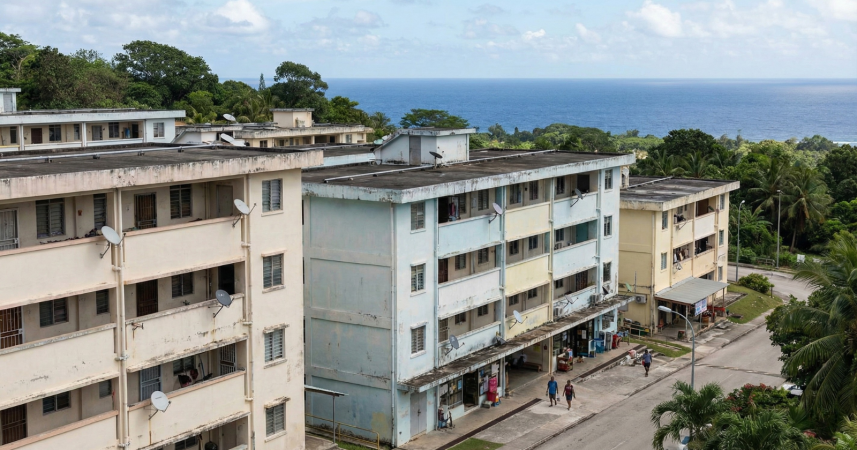
Five of the original seven blocks still stand, and anyone familiar with Singapore's older HDB estates would recognise them instantly. These three- to four-storey buildings feature flat roofs, pastel-coloured facades, and long access corridors that defined Singapore public housing in the 1970s.
Roughly 100 households currently occupy the mostly four-room units, reported by The Smart Local. The blocks sit approximately 800 metres above sea level, with some units offering sweeping views of the Indian Ocean.
When the flats were first completed, they had only basic cement flooring with no tiles or hot water supply. Modern amenities arrived slowly. Satellite dishes for internet access were only installed in 2016 and 2017. The ground floors still function much like Singapore's old HDB estates, housing sundry shops and eateries reminiscent of mama shops and kopitiams.
Local traditions have persisted too. Chinese New Year and the Mid-Autumn Festival are celebrated at the community club, maintaining cultural practices that echo Singapore's multicultural heritage. Christmas Island remains the only Australian jurisdiction that observes Chinese New Year and Hari Raya as public holidays. The island's population of around 2,000 is approximately 60% Chinese, 25% Malay, and 15% European.
How much the flats cost
The economics of Poon Saan differ starkly from Singapore. When units first launched in the early 1970s, they cost about $12,000 each. By 2015, four-room units were valued at approximately $250,000.
Perhaps most notably for lease-conscious Singaporeans, these properties are freehold. Owners face none of the 99-year lease concerns that affect most HDB residents back home.
Heritage protection ensures preservation
The Poon Saan precinct now sits on the Australian Commonwealth Heritage List. The designation recognises the area's significance to the Chinese population, its architectural styles imported from Singapore, and its role in the development of the island's union movement.
Any alterations or redevelopment require formal approval, meaning the estate's original character will be preserved for future generations. While low-rise 1970s HDB blocks have largely disappeared from Singapore's landscape through demolition and redevelopment, this remote Australian territory maintains an almost unchanged example of early Singaporean public housing design.
What's next
For Singaporeans curious about visiting, Christmas Island is accessible via a four-hour flight from Perth. There are no direct flights from Singapore, though the journey through Perth takes roughly 20 hours total.
Beyond the HDB-style flats, visitors can witness the island's famous red crab migration, explore rainforest hiking trails, or experience the unique multicultural community that blends Chinese, Malay, and Australian influences. Street names like Jalan Pantai and Jalan Ketam Merah reflect this heritage.
The Poon Saan blocks stand as an unlikely monument to Singapore's housing expertise, preserved 1,330 kilometres from home in a place most Singaporeans don't even know exists.
If You Were a Healing Herb, Which Would You Be?
Each herb holds a unique kind of magic — soothing, awakening, grounding, or clarifying.
This 9-question quiz reveals the healing plant that mirrors your energy right now and what it says about your natural rhythm.
✨ Instant results. Deeply insightful.