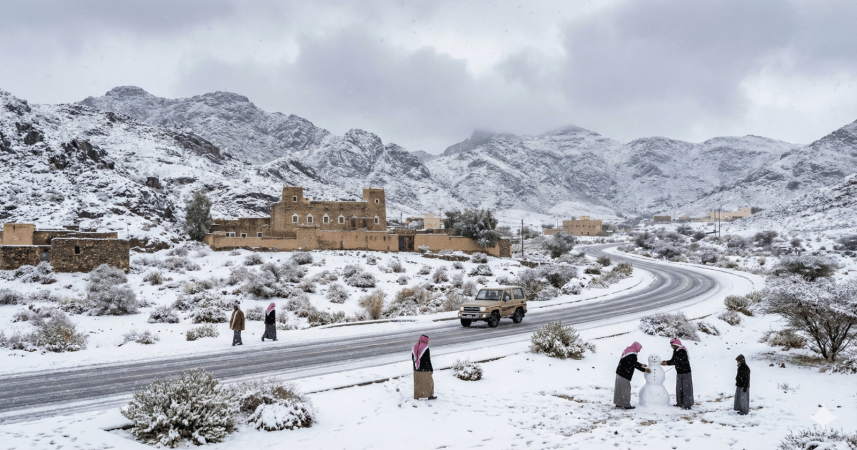
A powerful cold wave has blanketed regions from Tabuk to Riyadh, bringing freezing temperatures and scenes of camels walking through snow-covered dunes

Add VegOut to your Google News feed. 
Saudi Arabia's golden sand dunes transformed into an unexpected winter landscape this week as rare and heavy snowfall swept across the kingdom. Videos of camels treading through snow-covered terrain and residents sledding on desert slopes have flooded social media, marking what local broadcasters are calling a historic weather event.
The snowfall, which began around December 17 and continued through the week, has affected multiple regions including Tabuk, Hail, Qassim, and areas near the capital Riyadh. Temperatures plummeted below freezing in several locations, dropping to as low as -4°C at Jabal Al-Lawz in the Tabuk region, according to the Saudi Gazette.
What caused the unusual cold snap
The National Center of Meteorology (NCM) has attributed the phenomenon to a deep low-pressure system moving in from the Mediterranean Sea that pushed very cold air south into the Arabian Peninsula. Hussein Al-Qahtani, the NCM's official spokesperson, explained that a cold air mass pushed into central and northern regions and interacted with rain-bearing clouds, creating conditions for widespread snowfall.
While snow occasionally falls on Saudi Arabia's high mountain peaks, it is far more unusual for it to blanket flat desert plains, as it has this week. Snow was recorded in Al-Majmaah and Al-Ghat, north of Riyadh, where it accumulated on open fields and elevated terrains. Residents of Al-Ahsa in the eastern province, typically a warm region, also reported snowfall.
The NCM has noted that the most intense cold wave previously recorded in Saudi Arabia occurred in 1992, when temperatures at its Hail station dropped to a record low of -9.3°C. Historical reports also indicate that in January 1973, a massive polar surge from Siberia brought nearly 20 cm of snowfall to Riyadh.
Climate change and the warming paradox
Scientists point to climate change as a contributing factor to such extreme weather events. Experts from the World Meteorological Organisation have said the Arab region is warming at nearly twice the global average.
This leads to what scientists call the "warming paradox." As temperatures rise globally, the atmosphere holds more moisture, which can increase the intensity of extreme weather events, including both heatwaves and unexpected cold snaps. Rather than contradicting global warming, such events illustrate how climate change is making weather patterns more unpredictable and extreme.
Climatologists have noted that while a single weather event cannot confirm or deny climate change, the frequency of such unusual weather patterns appears to be growing across the region, from flash floods in typically dry areas to sudden cold snaps in desert regions.
From sand dunes to ski slopes
Saudi Arabia has already begun incorporating a colder future into its economic strategy. Under Crown Prince Mohammed bin Salman's Vision 2030, the kingdom is developing Trojena, a high-altitude winter destination in the Sarawat Mountains. Part of the $1.5 trillion Neom megacity project, Trojena is set to host the Asian Winter Games in 2029.
The timing of this week's natural snowfall has not gone unnoticed. Social media users have shared videos of residents embracing the rare weather, with some clips showing families building snowmen while others captured impromptu ski sessions on gentle slopes.
All schools in Riyadh were switched to remote learning as the inclement weather continued throughout the week. Authorities have urged citizens and residents to exercise caution, particularly while driving, due to the formation of ice on roads.
What's next
The NCM has forecast continued cold conditions across northern and central Saudi Arabia, with a chance of frost in several areas. Further snowfall has been predicted for the Qassim region and northern parts of Riyadh through December 25 as the intense weather system continues to affect large portions of the kingdom.
Moderate to heavy rain and potential hailstorms have also been forecast for parts of Riyadh, the Eastern Province, and the Northern Borders, with warnings of possible flash flooding in low-lying areas.
Whether this week's snowfall represents a new normal or remains a rare exception, the images of camels navigating through white-covered dunes serve as a striking reminder of how traditional climate expectations are shifting across the Arabian Peninsula.