While a secretive Indonesian dynasty battles family betrayals over stolen assets, their $20 billion pulp empire carves up Sumatra's tiger habitats—greenwashing destruction with "sustainable" loans as communities and wildlife vanish, unchecked.

Add VegOut to your Google News feed. 
In October 2024, nine former employees of a secretive Indonesian pulp company went public with explosive accusations. They claimed the Tanoto family, through their sprawling Royal Golden Eagle (RGE) conglomerate, secretly controls a vast "shadow empire" of companies responsible for massive deforestation across Borneo.
Logs from these clearings, the whistleblowers alleged, feed straight into RGE's mills, producing paper and pulp for everyday products like tissues and packaging that end up on shelves worldwide.
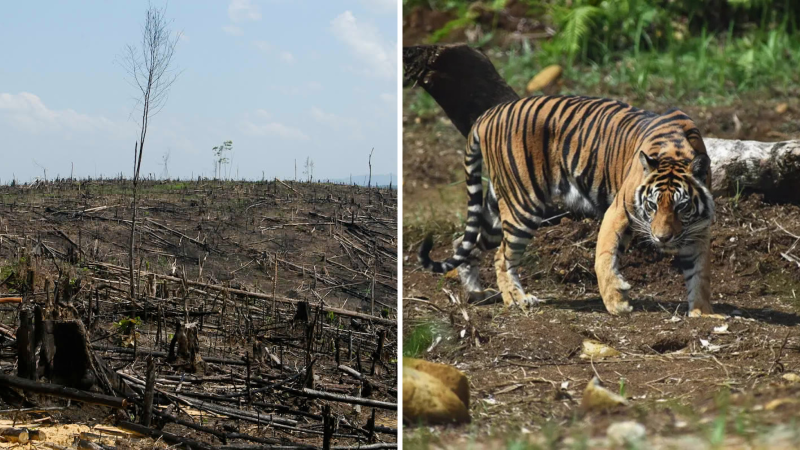
The revelations, detailed in an International Consortium of Investigative Journalists report, came amid fresh evidence of ongoing destruction—over 33,731 hectares of rainforest cleared by one linked company alone between 2022 and 2024. Much of this ties back to Sumatra, where similar operations have decimated habitats for the Sumatran tiger, a critically endangered species with fewer than 400 left in the wild.
Why the urgency now? Because despite a decade of "zero deforestation" pledges, the Tanotos are still raking in billions from green-labeled loans while allegedly hiding behind these opaque firms to keep the chainsaws running.
And lurking beneath it all is a history of family betrayal: In 1998, Sukanto Tanoto—the patriarch and founder—was sued by his own mother, who accused him of threats, forgery, and stealing her late husband's assets after a tragic plane crash. That feud, settled quietly but still echoing in family grievances, mirrors the ruthless tactics that built a $20 billion empire on Indonesia's vanishing ecosystems.
As Sukanto's children assume more control, the fortune's dark foundations persist, displacing indigenous communities and pushing tigers toward extinction. It's an under-the-radar scandal that begs the question: How does one family's unchecked greed continue to destroy irreplaceable habitats while the world funds it?
Sukanto Tanoto's rise is the stuff of business lore, but with a gritty edge. Born in 1949 in Medan, North Sumatra, to Chinese immigrant parents, he dropped out of school at 17 to help run a family spare-parts shop amid Indonesia's turbulent economy. By the early 1970s, spotting opportunities in the country's resource boom, he pivoted to construction supplies, logging, and plywood.
In 1973, he founded Raja Garuda Mas, which evolved into RGE—a behemoth now spanning pulp and paper, palm oil, energy, and more, with operations in Indonesia, China, Brazil, and beyond. Annual revenues hover around $20 billion, per industry estimates, powering subsidiaries like Asia Pacific Resources International Limited (APRIL), one of the world's largest pulp producers.
Sukanto, now 75 and based in Singapore, boasts a personal net worth of $3.5 billion. His family is integral: Wife Tinah Bingei Tanoto co-founded the Tanoto Foundation for philanthropy, while son Anderson and daughter Belinda hold key roles in operations and sustainability efforts. But the empire's growth has come at a steep environmental price, rooted in aggressive expansion into Indonesia's peat-rich rainforests.
Sumatra, the epicenter of this devastation, once teemed with biodiversity. It's the only place where tigers, orangutans, rhinos, and elephants coexist in the wild—or did, until industrial plantations took over. RGE and APRIL's operations have been repeatedly linked to clearing millions of hectares since the 1990s, converting ancient forests into acacia and eucalyptus groves for pulp.
A landmark 2013 Greenpeace report attributed nearly two-thirds of Sumatran tiger habitat loss between 2009 and 2011 to pulpwood and oil palm expansions like those tied to the Tanotos. In Riau province alone, APRIL concessions overlap with tiger strongholds such as Bukit Batabuh and Tesso Nilo, where forest cover has plunged 70% since 2000.
The tigers—symbolic guardians of these ecosystems—have paid dearly. Habitat fragmentation forces them into human areas, leading to deadly conflicts; poaching and starvation do the rest. WWF estimates that Sumatra's tiger population has halved in the last two decades, driven largely by such industrial activities.
Recent data shows no letup. Greenpeace's May 2025 report, "Under the Eagle's Shadow," uncovered 194 Indonesian and 63 overseas "shadow" companies likely under RGE control, some responsible for ongoing clearances. One entity, PT Asia Forestama Raya, cleared 33,731 hectares in 2022-2024—much in peatlands that overlap tiger migration routes via supply chains to Sumatran mills.
Draining these peatlands releases stored carbon, equivalent to emissions from millions of cars annually, supercharging climate change. In 2024, Indonesia's overall deforestation rose 4%, with pulp giants like APRIL contributing significantly.
The human cost is equally staggering. Indigenous communities, including the Batak and Dayak peoples, have lost ancestral lands to these concessions. In North Sumatra, protests against PT Toba Pulp Lestari—an RGE-linked firm—erupted in early 2025, with villagers reporting beatings, arrests, and forced evictions despite a supposed moratorium on expansions. "This is our land, passed down for generations, but they're taking it for paper while we suffer polluted rivers and lost livelihoods," one Batak leader told Mongabay investigators.
Hundreds of such conflicts mar RGE's record, from water contamination causing health issues to violent land grabs documented in a 2019 Auriga Nusantara study. Communities often end up with nothing: No forests for hunting, no clean water for farming, just broken promises of jobs and development.
The Tanotos insist they've changed. Since 2015, APRIL's Sustainable Forest Management Policy (SFMP 2.0) promises "zero deforestation" and protection for high-carbon-value areas. Their 2024 sustainability report claims 1.4 million hectares under management, with 33% conserved and no new clearances in protected zones.
But critics dismiss it as greenwashing. The 2024 whistleblower accounts and Greenpeace's 2025 probe refute the claims, pointing to shadow companies evading scrutiny. "These entities allow RGE to distance itself from destruction while profiting," noted an ICIJ source.
The hypocrisy extends to financing. In 2024, RGE secured over $2 billion in sustainability-linked loans (SLLs) from banks like MUFG, tied to eco-targets. These funded expansions, including a $3.3 billion acquisition of Chinese tissue maker Vinda. Yet Bloomberg's October 2024 feature exposed how these "green" debts coincided with deforestation spikes, prompting calls for banks to pull out.
Forests & Finance warned in 2023 that such financing lacks safeguards, enabling ecosystem collapse. The Tanoto Foundation's conservation grants—funding tiger monitoring in Restorasi Ekosistem Riau—seem like window dressing amid the broader harm.
This pattern of deception traces back to family infighting that reveals a deeper ruthlessness. In 1998, after Sukanto's father, Amin Tanoto, died in a plane crash, his mother Barbara (also called Lidia) filed a lawsuit accusing Sukanto of using threats of imprisonment, death warnings, and backdated documents to seize family assets worth millions.
"Sukanto imprisoned my mother, sent death threats, and used many illegal methods to pressure my family so he could steal my father's inheritance," claimed a relative on a family-run website still active in 2025. The suit detailed how Sukanto allegedly forced his mother to sign over properties under duress, including through a legal adviser close to him.
It settled out of court, but resentment lingers. Family sites accuse Sukanto of sidelining siblings and twisting facts, even claiming the 1998 claim was dropped for "lack of evidence"—a narrative disputed by relatives. This internal betrayal set the tone for RGE's opaque structures, like offshore entities revealed in the 2017 Paradise Papers, which hid logging ties.
Now, with Sukanto aging, succession questions swirl. Anderson, often at global forums touting sustainability, and Belinda, steering the foundation, inherit this legacy. But whispers of tensions persist, echoed in recent corporate shifts and the shadow company web that could spark future disputes over control.
The machine grinds on: New Brazilian acquisitions, more SLLs, while Indonesia's 2024 deforestation hit 129,896 hectares. Global demand for cheap pulp—from EU imports responsible for 16% of trade-linked tropical deforestation—fuels it. Regulations falter against offshore havens, and watchdogs like FSC are urged to probe RGE's remedy processes.
How does a family that fought so viciously over its own inheritance get to keep plundering the planet's? The answer lies in the shadows they've built—profitable, hypocritical, and tragically unchecked. Sumatra's tigers and communities can't afford the wait.
This article relies entirely on publicly available reports, news articles, and NGO investigations. It is not intended as legal advice or accusation, but to highlight under-reported issues.
What’s Your Plant-Powered Archetype?
Ever wonder what your everyday habits say about your deeper purpose—and how they ripple out to impact the planet?
This 90-second quiz reveals the plant-powered role you’re here to play, and the tiny shift that makes it even more powerful.
12 fun questions. Instant results. Surprisingly accurate.