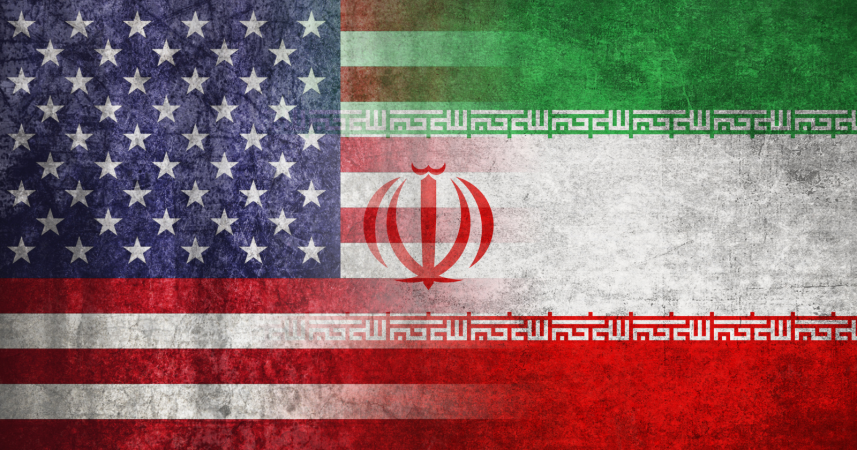
A classroom lecture nobody watched in 2024 is now the most viral video in geopolitics

Add VegOut to your Google News feed. 
In a recorded online lecture that barely anyone clicked on, a Beijing-based historian named Jiang Xueqin stood in front of his students and made three bold claims about the future of American politics. At the time, Joe Biden was still president. Trump had survived no assassination attempts yet. And the idea of a full-blown US conflict with Iran felt, to most people, like the plot of a Netflix thriller.
Fast forward to today, and two of those three predictions have come true with uncomfortable precision. His YouTube channel, Predictive History, has exploded past a million subscribers. Social media has crowned him "China's Nostradamus." And his third prediction? It's the one nobody in Washington seems to want to talk about.
Let's get into it.
The three predictions that started it all
During a May 29, 2024, lecture as part of his "Predictive History" series, Jiang laid out his forecast to a classroom of students. His exact words, as reported across multiple outlets, were straightforward. Prediction one: Trump would win in November. Prediction two: the United States would go to war with Iran. Prediction three: the US would lose that war, and it would reshape the global order forever.
At the time, it sounded almost absurd. The lecture generated a handful of views and sat quietly on the internet for over a year.
Then reality started catching up. Trump won the 2024 election. Tensions between the US, Israel, and Iran escalated sharply. Operation Midnight Hammer happened last June. And as of this week, with Operation Epic Fury in its early days and US-Iran hostilities dominating every headline, people started digging up that old lecture and passing it around like a prophecy.
Two down. One to go.
Who is Jiang Xueqin, really?
Before the viral fame, Jiang was primarily known in education circles. He's a Chinese-Canadian educator who graduated with distinction from Yale College in 1999 with a degree in English literature. Not political science. Not military strategy. English lit.
After Yale, he moved to China and spent years working in education reform, serving as deputy principal at Shenzhen Middle School and later directing the international division at Peking University High School. He's written for The Wall Street Journal, The New York Times Chinese edition, and CNN. He's a Fellow of the Royal Society of Arts and a researcher at Harvard's Global Education Innovation Initiative.
For most of his career, his passion was helping Chinese schools foster creativity and critical thinking in a system obsessed with test scores. His book, Creative China, documented those efforts. He wasn't a geopolitical commentator. He was a teacher.
Then somewhere around 2023, he launched his YouTube channel and started applying something he calls "predictive history" to world events. His framework borrows heavily from Isaac Asimov's fictional concept of psychohistory, the idea that you can use historical patterns, sociology, and mathematical reasoning to predict the behavior of large populations. Combined with game theory, he started mapping out how the incentives of key global players would push events in specific directions.
I spend a lot of my evenings reading behavioral science research, and the thing that hooks me about Jiang's approach is that it isn't mystical. It's structural. He's not reading tea leaves. He's reading incentives.
The method behind the predictions
So how did he get the first two right?
Jiang's argument was built on a game-theory breakdown of three key players: Trump, Iran's Revolutionary Guard, and Israel (with Saudi Arabia as a supporting actor). His central thesis was that all three parties had rational incentives to push toward confrontation, even though their endgames were wildly different.
For Trump, Jiang argued, war with Iran was essentially the price of political support from pro-Israel lobbying interests and Saudi allies. For Israel, neutralizing Iran would remove its biggest regional counterbalance. For Iran's leadership, a war against the "Great Satan" would unify a fractured population and provide religious and nationalist fuel.
He mapped out a hypothetical scenario he called "Operation Iranian Freedom," describing a multinational coalition of the US, Israel, Saudi Arabia, the UK, and the UAE. He predicted Trump would frame the war around Iran's nuclear ambitions, support for proxy groups, and threats to regional allies.
If you watched the news over the last year, those talking points sound very familiar.
I've mentioned this before, but one of the most useful things I ever picked up from reading about decision-making psychology is the idea that people (and governments) don't act based on ideology nearly as much as they act based on self-interest. Jiang operates from that same playbook. He told interviewers he doesn't focus on ideology at all. He focuses on what each player stands to gain.
The prediction Washington doesn't want to hear
Here's where things get uncomfortable. Jiang's third prediction is that the US will lose this war. And his reasoning is detailed enough to make you put down your coffee and pay attention.
His core argument is geographic and logistical. Iran's mountainous terrain, he claims, would turn any invading ground force into what he calls "hostages, not soldiers." Troops wouldn't be able to mass forces, protect supply lines, or retreat effectively. He estimates that actually occupying Iran would require three to four million soldiers, a number that is, by any measure, impossible for the current US military given recruitment shortfalls and manufacturing constraints.
He draws a historical parallel to the Athenian invasion of Sicily in 415 BCE during the Peloponnesian War. Athens, riding high on confidence and military success, launched an ambitious campaign far from home. It ended in total disaster and accelerated the empire's decline. Jiang sees the same structural trap here: overconfidence, stretched logistics, and an underestimated enemy with home-field advantage.
He also compares it to Vietnam and the ongoing Ukraine conflict, situations where a superior military force struggled against a determined local resistance with intimate knowledge of the terrain. In a recent appearance on Breaking Points, he argued that Iran has spent 20 years preparing for exactly this kind of fight. They've studied American strike capabilities during last year's 12-day conflict, and they've had months to prepare their response.
Perhaps his most provocative claim is about the broader economic fallout. Jiang argues that Iran's strategy of targeting Gulf state infrastructure threatens the financial lifeline that props up the US economy. If Gulf states can't sell oil or finance AI-related investments in the US, the whole system wobbles. He described the American economy as a "financial Ponzi scheme" held together by Gulf capital flows, a statement that's designed to provoke but carries a kernel of uncomfortable logic.
Not everyone is buying it
It's worth pumping the brakes here, because the Jiang Xueqin story isn't a clean narrative of genius validated.
Critics have pointed out that his historical analogies are selective. Comparing modern US military capabilities to ancient Athens is evocative, but it's also a massive oversimplification. On Reddit's military forums, the reaction has been blunt. One commenter noted that with enough people making geopolitical predictions online, someone was bound to get a scenario partially right.
Then there's a more serious critique. The Free Press recently reported that Jiang has promoted conspiracy theories in some of his other content, including claims about secret societies and global cabals operating behind world events. That kind of thing undercuts the credibility of anyone trying to be taken seriously as an analyst, regardless of how accurate their political forecasts might be.
And some of his predictions haven't aged perfectly. When Trump brokered a ceasefire between Iran and Israel at one point, social media was quick to call out the disconnect. The situation has continued to evolve in complex ways that don't fit neatly into any single person's forecast.
I think about this a lot when I'm walking around Venice Beach with my camera, just observing people. We're pattern-seeking creatures. When someone gets a big prediction right, we want to believe they've cracked the code. We latch onto the hits and ignore the misses. Behavioral scientists call it confirmation bias, and it's one of the most powerful forces in how we consume information.
What this really tells us
Here's what I find genuinely interesting about this whole phenomenon, and it goes beyond whether Jiang is right about prediction number three.
The reason his lectures went viral isn't just because he got two things right. It's because people are hungry for frameworks that help them make sense of a world that feels increasingly chaotic. When traditional media and government officials offer sanitized talking points, and social media is a firehose of noise, someone who walks you through the logic of how we got here fills a real psychological need.
Jiang's approach, stripping away ideology and focusing on incentives, is actually a solid mental model for understanding conflict. Game theory isn't perfect, but it forces you to ask a question most of us skip: what does each player actually want? Not what they say they want. What they structurally need.
That's a useful way to look at geopolitics. It's also a useful way to look at your own life, honestly. I've found that most of the arguments I've had, whether about food choices, career moves, or anything else, made a lot more sense once I stopped listening to what people said their reasons were and started looking at what they were actually incentivized to do.
Whether Jiang's third prediction comes true is something only time will tell. The US-Iran situation is evolving daily, and reality has a way of defying even the most logical frameworks. But the questions he's raised about imperial overreach, logistical hubris, and the economic fragility underlying military ambitions aren't going away regardless.
The bottom line
Jiang Xueqin went from obscure YouTube lecturer to one of the most discussed voices in geopolitical analysis in a matter of days. His first two predictions landed. His third, that the US will lose this war and the global order will shift permanently, is the kind of claim that makes powerful people uncomfortable.
Is he a visionary? Maybe. Is he selectively applying history to fit a narrative? Possibly that too. The truth is probably somewhere in between.
But here's what I keep coming back to. The most useful predictions aren't the ones that tell you exactly what will happen. They're the ones that force you to think about what's actually driving events beneath the surface. And on that front, whether you agree with his conclusions or not, Jiang Xueqin has given a lot of people something to think about.
If You Were a Healing Herb, Which Would You Be?
Each herb holds a unique kind of magic — soothing, awakening, grounding, or clarifying.
This 9-question quiz reveals the healing plant that mirrors your energy right now and what it says about your natural rhythm.
✨ Instant results. Deeply insightful.

Jordan Cooper
Jordan Cooper is a pop-culture writer and vegan-snack reviewer with roots in music blogging. Known for approachable, insightful prose, Jordan connects modern trends—from K-pop choreography to kombucha fermentation—with thoughtful food commentary. In his downtime, he enjoys photography, experimenting with fermentation recipes, and discovering new indie music playlists.
More Articles by Jordan