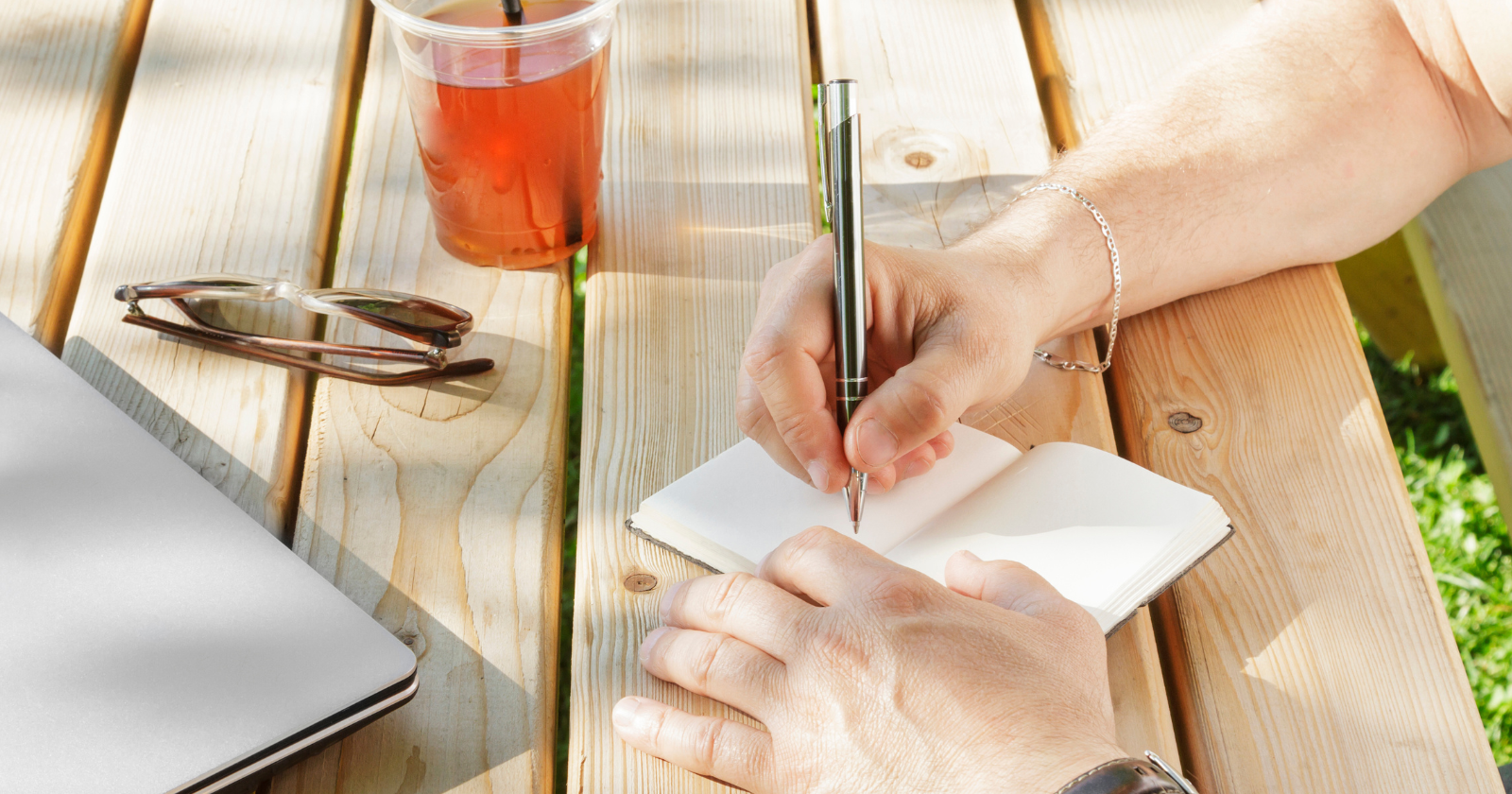
You're standing in the produce aisle trying to remember whether you already have tahini at home. You pull out your phone to check your grocery list, and before you've even opened the notes app, three notifications have hijacked your attention. By the time you remember why you reached for the phone, you've added impulse items to your cart and forgotten the tahini entirely.
This is the small, daily way digital overwhelm sabotages intentional living — including the kind of careful, values-driven food choices that define plant-based eating. Meal planning, grocery shopping, recipe development, seasonal eating: all of it benefits from the same thing the phone keeps stealing, which is undivided attention.
Which is why a growing number of people committed to mindful, sustainable living have quietly returned to something low-tech: the pocket notebook. Not as nostalgia. As infrastructure.
When neuroscientists wired up university students with EEG caps, they found significant differences between handwriting and typing. Writing words by hand in cursive lit up connectivity across the parietal and central brain regions in ways that typing the same words simply did not. The brains of typists looked, by comparison, quiet.
The pocket notebook is not a nostalgia object. It is a cognitive instrument — and arguably, a tool of intentional consumption.
The conventional wisdom is wrong about analog
The default assumption goes like this: typing is faster, searchable, syncable, shareable. Therefore typing is better. Therefore anyone still scratching ink onto paper is sentimental, slow, or performatively retro.
Studies keep refusing to cooperate with that story. Students who took notes by hand outperformed laptop users on conceptual questions, even though the typists captured more verbatim text. The reason: handwriting forces selection. You cannot transcribe everything, so your brain has to decide what matters.
That decision-making — what to keep, what to drop, how to phrase it — is the learning. Typing skips it. And learning to cook plant-based, to garden, to shop seasonally, to reduce waste — all of it is decision-making practice.
What the brain actually does with a pen
Handwriting recruits a wider neural network than typing because the act itself is more demanding. You are coordinating fine motor control, visual feedback, spatial planning, and language production all at once. Research shows a consistent pattern: better letter recognition in preschoolers who write by hand, stronger reading development, deeper conceptual recall, and improved idea generation in adults.
None of this means typing is bad. Typing is excellent for what typing is for — speed, volume, collaboration, distribution. The mistake is assuming one tool replaces the other.
A keyboard is a conveyor belt. A notebook is a workshop. And much of plant-based living happens in the workshop: the recipe scrawled at the farmers market, the substitution worked out by hand, the garden bed sketched in pencil before the seeds are ordered.
Why the pocket part matters
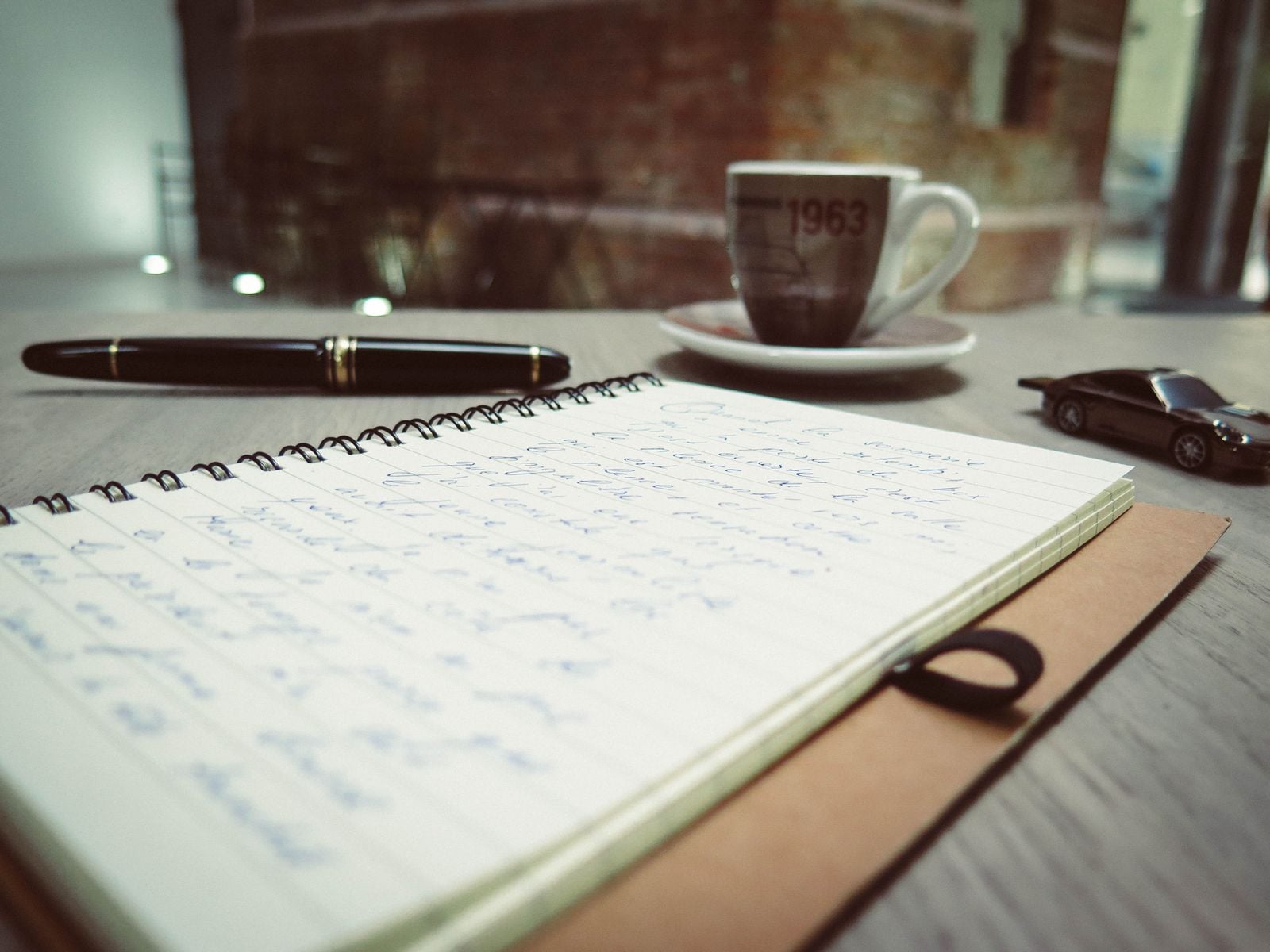
There is a specific subspecies of notebook user worth paying attention to: the one who carries it on their body. Not on a desk. Not in a bag. In a pocket, where it can be retrieved in under three seconds.
The pocket notebook exists because ideas do not schedule themselves. A meal idea arrives while walking past a bakery. A grocery item surfaces while half-listening to a podcast. A vendor at the farmers market mentions a variety of squash you've never tried. The phone is theoretically there for capture, but the phone is also there for seventeen other things — and by the time you've navigated past the notifications, the squash is forgotten.
This is the quiet logic of the pocket notebook. It does exactly one thing. It cannot ping you. It cannot serve you an ad for the very ingredient you were trying to remember.
People who undertake digital detoxes often describe the first week as brutal, then report by week three that they sleep better, feel calmer, and reach for hobbies they had forgotten — cooking, gardening, reading. The notebook user has pre-installed a small piece of that calm into every transaction with their own thoughts.
The memory effect is not subtle
People who keep paper lists tend to actually complete the items on them. This is not folklore. As VegOut has explored elsewhere, the physical act of writing something down encodes it more deeply than tapping it into an app, which is why the shopping list scribbled on the back of an envelope often gets remembered even after the envelope is left at home.
The mechanism is partly motoric. When you write the word "lentils," your hand draws seven distinct shapes, each requiring its own micro-decision. When you type it, you press seven identical-feeling keys. The first experience is texture. The second is just speed.
The brain remembers texture. And the brain that remembers what's already in the pantry buys less, wastes less, and shops more intentionally — outcomes that matter both for personal budgets and for the larger environmental footprint of how we eat.
The notebook as a small act of presence
Mindfulness practices aim to help people stop ruminating about the past and catastrophizing about the future. The standard prescription is meditation — sitting still, watching the breath, returning the mind to the present.
The notebook functions similarly. Pulling out a small notebook to jot down a recipe idea, a meal-prep list, or the name of a new heirloom tomato is a thirty-second pause. You stop. You look at the page. You form the words. Then you put it away. For that half-minute, you are entirely in the present — not because you were trying to be, but because the act required it.
This matters more than it sounds. Mindful eating, mindful shopping, mindful cooking — the practices that sustain a plant-based lifestyle long-term — all depend on small, repeated moments of presence. The notebook builds those moments into the day without requiring a meditation cushion.
The social misreading
People who pull out a notebook in meetings or at dinner sometimes get looked at strangely now. The assumption is either that they are showing off, taking themselves too seriously, or — most often — failing to adopt technology.
The third reading is the funniest, because the notebook user has almost always tried the apps. They have used Notion. They have used Apple Notes. They have used every meal-planning app and recipe organizer on the market. They came to the pocket notebook not because they could not figure out the alternatives, but because they did.
This is the same pattern that shows up in other small analog choices — the person who skips self-checkout, the person who reads physical books, the person who keeps a paper recipe box. These are not people who failed to evolve. They are people who tried the upgrade and found something missing.
The economics nobody mentions
There is one more thing worth saying out loud, and it lines up neatly with the values of conscious consumption. The notebook is not an addictive product. It does not have a business model that depends on capturing your attention. The company that made the notebook got paid the day you bought it and has no further interest in your behavior.
Every digital alternative is the opposite. The notes app on your phone is bundled inside a device engineered to maximize the time you hold it. The standalone apps are freemium, designed to convert engagement into upgrades. A tool that profits from your attention will, over time, optimize for your attention. A tool that does not have a business model after the point of sale will not.
For people already thinking about where their food comes from, who made their clothes, and what corporations do with their data, this is not an unfamiliar calculation. The pocket notebook is, in the most literal sense, the only writing tool you own outright once you have paid for it.
What handwriting protects
The deeper argument for the pocket notebook is not productivity. It is not even memory. It is the protection of a particular kind of thinking — the slow, branching, half-formed kind that requires friction to develop.
Typing rewards completion. The cursor blinks, autocomplete suggests, spell-check corrects, and the sentence arrives in the world looking finished before you have decided what you actually meant. Handwriting forces you to sit inside the unfinished sentence. You can see the cross-outs. You can see where you changed your mind.
This is closer to thinking than typing usually is — and closer to how recipes actually develop, how a garden actually gets planned, how a week of meals actually comes together. Messy, with cross-outs. The notebook lets it stay messy long enough to become something.
What the research does not say
Worth being honest about the limits. Handwriting is not a panacea. It will not cure anxiety, replace therapy, or compensate for a chaotic life. The strongest mental-health gains come from reducing overall screen time, not from any single substitute behavior. A notebook in your pocket while you doomscroll for four hours a night is not going to save you.
The notebook is a small lever. Used consistently, it shifts the ratio between input and reflection in your day by a few percentage points. Over months, that adds up — in clearer thinking, in better meals, in more deliberate consumption. Over years, it changes how you think.
That is the whole pitch. Not revolution. Not rebellion against the digital age. A small, durable, unglamorous tool that supports the same value plant-based living already rests on: paying attention to what you put into your body, your home, and your day.
The people who carry one are not behind. They are just paying attention to where the pen still beats the keyboard, and acting accordingly.