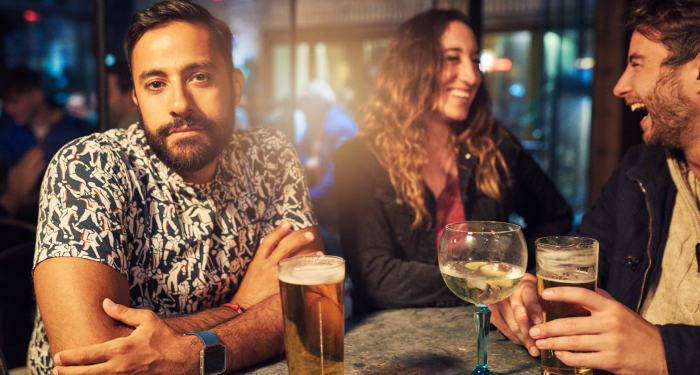
What looks like indifference is often something far more complicated—fear, fatigue, and freedom colliding in ways we rarely talk about.

Add VegOut to your Google News feed. 
Walk into any bar or scroll through social media and you’ll see the paradox: plenty of men talking about how much they’d love to meet someone special, yet more of them are actively choosing to remain single.
It’s not that they don’t want intimacy. They do. The problem is that the traditional model of relationships feels increasingly unworkable for a lot of guys—and many are deciding that staying solo, at least for now, is the safer bet.
So why the gap between desire and action? Let’s dig in.
The fear of financial strain
One of the biggest unspoken barriers is money. Relationships today often come with a hefty price tag. Between rising living costs, dating expenses, and the cultural expectation that men still “pick up the check,” many guys feel pressure they can’t keep up with.
I’ve had friends tell me they’d love to date more, but they can’t justify dropping hundreds on restaurants, gifts, and weekend trips when they’re barely saving for themselves.
Emerging adulthood is already an expensive stage of life. Add the cost of dating and potential family planning, and it’s no wonder some men step back until they feel financially secure.
It reminds me of running a restaurant kitchen. You might love creating beautiful dishes, but if the margins aren’t there, you’ll hesitate to add another item to the menu. Men feel the same with relationships: love is appealing, but the financial risk looms large.
And there is data to back this up: a recent Self Financial survey of more than 1,000 U.S. adults found that the average person spends about $58.84 per date, with men spending more (~$67.87) than women.
Over two-thirds of respondents said they feel stressed about money when planning a date, and many are opting for lower-cost alternatives.
The rise of independence as identity
Men are also becoming more protective of their independence. For decades, society told them that a man without a partner was somehow incomplete. Now? Many are rewriting that script.
In the same way someone might savor a perfectly cooked steak at a high-end restaurant, men are learning to savor their own freedom. They travel when they want, spend how they want, and build routines without compromise.
This doesn’t mean they don’t want connection—it just means they value autonomy more than ever. Giving that up feels like too big of a cost, especially if they’ve watched friends lose themselves in relationships.
A friend of mine recently put it bluntly: “I love the idea of a girlfriend, but I also love not having to explain why I’m working late, or why I booked a last-minute trip.” For him, independence has become as much a part of his identity as his career.
Burnout from modern dating
Let’s be honest—dating apps have changed the game. And for many men, not in a good way.
The endless swiping, ghosting, and algorithm-driven “matches” leave a lot of people drained. Men in particular often report putting in more effort just to get a response, which can feel discouraging over time.
A Pew Research Center survey of U.S. online daters found that while 53% of online dating users describe their personal experiences as very or somewhat positive, 46% describe them as very or somewhat negative.
Among younger users especially, many report feeling insecure from lack of responses, and disappointed by superficial or non-committal behavior.
Imagine if every time you ordered food, the restaurant canceled your order without explanation. That’s how ghosting feels. Eventually, you’d stop bothering and just cook at home. For men burned out by dating culture, staying single feels like the equivalent of eating in—it’s simpler, less disappointing, and more in their control.
Shifting gender dynamics
Relationships used to follow clearer, if outdated, scripts. Today, expectations are in flux. Women are rightly demanding equality, communication, and emotional labor from men. But many men are unprepared for this shift.
As one therapist put it: “A lot of men want relationships, but not the version that requires vulnerability, empathy, and ongoing negotiation.” That’s not because they’re incapable—it’s because they were never taught.
The result? A lot of men retreat instead of risk falling short. It’s easier to stay single than to confront skills they feel unequipped to develop.
This is echoed in the work of psychologist and couples therapist Terrence “Terry” Real, who argues that men often lack what he calls “relational literacy”—that is, the ability to name feelings, listen deeply, tolerate vulnerability, and compromise.
Without those tools, relationships feel more like exams than partnerships.
Past relationships leaving scars
Another reason is personal history. I’ve had conversations with men who were deeply hurt by previous relationships—whether it was betrayal, manipulation, or simply a painful breakup. Those experiences linger.
When you’ve invested years into someone and walked away feeling drained or rejected, it makes sense that you’d be hesitant to try again. It’s like burning your tongue on hot coffee—you’ll be more cautious the next time around.
Psychologists call this “avoidant coping.” It’s not that men don’t want love; it’s that they don’t want to risk being blindsided by the same pain again.
One guy I know still hasn’t dated seriously since his divorce five years ago. He told me: “I’m not against relationships. I’m just against going through hell again.” That hesitation is real, and it keeps a lot of men parked in singleness.
Conflicting priorities
Many men are also more focused on career, fitness, or personal growth than in past generations. And with limited time and energy, something has to give.
Think about it: if you’re working 60 hours a week building a business or traveling constantly for your career, squeezing in a relationship can feel impossible.
Discipline requires trade-offs. Some men are choosing to invest in themselves first, hoping relationships will come later.
There’s also the factor of lifestyle mismatch. If a man’s priorities are intense—say, marathon training or scaling a startup—it can feel easier to stay single than to constantly negotiate for time with a partner.
The stigma around vulnerability
Finally, let’s talk about the cultural elephant in the room: men still struggle to be vulnerable.
Opening up emotionally is tough when you’ve been conditioned to “man up” your whole life. While more conversations around mental health are happening, many men fear being judged—or worse, rejected—if they show their softer side.
So they keep their guard up. And as every relationship expert will tell you, intimacy can’t grow when walls are too high. This fear of exposure keeps men in the safety of singleness, even if it feels lonely.
As author Brené Brown has noted, “Vulnerability is the birthplace of connection.” Without it, relationships remain surface-level. And for many men, it’s easier to avoid relationships altogether than risk feeling exposed.
Why this matters
The point here isn’t to paint men as victims or women as demanding. It’s about recognizing the gap between wanting connection and being willing—or able—to pursue it.
The real reason many men are staying single isn’t laziness or lack of desire. It’s a mix of economic pressures, cultural shifts, emotional scars, and a changing definition of what relationships should look like.
For some, staying single is a temporary pause while they figure themselves out. For others, it’s a long-term choice rooted in the value of freedom. Either way, it’s a reflection of how relationships today demand more than they used to—and not everyone feels ready to rise to that challenge.
And here’s the kicker: the more society normalizes singleness, the less pressure there is to settle down “just because.” That creates space for men to build lives they actually want, not lives dictated by outdated timelines.
Final thoughts
When I look at the men around me—friends, colleagues, even people I meet while traveling—I don’t see apathy toward relationships. I see caution.
They want love, but they don’t want to lose themselves, their financial stability, or their sense of freedom. And until they feel confident that a relationship will add more than it takes away, many are choosing the single path.
Maybe that’s not such a bad thing. Taking the time to understand yourself, to grow, to protect your energy—it can mean that when you do finally step into a relationship, you’re showing up as someone truly ready.
Because the truth is, staying single isn’t about avoiding love. It’s about waiting for the kind of connection that makes the trade-offs worth it.