The way you place your fork when you're finished eating says more about your childhood than you realize.
The first time I had dinner at my partner's parents' house, I reached across the table for the salt. Nothing major, right? Wrong. The look I got from their mother could have frozen lava.
Growing up in Sacramento, dinner at our place was pretty casual. We ate, we talked, we passed things when someone asked. But there were certain unspoken rules we never learned, codes of conduct that apparently separated the classes at the dining table.
It wasn't until I started paying attention as an adult that I realized how much these small rituals reveal about upbringing. The families who enforce them tend to come from upper-middle-class backgrounds where dining etiquette mattered. The rest of us? We got by just fine without knowing which fork to use.
1) Waiting for everyone to be served before eating
At my family dinners, food hit your plate and you ate it. Simple. Hot food should be eaten hot, and nobody wanted their meal getting cold while we waited for everyone to sit down.
But in more formal households, there's this rule: nobody touches their food until everyone has been served. It's about collective experience, showing restraint, demonstrating that the social aspect matters more than satisfying your immediate hunger.
My grandmother, who raised four kids on a teacher's salary, would have laughed at this. With that many mouths to feed, meals were efficient operations. You ate when food appeared because there might not be seconds.
The waiting game is a luxury. It says your family had enough abundance that a few minutes of cooling didn't matter. It says meals were events, not just fuel stops between activities.
2) Using proper utensil placement to signal you're finished
Here's something I only learned in my thirties: apparently, you're supposed to place your knife and fork in specific positions to tell servers whether you're done eating or just taking a break.
Knife and fork parallel at the four o'clock position? Finished. Knife and fork crossed or at different angles? Still eating.
Growing up lower-middle-class, we had one signal for being done: an empty plate. No one was reading semaphore in our silverware arrangement. We didn't have servers anyway. We had Mom asking if anyone wanted more while she was already standing up to clear the table.
This is the kind of thing you learn if your parents took you to nice restaurants or if formal dining was part of your regular life. For the rest of us, utensils were tools, not communication devices.
3) Never putting elbows on the table
"Get your elbows off the table." Some people heard this constantly. Others, like me, heard it maybe once or twice as an afterthought.
The no-elbows rule has aristocratic origins. It was about posture, about appearing refined and controlled even during the casual act of eating. Slouching suggested laziness or lack of discipline.
But in working-class and lower-middle-class homes, comfort often trumped formality. After a long day, people leaned in. They got comfortable. The table was a place to relax, not perform.
I've watched this play out at countless dinners. People from stricter backgrounds sit up straight naturally, keeping their elbows in their laps between bites. The rest of us lean forward, prop ourselves up, take the weight off our backs.
Nobody's more comfortable, just differently trained.
4) Passing dishes instead of reaching
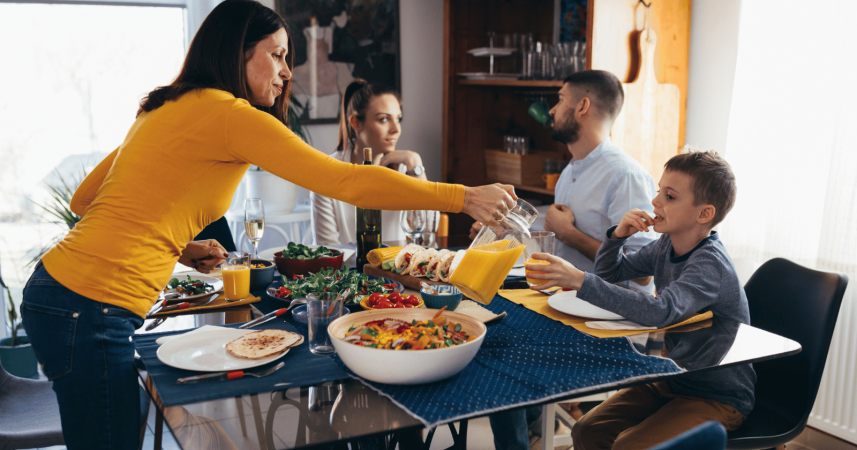
That salt incident at my partner's parents' house? Apparently, the proper thing to do was ask someone to pass it, even though it was right there within arm's reach.
Reaching across the table is considered rude in formal dining settings. It invades other people's space, disrupts conversation, and shows impatience. You're supposed to politely ask for items to be passed, even if you could easily grab them yourself.
This wasn't a thing at our house. If you needed something and could reach it, you reached. Why bother someone else for something you could handle yourself? Self-sufficiency was valued more than ceremony.
The passing ritual assumes a certain kind of meal, one where everyone stays seated for extended periods, where the table is set with everything needed, where dinner is a production rather than a pit stop.
5) Keeping your napkin on your lap throughout the meal
Cloth napkins that go on your lap, stay on your lap until the meal is completely finished, then get placed loosely to the left of your plate. Not on the chair when you get up temporarily, not tucked into your shirt, not left crumpled on the table.
We had paper napkins. They lived in a holder in the middle of the table. You grabbed one when you needed it, used it, and tossed it when you were done. Sometimes we just used paper towels.
The cloth napkin choreography is learned behavior. It's not intuitive. You have to be taught that the napkin goes on your lap immediately, that you blot rather than wipe, that it stays on your chair if you excuse yourself temporarily.
These distinctions matter in certain circles. They mark you as someone who knows the rules, someone who's dined in places where these things are expected.
6) No phones or screens at the dinner table
Okay, this one might seem universal now, but here's the difference: some families banned phones because of dining etiquette principles. Others banned them because phones didn't exist when the rules were set.
Upper-middle-class families often have explicit, enforced policies about devices at dinner. It's about respecting the meal, respecting conversation, treating dinner as sacred family time.
Lower-middle-class families might have the same rule, but it came later and was less about preserving tradition and more about wrestling attention away from screens. The framing was different. "Put your phone away" versus "We don't have phones at the table in this family."
One approach treats dining as an institution worth protecting. The other treats phones as a modern nuisance to be managed.
The outcome might look the same, but the underlying philosophy reveals different class backgrounds.
7) Chewing with your mouth closed and not talking with food in your mouth
This is probably the most universal rule, but enforcement varies wildly by class background.
In homes where dining etiquette mattered, this was non-negotiable. Getting caught chewing with your mouth open or talking with food visible would earn immediate correction. It was about respect, about not being disgusting, about controlling your base impulses.
In more casual households, these rules were suggested rather than enforced. Sure, don't be gross, but if you needed to answer a question mid-chew, nobody was timing your swallows.
I've mentioned before that my journey from music blogger to lifestyle writer taught me a lot about class markers, and dining habits are some of the most revealing. The way we eat tells a story about where we came from, even when we're not saying a word.
Conclusion
Table manners aren't about being better or worse. They're cultural markers, signs of the environment that shaped us.
Missing these lessons doesn't make anyone less than. It just means your family prioritized different things, operated under different constraints, or simply had a more relaxed approach to meals.
The interesting part is what happens when you learn these rules as an adult. You can choose to adopt them, ignore them, or pick and choose based on context. That flexibility, that ability to code-switch at the dinner table, might be the most valuable skill of all.
Your childhood table manners don't define you. But they do explain a few things about where you started.