
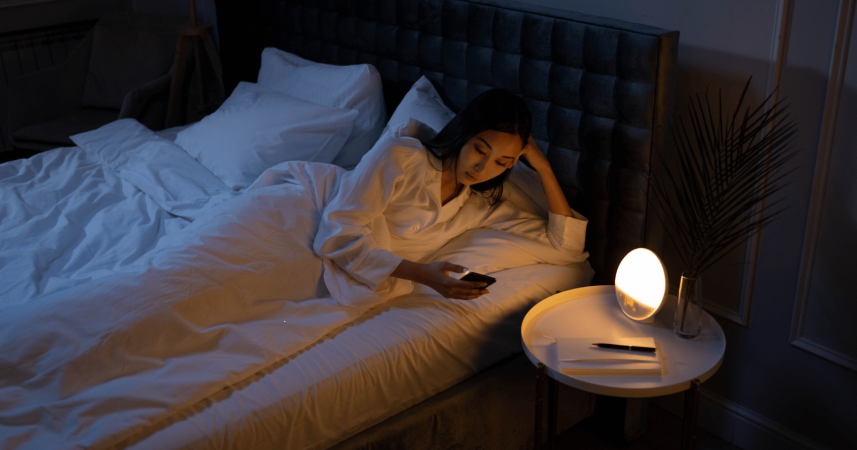
What if the way you spend your quietest hours says more about your psychology than anything you do in daylight?
Most of us know that scrolling before bed isn’t exactly good for sleep. Yet, night after night, we still find ourselves reaching for the phone, thumbing through Instagram reels, newsfeeds, or random rabbit holes on Reddit.
It’s not just about distraction or habit. Psychology suggests that people who do this often share some common traits—ways of thinking and feeling that explain why late-night scrolling feels so irresistible.
Let’s dive in.
1. You have a restless mind
Do you ever notice how your brain feels busier at night than it did all day? That’s not unusual. People who scroll aimlessly before bed often have restless minds that resist stillness.
Instead of lying in the dark waiting for sleep, your brain craves input. Scrolling becomes a way to feed that need.
I’ve been there after long days of writing—my head buzzing with ideas I couldn’t shut off. The phone gave me something to focus on, even if it wasn’t productive.
Psychologists call this cognitive arousal—your brain is activated, searching for stimulation, even when your body is tired. It’s the same mechanism that makes it hard to stop replaying a conversation or worrying about tomorrow’s to-do list when you’re trying to fall asleep.
If you recognize yourself here, it’s not that you lack discipline. It’s that your brain has developed a strong association between stimulation and comfort, even at times when quiet would serve you better.
2. You struggle with boundaries
Boundaries aren’t just about saying no to people. They’re about saying no to yourself, too.
If you often scroll into the night, it’s a clue that you might struggle with setting internal boundaries. You know you need sleep. You know the screen light isn’t helping. But you still let yourself push the limit “just five more minutes.”
As noted by Dr. Anna Lembke, author of Dopamine Nation, “We live in a world of overwhelming abundance. Our brains are not wired for it.” That abundance makes setting limits incredibly tough.
The phone offers endless possibility—more videos, more posts, more opinions. Boundaries feel almost impossible when you know there’s always “just one more.”
In some ways, late-night scrolling is a microcosm of modern life. We’re constantly surrounded by choices, and without strong internal guardrails, we overindulge—whether it’s food, shopping, or screens.
3. You’re curious by nature
Scrolling isn’t always mindless—it’s often driven by curiosity. The need to know, to see what’s happening, to keep learning—even if what you’re learning isn’t exactly deep.
Curious people love novelty. A new headline, a new meme, a new TikTok hack—it all feeds that itch.
When I was traveling through Japan years ago, I noticed how I could spend hours just wandering alleys, not with any goal, just following curiosity. Late-night scrolling scratches that same itch in a digital way.
Of course, curiosity is a strength in most areas of life. It fuels innovation, creativity, and personal growth. But at night, curiosity doesn’t switch off. Instead, it pulls you into a loop of “what’s next?” until suddenly it’s 1 a.m.
That doesn’t mean you should stop being curious—it just means channeling it differently. Books, audiobooks, or even a “curiosity list” you can explore the next day can satisfy the urge without sabotaging your sleep.
4. You use distraction as a coping mechanism
Quote: “Avoidance is one of the most common ways people deal with uncomfortable feelings,” notes Dr. Susan David, psychologist and author of Emotional Agility.
Nighttime scrolling is often less about entertainment and more about avoidance. Stress from the day, anxiety about tomorrow, or even loneliness can feel easier to manage with a glowing screen in your hand.
The endless feed creates a buffer between you and whatever emotions you don’t want to sit with. But of course, the emotions don’t go away—they just get postponed.
I remember finishing a particularly heavy book on grief one evening. Instead of letting myself process the feelings it stirred up, I immediately opened Twitter and lost an hour. The scrolling wasn’t about information—it was about numbing.
Distraction isn’t always bad. It can give you space when emotions feel overwhelming. But when it becomes your default response to discomfort, it robs you of opportunities to build resilience.
5. You’re wired for connection
If you spend your late-night scrolling mostly on social apps, there’s another layer at play: the need for connection.
Humans are social animals. Even when we’re winding down for the day, we want to feel connected to others. Scrolling through updates, liking a photo, or dropping a quick comment can simulate closeness.
I’ve mentioned this before in another post, but loneliness often shows up most acutely at night. That’s when we crave a sense of belonging—and the phone offers an easy fix.
The trouble is, digital connection rarely fills the same gap as in-person presence. Instead of winding down with the comfort of connection, we end up overstimulated and oddly empty.
As Sherry Turkle, MIT professor and author of Alone Together, once noted, “We expect more from technology and less from each other.” That line hits harder at midnight when you’re scrolling through someone else’s highlight reel instead of feeling truly connected.
6. You lean toward procrastination
Ask yourself this: how many times has scrolling been your way of putting off sleep?
For many, scrolling is bedtime procrastination. It’s not about the content, it’s about resisting the transition into sleep.
Why? Sometimes it’s because sleep feels like giving up control. Other times, it’s because the day didn’t feel “full enough,” and scrolling becomes a way of stealing back time.
Behavioral scientists call this revenge bedtime procrastination. It’s common in people who feel their daytime hours aren’t fully theirs. Scrolling becomes a tiny act of rebellion—your way of reclaiming a sliver of the day.
I’ve felt this most after long work stretches when my schedule didn’t feel like my own. By staying up, even aimlessly, I felt like I was regaining agency. But the irony is, it left me even more drained the next day, further reducing the sense of control.
It’s a cycle worth noticing. If you’re procrastinating sleep because you crave freedom, maybe the real solution isn’t another hour on your phone, but finding ways to insert freedom and joy into your day.
7. You’re sensitive to stimulation
Finally, if you scroll aimlessly at night, it might be because your brain is wired to respond more strongly to stimulation.
Some people can drift off with a book and be asleep in minutes. Others need the buzz of information, images, and noise to feel regulated, even if it costs them rest later.
Being highly sensitive to stimulation doesn’t always mean you like it—it just means your nervous system reacts to it more intensely. That explains why the glow of a phone can feel both soothing and disruptive at the same time.
If you’ve ever felt more awake after “just a quick scroll,” you’ve experienced this. The phone provides stimulation that your body interprets as a reason to stay alert.
The challenge here isn’t just about putting the phone down—it’s about recognizing how your nervous system responds to stimulation in general. That awareness can help you choose healthier alternatives, like calming music, meditation apps, or journaling.
The bottom line
If you’re guilty of late-night scrolling, you’re not broken or weak. You’re human—and probably curious, restless, socially wired, and prone to avoiding discomfort.
The traits that keep you scrolling aren’t bad in themselves. In fact, they can be strengths in the right context. But if sleep and rest matter (and they do), learning to direct those traits in other ways—journaling your racing thoughts, connecting with someone earlier in the day, or setting firmer boundaries—can help.
So maybe tonight, ask yourself: do I really want to scroll, or am I just avoiding something? The answer might tell you more about yourself than the feed ever could.
What’s Your Plant-Powered Archetype?
Ever wonder what your everyday habits say about your deeper purpose—and how they ripple out to impact the planet?
This 90-second quiz reveals the plant-powered role you’re here to play, and the tiny shift that makes it even more powerful.
12 fun questions. Instant results. Surprisingly accurate.












