
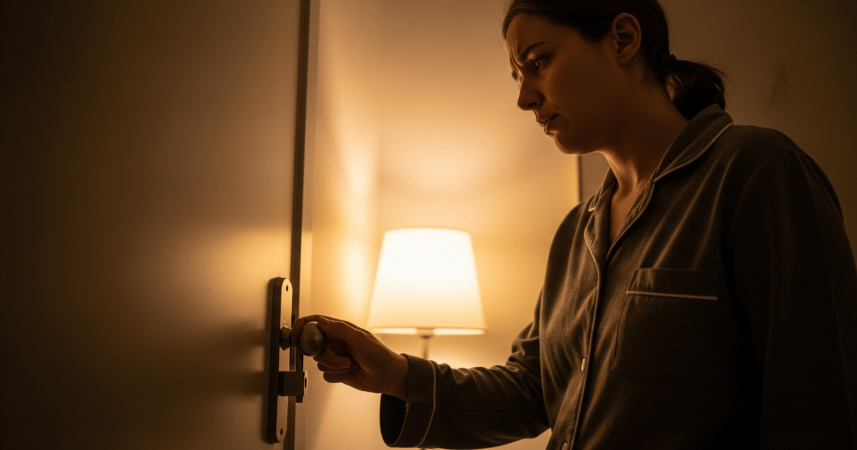
That last glance at the lock before bed might not be about safety at all—it could be a window into your hidden inner world.

Add VegOut to your Google News feed. 
Most people brush their teeth, maybe scroll their phone, and crash into bed. But if you’re the type who always pauses, walks back, and makes sure the front door is locked—even when you’re pretty sure you already did it—there’s more going on than just caution.
Psychology suggests these small, almost automatic rituals say something about your inner wiring. And no, it’s not just about being “paranoid.”
Think of it like this: our smallest routines can act like mirrors. They reflect personality traits, emotional tendencies, and the way we process uncertainty. Lock-checking before bed is one of those micro-behaviors that’s easy to overlook but surprisingly revealing once you dig into it.
Let’s break down eight distinct traits that often hide behind this habit.
1. You lean toward conscientiousness
Double-checking is often less about fear and more about thoroughness.
In psychology, conscientiousness is one of the Big Five personality traits. People high in it are careful, detail-oriented, and like to feel things are done properly.
That quick lock check isn’t random—it’s your brain wanting closure, a way to tie a neat bow on the day. It’s the same instinct that drives some people to triple-check they’ve sent an email before hitting “send.”
I’ve noticed this myself when traveling. If I don’t make sure the hotel door is sealed tight, my mind won’t let me enjoy sleep. It’s not worry—it’s finishing the checklist.
Ask yourself this: how often do you feel unsettled when things are “almost done” but not fully confirmed? If that question hits home, it’s a sign you carry this trait across multiple areas of life.
2. You wrestle with a need for control
Do you ever feel more at ease only when you are the one to check the lock? That’s not an accident.
Double-checking behaviors are a subtle way of asserting control in a world that rarely feels predictable. As psychologist Daniel Wegner once noted, “The sense of control is central to our psychological well-being.”
This isn’t necessarily negative. In fact, research shows people who perceive greater control over their environments tend to experience less stress overall.
One neural-simulation study showed that when individuals have control over stressful stimuli, their brains undergo plastic changes that help buffer against future stress.
When I was younger, I used to laugh at my dad for always circling back to check car doors—sometimes twice. Now I get it. For him, it wasn’t fear—it was his way of reclaiming order in a busy life where much felt outside his influence.
3. You have a streak of anxiety
Of course, sometimes the habit ties back to anxious tendencies. Anxiety often shows up in small repetitive behaviors meant to reduce uncertainty.
Even if rationally you know the door is locked, the “what if?” lingers. And so, you check again.
This isn’t about labeling yourself with a disorder—it’s about recognizing the subtle ways anxiety sneaks into daily life. Some people pace, some bite their nails, and some test the lock one more time.
I’ve mentioned this before in another post, but small rituals like this aren’t necessarily bad. They can be a coping mechanism—your brain’s way of quieting that background hum of worry.
So the next time you’re annoyed at yourself for the habit, flip it: that extra step is your nervous system looking for calm.
4. You’re attuned to risk
Some people walk through life oblivious to danger. Others have a radar that never fully shuts off.
If you always confirm the lock, it might mean you’re more sensitive to risk than average. That doesn’t make you paranoid—it makes you cautious.
A study in personality psychology shows that people who score high in risk aversion tend to prefer certainty, avoid ambiguous situations, and take steps—sometimes small habits—to reduce potential threats. This could include behaviors like double-checking locks: low-effort actions that grant peace of mind.
Think of it as psychological insurance. You’re not just locking a door—you’re shutting down dozens of potential “what ifs” that could keep you awake.
5. You value safety for others
Here’s an angle people often miss: sometimes it’s not about you at all.
I remember once staying at a friend’s place while we were on a photo trip in New Mexico. He laughed because I kept walking back to make sure the Airbnb door clicked shut. The truth? I wasn’t worried for myself—I just didn’t want hisgear stolen while we slept.
For many people, double-checking isn’t just self-protection. It’s a small way of protecting family, roommates, or anyone under the same roof.
Parents especially understand this. Locking up before bed isn’t just about personal safety—it’s about creating a safe container for the people you love. And if you’re the one in the household who always takes that role, it often means you naturally step into protector mode.
6. You’re prone to overthinking
“Did I lock it? I think I locked it. But what if I didn’t?”
Sound familiar?
Rumination theory shows that repetitive thinking about distressing thoughts or uncertainties tends to prolong negativity and interfere with problem solving.
While lock-checking isn’t directly studied, it fits the pattern of translating rumination into low-cost physical rituals to momentarily quiet mental loops.
The upside? Overthinkers often excel in problem-solving because they explore angles others miss. You might notice patterns, risks, or solutions others overlook.
The downside? Your brain doesn’t always know when to stop. So even small uncertainties—like a lock—become mental rabbit holes.
The lock-check is a way of closing the loop. It’s the simplest way to tell your mind, “This chapter is finished.”
7. You appreciate ritual
Ritual isn’t always spiritual. Sometimes it’s just the sequence that makes us feel ready for rest.
Locking the door—then double-checking—is part of your wind-down script. It signals to your mind: the day is done, the house is safe, now it’s time to sleep.
I’ve noticed that people who build rituals around the end of the day—whether it’s journaling, tidying the kitchen, or yes, checking locks—often report better rest. It’s the predictability that soothes.
And there’s research behind this. Harvard Health’s sleep hygiene guidelines note that consistent pre-bed routines—turning off screens, dimming lights, doing calming activities—help your brain transition from alertness to rest more smoothly, improving sleep quality.
8. You carry a sense of responsibility
At the heart of it, this habit often comes down to responsibility.
People who double-check locks tend to feel accountable for outcomes, even small ones. They don’t shrug things off as “someone else’s problem.”
As noted by clinical psychologist Meg Jay, “Responsibility is the engine of adulthood.” Those who take it seriously are the ones who ensure small safeguards—like a secure door—are never overlooked.
And responsibility goes beyond doors. It often shows up at work, in friendships, and even in how you handle money. Small acts of accountability reflect bigger patterns of trustworthiness.
If you’re the one who always checks, chances are others already rely on you more than you realize.
The bottom line
If you’re a lock double-checker, you’re not weird—you’re wired.
That tiny pause before bed can reveal conscientiousness, control, caution, even compassion for others. It’s less about paranoia and more about the subtle ways your psychology shows up in everyday life.
So next time you catch yourself checking the door one more time, don’t roll your eyes. That habit is telling you something valuable about who you are.
And maybe—just maybe—it’s also telling you that sometimes the smallest rituals are the ones that give us the biggest sense of security.












