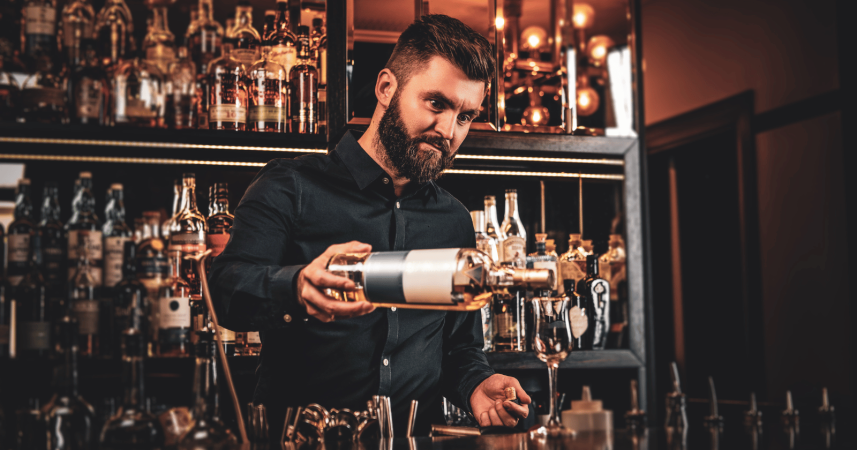
The truly wealthy don't announce their status at the bar, they quietly signal it through a dozen small choices that most people never notice.

Add VegOut to your Google News feed. 
I spent most of my twenties in luxury hospitality, working everywhere from boutique hotels to fine-dining restaurants where a single bottle of wine could cost more than my monthly rent. During those years, I watched thousands of people order drinks. And here's what I learned: how someone orders a drink tells you more about them than any conversation ever could.
I'm not talking about the drink itself necessarily. I'm talking about the entire performance. The confidence, the hesitation, the language they use, whether they make eye contact with the server. After coordinating wine programs and managing high-profile dinners for ultra-wealthy families, you start to recognize patterns.
The truly wealthy order differently than people trying to look wealthy. It's subtle, but once you see it, you can't unsee it.
1) They order by spirit, not by brand
Middle-class drinkers love to name-drop. "I'll have a Grey Goose martini" or "Make that a Johnnie Walker Blue, neat."
People with real money? They just say "vodka martini" or "scotch, neat." They might specify a preference if asked, but they're not leading with the label. They don't need to prove anything to the bartender.
I remember this regular at one of the hotels I worked at, a guy who owned a string of car dealerships across the Southwest. Every single time he ordered bourbon, he'd announce the brand like he was reading off a trophy shelf.
Compare that to a hedge fund manager I once served at a private dinner who simply asked for "bourbon, two fingers, no ice" and left it at that. The difference was impossible to miss.
When you're secure in your wealth, you don't use drink orders as status signals. You trust the establishment to pour quality, or you wouldn't be there in the first place.
2) They never customize classic cocktails
Nothing screams "I watched too many cocktail tutorials on Instagram" quite like someone ordering a martini with seventeen modifications.
Wealthy regulars order classics as they're meant to be made. A Negroni is a Negroni. An Old Fashioned is an Old Fashioned. They might specify gin or vodka for a martini, maybe request it dirty, but that's where it ends.
I've watched people from old money order the same drink at the same restaurant for decades without changing a single element. They found what they like, and they stick with it. There's a quiet confidence in that consistency.
Middle-class patrons, on the other hand, often treat ordering like a creative writing exercise. Extra this, no that, substitute the other thing. It's not wrong, but it reveals something about how comfortable you are in these spaces. People who belong don't feel the need to put their personal stamp on everything.
3) They tip before the first drink arrives
This one's subtle but powerful.
The wealthy understand that good service is a relationship, not a transaction. They establish that relationship immediately, usually with a generous tip on the first round. Not in a flashy way. Quietly, sometimes with a folded bill.
I learned this watching how certain guests interacted with bartenders during private events. The ones with serious money would take care of the staff early and well. It wasn't about showing off. It was about ensuring excellent service for the rest of the evening.
Middle-class tippers wait until the end. They calculate percentages. They adjust based on perceived service quality. All perfectly reasonable, but it's a fundamentally different approach. One is transactional, the other is strategic.
The early tip isn't just generosity. It's an investment in the experience you're about to have.
4) They order wine by characteristic, not by price
When someone picks up a wine list and immediately flips to the most expensive page, you know they're performing.
Actually wealthy wine drinkers ask questions. They describe what they're in the mood for. "Something light and mineral" or "A full-bodied red that'll stand up to the steak." They engage with the sommelier as a partner, not an audience.
During my years coordinating wine programs, I learned that the guests who spent the most weren't always the ones with the most. Sometimes they were just the most insecure. The old-money crowd often ordered mid-range bottles because they were more interested in the wine than the price tag.
I remember one woman, a philanthropist who'd inherited a fortune, who always asked me to recommend something "interesting under eighty dollars." Not because she couldn't afford more, but because she genuinely wanted to discover something good rather than something expensive.
Price is amateur hour. Character is what matters.
5) They order what they actually want
This sounds obvious, but you'd be surprised how many people order drinks they think they should want.
Men ordering whiskey neat when you can tell they'd rather have something sweeter. Women ordering white wine when they clearly want a margarita. All because they're managing an image.
The wealthy are past that. I've watched billionaires order fruity cocktails with umbrellas. I've seen female CEOs order bourbon on the rocks. They've done enough performing in their lives. The bar is where they get to be honest.
There's something deeply middle-class about the anxiety of ordering "correctly." When you have nothing to prove, you can order exactly what you're in the mood for, social expectations be damned.
The freedom to be unself-conscious is perhaps the most underrated luxury.
6) They don't order shots
Show me someone ordering a round of shots for the table, and I'll show you someone who's not in the top tax bracket.
I'm not saying wealthy people don't drink. They absolutely do, often quite well. But shots are performance drinking. They're about the group spectacle, the Instagram story, the "we're having such a crazy night" energy.
Wealthy drinkers are there to enjoy the drink, not to prove they can handle their alcohol or bond through shared suffering. They sip. They savor. They might get just as drunk by the end of the night, but they're not racing to get there.
During my time in Bangkok, I learned the Thai concept of "sabai," which roughly translates to ease and contentment. Shots are the opposite of sabai. They're forced fun, manufactured intensity. The people who've achieved real success don't need to manufacture anything.
7) They ask the bartender what's good
Here's a counterintuitive one: the wealthy are more likely to ask for recommendations.
Not in a helpless way. In a curious way. They respect expertise. They understand that the bartender knows the bar better than they do, and they're genuinely interested in hearing what's working well that night or what's seasonal.
Middle-class pride often prevents this. There's an anxiety about appearing unknowledgeable, so people default to safe orders they've heard of. The wealthy don't have that anxiety. They're comfortable not knowing everything.
I watched this play out constantly at high-end hospitality venues. The richest guests were the ones most willing to be guided, to try something new, to trust the professional in front of them. They'd built their wealth by recognizing and leveraging expertise. Why would ordering a drink be any different?
Confidence means knowing what you don't know.
8) They order the same thing every time
There's a specific type of regularity that marks old money. They find their drink, and it becomes part of their identity.
Not in a limiting way. In a "I know what I like" way. Every Wednesday, same seat, same drink. It's ritualistic. It's efficient. It removes one small decision from a life full of much larger decisions.
I had a regular during my fine-dining days who ordered the same Hendrick's gin and tonic every single time he came in. No variation. He was worth somewhere north of fifty million dollars, and he'd found the drink that made him happy. Why mess with that?
Middle-class drinking tends to involve more experimentation, more novelty-seeking. Which isn't bad. But there's something quietly powerful about the wealthy person who walks in and the bartender already knows what they want.
It's the difference between exploring your identity and being secure in it.
9) They never complain about the price
If the price is an issue, they simply don't order it. There's no negotiating, no commenting about how expensive things are, no pointed remarks about cocktail prices in this city.
The wealthy understand that if you're at an establishment, you've accepted their pricing structure by walking through the door. Complaining about price after ordering is deeply middle-class behavior. It's wanting to participate in luxury spaces while simultaneously protesting the cost of admission.
I can't count how many times I heard some variation of "sixteen dollars for a cocktail?" during my hospitality years. And it was never from the guests who could genuinely afford anything on the menu. The truly wealthy just ordered what sounded good and moved on with their evening.
This extends beyond drinks, obviously. But drinks are where people reveal themselves most clearly because the stakes feel lower. The bill isn't big enough to truly matter, so the performance becomes more obvious.
Final thoughts
Look, these aren't rules. They're observations from years spent in spaces where wealth intersects with service. And here's the thing: none of this actually matters.
How you order a drink doesn't determine your worth as a person. Middle-class drinking behaviors aren't inferior, just different. And plenty of wealthy people order in ways that would contradict everything I've written here.
But patterns exist for a reason. After serving enough high-profile dinners and charity galas, you start to recognize the quiet signals of real wealth versus performed wealth. The former is relaxed, trusting, unself-conscious. The latter is tense, proving, performing.
The most interesting part? You can adopt the ordering style of the wealthy without having any money at all. Confidence, respect, and self-awareness cost nothing. Order what you want. Tip well. Trust the professionals. Don't perform.
That approach will serve you better than any drink order ever could.
If You Were a Healing Herb, Which Would You Be?
Each herb holds a unique kind of magic — soothing, awakening, grounding, or clarifying.
This 9-question quiz reveals the healing plant that mirrors your energy right now and what it says about your natural rhythm.
✨ Instant results. Deeply insightful.

Adam Kelton
Adam Kelton is a writer and culinary professional with deep experience in luxury food and beverage. He began his career in fine-dining restaurants and boutique hotels, training under seasoned chefs and learning classical European technique, menu development, and service precision. He later managed small kitchen teams, coordinated wine programs, and designed seasonal tasting menus that balanced creativity with consistency.
After more than a decade in hospitality, Adam transitioned into private-chef work and food consulting. His clients have included executives, wellness retreats, and lifestyle brands looking to develop flavor-forward, plant-focused menus. He has also advised on recipe testing, product launches, and brand storytelling for food and beverage startups.
At VegOut, Adam brings this experience to his writing on personal development, entrepreneurship, relationships, and food culture. He connects lessons from the kitchen with principles of growth, discipline, and self-mastery.
Outside of work, Adam enjoys strength training, exploring food scenes around the world, and reading nonfiction about psychology, leadership, and creativity. He believes that excellence in cooking and in life comes from attention to detail, curiosity, and consistent practice.
More Articles by Adam