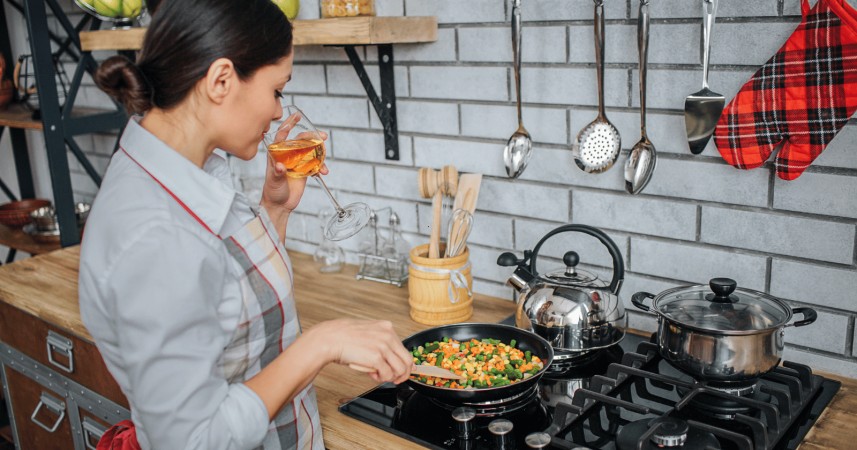
While your friends are financing their "smart" kitchens, you could be mastering the same techniques that help professional chefs create magic with nothing but a beat-up pan and sharp knife.

Add VegOut to your Google News feed. 
You know those friends who drop thousands on sous vide machines, stand mixers with every attachment known to man, and smart ovens that supposedly cook everything perfectly? Yeah, they still call me when they need to save a dinner party disaster.
Don't get me wrong. I love a good gadget as much as the next person. But after spending my twenties in luxury F&B, training under seasoned chefs who could make magic happen with nothing but a beat-up pan and a sharp knife, I learned something crucial: real cooking skill has nothing to do with how much money you've spent on your kitchen.
The truth is, if you've mastered these eight fundamental techniques, you're already leagues ahead of anyone relying on expensive equipment to do the heavy lifting. These are the skills that separate cooks from button-pushers.
1. Knife skills that actually matter
Ever watched someone struggle for ten minutes trying to dice an onion while their $400 food processor sits unused on the counter? That's because machines can't replicate the control and precision of proper knife work.
During my classical European technique training, we spent weeks just learning to hold a knife correctly. Not because the chefs were trying to torture us, but because this single skill transforms everything else you do in the kitchen.
When you can julienne vegetables into perfect matchsticks or brunoise them into tiny, uniform cubes, your food doesn't just look better. It cooks evenly. Flavors distribute properly. Textures harmonize.
I once watched a friend struggle with her mandoline slicer (those things are actually dangerous if you don't know what you're doing) while I finished prepping vegetables for eight people with just my chef's knife. She asked if I wanted to borrow it. I just smiled.
The key isn't speed, though that comes naturally with practice. It's consistency. When every piece is the same size, everything finishes cooking at the same time. Revolutionary concept, right?
2. Temperature control without the tech
Smart thermometers and precision cookers promise perfect results every time. But what happens when the battery dies or you're cooking somewhere without your gear?
Real temperature control comes from understanding how heat works. It's knowing that a drop of water should dance across a pan when it's ready for your eggs. It's hearing the difference between a gentle simmer and a rolling boil without looking.
When I make pasta from scratch, I don't need a thermometer to tell me if my water is the right temperature. The bubbles tell me everything. Small bubbles forming on the bottom means it's about 160°F, perfect for poaching.
Steady stream of bubbles rising? That's your simmer at 185°F. Full rolling boil with violent bubbles? You're at 212°F and ready for pasta.
This intuitive understanding means you can cook anywhere, anytime, without depending on gadgets. Your senses become your most reliable tools.
3. Seasoning by instinct, not measurement
Those expensive kitchen scales that measure to the tenth of a gram? Useful for baking, sure. But for everyday cooking, the best measurement tool is your palate.
Learning to season properly is like learning a language. At first, you need guidelines and rules. But eventually, you develop an instinct for what a dish needs. You taste, adjust, taste again. You learn how salt amplifies sweetness, how acid brightens flavors, how fat carries aromatics.
During my time learning Thai cooking techniques from friends, I discovered how they never measured fish sauce or lime juice. They'd add, taste, add more, taste again. The dish told them when it was ready, not a recipe.
This skill transforms you from someone who follows recipes to someone who creates. You stop asking "how much salt?" and start understanding what your food is asking for.
4. Reading the signs your food gives you
No amount of expensive equipment can replace the ability to read visual and auditory cues from your food. This is where cooking becomes intuitive rather than mechanical.
That sizzle when food hits the pan tells you if it's hot enough. The way meat releases from the surface when it's properly seared. The smell change when garlic goes from raw to fragrant to almost burnt. These are your real indicators, not timers and temperature probes.
I remember ruining countless steaks before learning to read the signs. Now? I can tell doneness by how the meat springs back when pressed. My fingers are more accurate than most digital thermometers.
Vegetables tell you when they're done by their color change and the way they yield to a fork. Bread dough shows you it's ready by how it feels in your hands, not what the timer says.
5. Improvisation and substitution
Here's what that $3000 smart oven won't tell you: cooking isn't about perfection, it's about adaptation. The ability to improvise when you're missing ingredients or things go wrong is what separates competent cooks from truly skilled ones.
Running out of white wine for that pan sauce? Apple cider vinegar with a touch of water works. No buttermilk for pancakes? Regular milk with a splash of lemon juice does the trick. This isn't about memorizing substitutions, it's about understanding what each ingredient actually does in a dish.
My fine-dining background taught me that even Michelin-starred kitchens constantly adapt. Supply chain issues, seasonal changes, unexpected dietary restrictions. The best chefs roll with it.
Once you understand the why behind ingredients, you stop being enslaved by recipes. You become the kind of cook who can open any fridge and create something delicious.
6. Building and balancing flavors
Those fancy molecular gastronomy kits won't teach you this fundamental truth: great food is about balance, not complexity. Understanding how flavors interact and support each other is worth more than any expensive immersion circulator.
Think of it like constructing a building. You need a foundation (usually fat, aromatics, or umami), supporting structures (proteins, starches), and finishing touches (herbs, acids, final seasonings). Each element has a role, and understanding these roles lets you build dishes intuitively.
When making my own bread from scratch, I learned how a tiny amount of vinegar could strengthen the dough structure. Not from a recipe, but from understanding how acids affect gluten development. This kind of knowledge compounds. Every technique you master opens doors to ten more possibilities.
7. Proper heat management
All those induction cooktops with precise temperature controls mean nothing if you don't understand how different foods respond to different types of heat.
High heat for searing, medium for sautéing, low for braising. Sounds simple, but knowing when to use which and how to transition between them is an art. It's understanding that you start mushrooms in a cold pan to draw out moisture, but meat needs screaming hot metal for that perfect crust.
I've seen people with professional-grade ranges who still can't properly caramelize onions because they don't understand the relationship between time, temperature, and moisture. They crank up the heat trying to speed things up, ending up with burnt edges and raw centers.
Real heat management means knowing when to be patient and when to be aggressive. It's moving your pan on and off the flame to control temperature, using residual heat to finish cooking, understanding how different materials conduct heat differently.
8. Timing and workflow management
Finally, this might be the most underrated skill of all. You can have every smart appliance in the world, but if you don't know how to orchestrate a meal, you'll still serve cold sides with your perfectly cooked protein.
Professional kitchens run on mise en place, everything in its place. But more importantly, they run on understanding task sequencing. What needs to start first? What can be held warm? What must be served immediately?
This isn't about following a schedule. It's about understanding how long things actually take and how they interact. That pasta water can be heating while you prep vegetables. Those roasted vegetables can rest while you finish the sauce. It's a dance, and no appliance can choreograph it for you.
Final thoughts
Look, I'm not saying expensive equipment is worthless. But I've cooked in cramped apartment kitchens with one working burner and produced better meals than what comes out of some space-age kitchen setups.
Because at the end of the day, great food is about connection more than technique. It's about understanding your ingredients, trusting your senses, and developing an intuition that no machine can replicate.
Master these eight techniques, and you won't need to drop thousands on equipment to cook like a pro. You'll have something better: the confidence and skill to create delicious food anywhere, with whatever you have on hand. And honestly? That's worth more than any gadget ever could be.