
Generational clashes at 30,000 feet reveal more than quirks—they expose the hidden psychology of how we share space, comfort, and connection.
Airports are fascinating. They’re one of the few places where generations collide in such close quarters, each carrying their own rituals, habits, and unspoken rules. Nowhere is that more obvious than on a plane.
Gen Z has reshaped how people travel. Their habits are influenced by tech, social media, and a different sense of boundaries than the ones boomers grew up with. Many of these make perfect sense if you’ve always had Wi-Fi in your pocket—but they can drive older travelers absolutely wild.
Let’s break down eight of the biggest ones.
1. Filming everything for social media
Have you noticed how phones come out the second the seatbelt clicks? Gen Z travelers love documenting every part of the experience—boarding, takeoff, their snacks, even mid-flight turbulence.
For boomers, who grew up in an era where travel was something private and rarely recorded, this can feel invasive. Their idea of documenting a trip might have been a few rolls of film developed weeks later, not a play-by-play broadcast.
Personally, I once sat next to a college student who filmed her window view for the entire descent into LAX. By the time we landed, the guy across the aisle looked like he wanted to crawl under his seat.
There’s more than awkwardness behind this. Communication scholar Nancy Baym argues that for digital natives, sharing isn’t just a habit—it has become a form of living. Posting and filming aren’t separate from the experience; they are the experience.
2. Taking shoes off like it’s their living room
For younger flyers, comfort is king. Socks off, feet tucked onto the seat, sometimes even cross-legged scrolling—it’s a vibe.
Boomers, however, tend to see planes as shared, public spaces where a baseline of formality still applies. A stranger’s bare feet brushing your armrest? That’s not exactly their idea of travel etiquette.
I once watched a twenty-something remove his sneakers, place them neatly under the seat, and then stretch out so his socked foot nudged into his neighbor’s space. The man beside him (definitely boomer age) pressed his call button faster than you can say “flight attendant.”
There’s actual science behind this discomfort. Psychological studies show that our sense of personal space—what Edward T. Hall called proxemics—is deeply shaped by the era we grew up in. Older individuals generally expect more space and may feel invaded when younger folks treat tight shared areas like personal zones.
3. Constantly swapping seats
“Anyone want to trade?” It’s a line you’ll often hear from younger passengers trying to sit together.
For Gen Z, flexibility is normal. They assume asking for a switch is no big deal. But boomers often find this irritating. They chose their seat carefully—extra legroom, aisle vs. window—and being asked to give it up feels like a disruption.
One older traveler I spoke to put it bluntly: “I paid for this seat. Why should I move because someone else didn’t plan ahead?”
This gets at a deeper generational difference. Boomers grew up in an era where planning ahead was a marker of responsibility. For Gen Z, last-minute changes are expected because they’ve always had the flexibility of apps, ride-shares, and on-demand everything.
4. Wearing noise-cancelling headphones start to finish
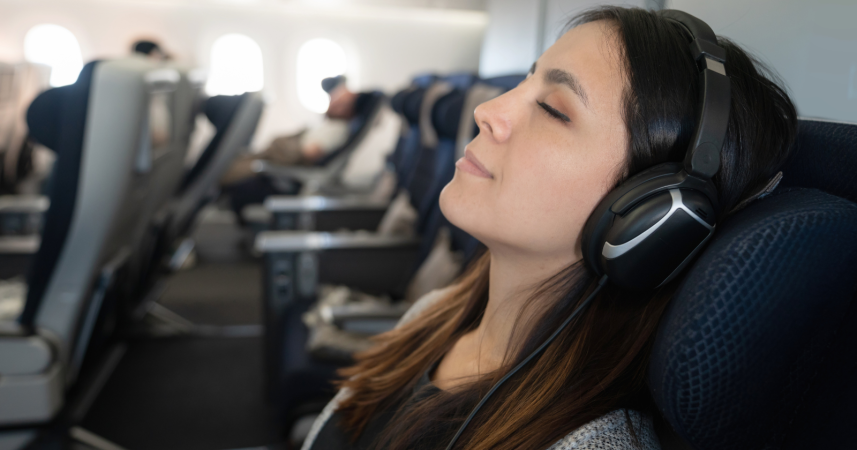
For Gen Z, the plane is basically a moving pod. Headphones go on before boarding and stay on until baggage claim. Music, podcasts, movies—they curate their own bubble.
Boomers, by contrast, often value the old-school courtesy of chatting with your seatmate, or at least being approachable. A wall of AirPods reads as closed-off and, to some, even rude.
I’ve felt both sides of this. On long-hauls, I love sinking into a playlist. But on short flights, I’ve had genuinely great conversations with strangers who would’ve been tuned out in today’s world.
Psychologist Sherry Turkle calls attention to this dynamic in Reclaiming Conversation. She argues that constant connectivity may streamline communication—but it often replaces spontaneous, in-person human interaction.
To Gen Z, tuning into a device can feel efficient, but to older generations, it can feel like losing the spark of shared experience.
5. Standing up the second the plane lands
Yes, this one’s been around for decades—but Gen Z has turned it into a meme. The moment the wheels touch down, phones are out, seatbelts off, and people are standing before the door is even cracked open.
Boomers find it baffling. As etiquette writer Thomas Farley once put it, “Airplanes are one of the last places where patience actually matters.” The rush to stand feels pointless when you know you’ll be waiting anyway.
Still, for younger travelers, it’s partly about control. Sitting still for hours with little agency, standing the moment you’re allowed is a way of reclaiming movement. To boomers, it just looks like chaos.
6. Treating the tray table as a workstation
Gen Z often uses flights as catch-up zones. Laptops, tablets, even portable gaming consoles get spread across the tray table. Some even bring mini ring lights for Zoom calls in mid-air.
For boomers, who see the tray table as strictly for meals or maybe a paperback, this level of multitasking can look chaotic—and occasionally inconsiderate if elbows spill over into the next seat.
I once watched a twenty-something edit a YouTube video with a full mouse and keyboard set up. Impressive? Absolutely. Distracting to the man next to him trying to sip his ginger ale? Also yes.
This isn’t just anecdote. Data show that 62% of Gen Z travelers report working or creating content during flights, compared to just 28% of baby boomers—framing the plane for many younger flyers as productivity time, not downtime.
7. Using slang and memes mid-flight
Language is another dividing line. Gen Z peppers conversations with slang, TikTok references, and memes. “That landing was low-key bussin” might make perfect sense to their friend but leave the boomer nearby confused or even irritated.
As linguist Deborah Tannen has said, “Language isn’t just about meaning—it’s about belonging.” For younger travelers, shared slang signals identity. For older ones, it can feel like exclusion.
This is less about disrespect and more about generational culture. Still, when you’re trapped in a tin can 30,000 feet up, it can grate.
I once overheard a conversation between two teens debating whether their inflight pretzels were “mid” or “fire.” The boomer in front of them turned around and asked, “Are you talking about the food or the flight?” The blank stares said it all.
8. Treating the flight like a background for selfies
Finally, the selfies. Gen Z has no problem striking poses in the aisle, adjusting the cabin lighting, or asking strangers to take group shots.
Boomers often see this as disruptive. Airplanes, to them, are functional spaces—not photo studios. The constant documenting feels frivolous, even inconsiderate.
On a recent flight, I watched two teens stage a whole “airport core” photo shoot in row 17. Cute, but the woman in row 18 looked ready to file a noise complaint.
Research shows selfies aren’t just about vanity—they function as a kind of digital diary and identity work. In developmental psychology, researchers highlight how younger generations use self-images to shape and broadcast identity, especially in social-media contexts.
These photos are less about showing off and more about building connection with the self and others.
Wrapping it up
Air travel has always reflected the cultural shifts of the moment. What Gen Z sees as normal self-expression, boomers often interpret as breaking unspoken rules.
Neither side is completely wrong. Planes are shared spaces, and shared spaces will always highlight generational friction.
The real question is: can we recognize the psychology behind these behaviors instead of just rolling our eyes?
Because understanding why someone does something—whether it’s filming a descent, kicking off their shoes, or wearing headphones for six hours—is often the first step toward patience.
And let’s be real: on a cramped flight, patience is the one upgrade everyone needs.
If You Were a Healing Herb, Which Would You Be?
Each herb holds a unique kind of magic — soothing, awakening, grounding, or clarifying.
This 9-question quiz reveals the healing plant that mirrors your energy right now and what it says about your natural rhythm.
✨ Instant results. Deeply insightful.












