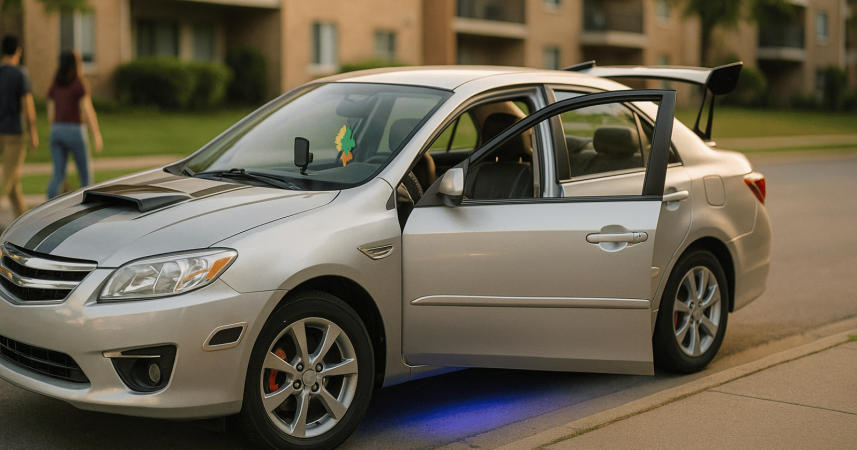
We often dress up our cars to look impressive—yet the very things we add can quietly reveal more about insecurity than success.

Add VegOut to your Google News feed. 
Cars have always been about more than just getting from point A to point B.
They’re rolling symbols of who we are—or at least who we want to be. That’s why families will sometimes spend more on accessories and add-ons than on regular maintenance. The thinking goes: if I dress up my ride, people will see me as successful, stylish, maybe even enviable.
The reality? Most of these modifications don’t land. Instead of admiration, they trigger eye rolls, confusion, or in some cases, pity. Because what actually impresses people isn’t loud or flashy—it’s subtle, functional, and authentic.
Here are seven things I’ve seen (and sometimes cringed at) that don’t impress anyone the way their owners hope they will.
1. Oversized spoilers
Ever sat at a stoplight behind a decade-old sedan rocking a spoiler so massive it looks like it was borrowed from a jet?
Spoilers are designed for one purpose: keeping high-performance cars glued to the road at race-track speeds. On a Toyota Camry or minivan? They serve no aerodynamic function whatsoever.
What they do instead is broadcast insecurity. Psychologist Thorstein Veblen coined the term conspicuous consumption to describe exactly this: purchases meant to show off status rather than serve utility. The oversized spoiler doesn’t say, “I’m a racer.” It says, “I want you to think I’m one.”
And here’s the kicker: instead of being impressed, most onlookers assume the driver is compensating for something—usually a lack of actual performance under the hood.
2. Fake luxury badges
I once parked next to a Honda Civic with a glued-on Mercedes emblem. For a split second I thought my eyes were playing tricks.
No one is fooled by these fake badges. People know a Lexus from a Kia, a BMW from a Nissan. The badge swap doesn’t elevate the car—it cheapens it.
As noted by consumer psychologist Kit Yarrow, “When people sense inauthenticity in products, they often project that same inauthenticity onto the person.” That’s the danger here: instead of being admired, the driver comes off as someone trying too hard.
If you’ve ever traveled through places where knockoff fashion is everywhere (I saw this in parts of Southeast Asia), you’ll recognize the same pattern. A fake Rolex doesn’t say wealth. It says I couldn’t afford the real thing. Same with car badges.
3. LED underglow lights
When The Fast and the Furious first hit theaters, underglow lights had a moment. Every teenager wanted their car to look like it rolled out of a Tokyo street race.
But here’s the truth: outside of that fantasy, neon lighting doesn’t make your car look futuristic—it makes it look dated. Today, they’re the visual equivalent of frosted tips: a trend that had its time but doesn’t belong in 2025.
Worse, they can be distracting and even illegal in some states. Instead of drawing admiration, they draw police attention and groans from drivers stuck next to a rolling light show.
There’s a psychological angle here too. Bright neon is the epitome of “costly signaling”—an attempt to scream for attention in environments where subtlety would earn more respect.
4. Giant subwoofers rattling the trunk
I love music. I grew up writing about indie bands, I still photograph live shows when I can, and I’m the guy who tweaks playlists for long road trips. So I get it—sound matters.
But I’ve also ridden in cars where the bass was so heavy the mirrors shook, and every song sounded like a muffled thunderstorm. The driver thought it was impressive. Everyone else thought it was unbearable.
Psychologist Adrian North, who’s studied how music is used for social identity, put it bluntly: “When people impose their music loudly on others, it communicates dominance rather than taste.” That’s exactly what giant subwoofers do.
The irony is that most of these systems don’t even produce good sound. They emphasize bass at the expense of clarity. A balanced stereo with mid-range detail will impress music lovers far more than a trunk that rattles at stoplights.
5. Seat covers with flashy logos
I once climbed into a car where every seat was covered in knockoff Louis Vuitton fabric. For a second, I thought I’d been swallowed by a counterfeit handbag.
The intent was obvious: luxury by association. But instead of signaling wealth, it signaled insecurity. People who actually buy luxury cars don’t need to plaster logos across their interiors.
Research backs this up. A 2019 study in the Journal of Consumer Psychology found that using counterfeit luxury items can backfire, lowering how trustworthy and competent the owner is perceived. In other words, fake logos don’t just fail to impress—they actively harm social perception.
A spotless, uncluttered car interior makes a far better impression than seats covered in synthetic designer print.
6. Chrome stick-on accessories
Every auto parts aisle has them: stick-on chrome handles, mirror covers, gas caps. For a few bucks, you can turn any car into a “luxury” model—or so the marketing says.
In practice, they rarely line up perfectly, they bubble after a year in the sun, and they scream “cheap add-on.” Chrome is one of those materials where quality shows. The factory-installed chrome on a Jaguar looks polished and intentional. The adhesive chrome on a budget sedan looks exactly what it is: pretend.
I’ve mentioned this in another post, but authenticity always trumps imitation. People respect a car for what it actually is—not what you try to make it look like.
7. Dashboard screens that don’t integrate
Technology can make cars better. A seamless infotainment system with CarPlay or Android Auto? Genuinely useful. A bulky, aftermarket screen stuck onto the dash with Velcro? Not so much.
I’ve ridden in cars where these add-ons froze mid-navigation, lagged on every touch, and cut out during phone calls. Instead of “modern upgrade,” they felt like distractions.
As noted by MIT researcher Sherry Turkle, “Technology should be a tool that extends us, not something that frustrates and interrupts.” When it comes to cars, integration is everything. If the screen doesn’t feel native, it doesn’t feel impressive—it feels awkward.
The psychology behind it all
So why do people keep installing these things? It comes down to status signaling. Families in the lower-middle-class bracket often face social pressure to “keep up” or appear more successful than their financial reality allows.
Cars become the canvas for this performance. They’re visible, mobile, and highly associated with status in American culture. But here’s the paradox: the more obvious the attempt, the less effective it is.
True status isn’t loud—it’s subtle. It’s the quiet confidence of driving a well-maintained, clean, authentic car without the need for glued-on logos or neon distractions.
The bottom line
Cars reflect identity, but they also reveal effort. When the effort is too obvious, it backfires.
Oversized spoilers, fake badges, neon underglow, rattling subwoofers, flashy seat covers, stick-on chrome, and clunky dashboard screens don’t earn respect. At best, they’re ignored. At worst, they invite ridicule.
The real flex? A car that runs well, looks clean, and feels authentic. That’s what people actually notice.
And if you really want to impress? Skip the spoiler. Take care of the basics. Authenticity beats imitation every single time.
If You Were a Healing Herb, Which Would You Be?
Each herb holds a unique kind of magic — soothing, awakening, grounding, or clarifying.
This 9-question quiz reveals the healing plant that mirrors your energy right now and what it says about your natural rhythm.
✨ Instant results. Deeply insightful.

Jordan Cooper
Jordan Cooper is a pop-culture writer and vegan-snack reviewer with roots in music blogging. Known for approachable, insightful prose, Jordan connects modern trends—from K-pop choreography to kombucha fermentation—with thoughtful food commentary. In his downtime, he enjoys photography, experimenting with fermentation recipes, and discovering new indie music playlists.
More Articles by Jordan