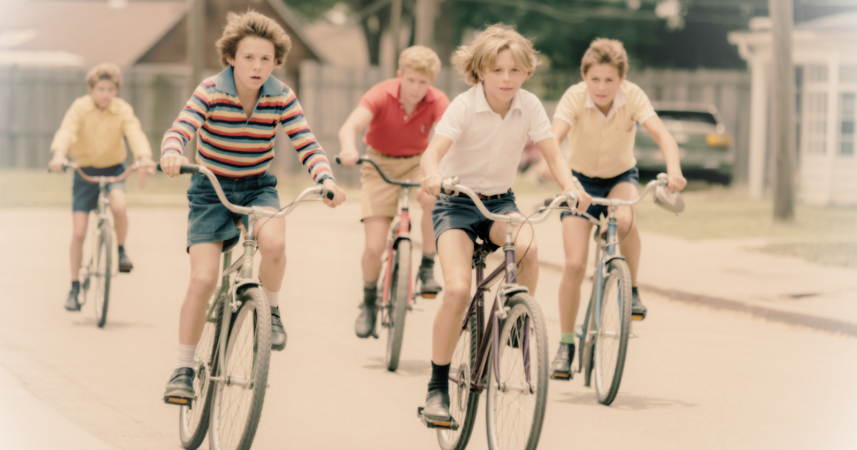
While today's kids learn resilience through structured activities and emotional support, those who grew up in the 60s and 70s discovered it accidentally—through burns from stoves nobody childproofed, engines they dismantled without manuals, and problems they solved because no one else would.
My fourteen-year-old hands smelled like chicken fat and oregano for most of 1978. Every day after school, I'd walk straight to my uncle's diner kitchen and start prepping vegetables without being asked. Nobody taught me knife skills—I just watched the line cooks and copied their movements until my julienne looked like theirs. When I sliced my thumb open (twice), the dishwasher showed me how to superglue it shut and keep working. That was the entire safety training program.
The education that happened between catastrophes
Looking back, the most valuable things I learned came from disasters nobody prevented. The summer I turned fifteen, I decided to build a treehouse using scrap lumber from a construction site. No plans, no supervision, just a hammer I "borrowed" from the garage and determination. It collapsed three times before I figured out triangular bracing. The fourth version lasted until I left for college.
The restaurant kitchen became my real classroom by age sixteen. Not because anyone decided I should learn, but because help was needed and I was there. I learned fractions by scaling recipes, chemistry by watching oil temperatures, time management by juggling multiple orders. The burns taught me respect for heat, the cuts taught me respect for sharp edges, and the dinner rush taught me that panic is a luxury you can't afford when tickets are piling up.
When I was seventeen, I decided to fix a friend's motorcycle despite knowing little to nothing about engines. I took it apart completely, spread the pieces across the garage floor like a metal jigsaw puzzle, and spent three weeks trying to remember where everything went. The bike never ran quite right again, but I learned how combustion engines work, how to read repair manuals, and most importantly, that taking something apart doesn't mean you can put it back together.
The kitchen taught parallel lessons. My first attempt at hollandaise broke into greasy puddles. Nobody rushed in to fix it or explain emulsification. I just stood there, staring at the mess, until the sous chef grunted, "Too hot. Start over." By the fifth batch, I could make hollandaise in my sleep. The lesson wasn't just about sauce—it was about persistence, observation, and the willingness to waste eggs until you got it right.
Problem-solving was the only option
Experts note that "Children who learn to solve problems independently develop stronger critical thinking, better emotional regulation, and a deeper sense of self-efficacy".
No surprise there. We didn't need research to tell us this. We lived it every time the washing machine broke and calling a repairman meant not eating for a week.
I remember the winter our furnace died. My father and I spent an entire Saturday with the thing in pieces on the basement floor, comparing each part to diagrams in a library book. We fixed it with a part from a junkyard and electrical tape. It ran for another eight years. That kind of problem-solving—desperate, creative, mandatory—shaped how an entire generation thinks.
The cost of unlimited freedom
But here's what nobody talks about: we also learned some terrible habits. We learned to hide injuries because complaining meant you were weak. We learned to work through pain because stopping meant falling behind. We learned that asking for help was failure, that vulnerability was dangerous, that emotions were something to be managed alone, preferably with alcohol.
The same independence that made us resourceful also made us isolated. I spent eleven years in my first marriage never once admitting I was struggling with the restaurant's finances, with exhaustion, with the weight of keeping everything afloat. My generation confused self-reliance with stubborn silence.
Passing on the useful, leaving behind the damage
Now I watch my granddaughter in my kitchen, standing on a stepstool, carefully measuring ingredients for Saturday morning vegan pizza. She's learning. But she's learning with safety guards on the stove and cut-resistant gloves, with encouragement to ask questions and permission to make mistakes without shame.
The balance is delicate. I want her to know the satisfaction of solving her own problems, but not the loneliness of never asking for help. I want her to build competence through experience, but not the scars that come from preventable injuries.
This is what my generation missed—we learned skills in isolation, through necessity, often alone. The next generation can learn the same skills through connection, with guidance that doesn't remove the challenge but provides a safety net.
Final words
Every generation thinks the ones after it are softer, less capable. But capability isn't just about toughness—it's about adaptation. My generation adapted to a world that required physical problem-solving and emotional suppression. The current generation adapts to a world requiring technological fluency and emotional intelligence.
The tragedy isn't that kids today don't learn the way we did. The tragedy would be losing the core lesson entirely: that humans are capable of figuring things out, that competence comes from practice, that the best education happens when you're allowed to try, fail, and try again.
The answer isn't to recreate the benign neglect of our childhoods. It's to preserve the freedom to experiment while adding the support we wished we'd had. Let them touch the stove, but be there when they do. Let them fail, but help them process the failure. Let them solve problems, but show them it's okay to ask for help.
Because in the end, the most valuable thing my generation learned wasn't any particular skill. It was the deep knowledge that we could learn anything we needed to, given time and necessity. That's the gift worth passing on—wrapped in a bit more bubble wrap, perhaps, but intact.
What’s Your Plant-Powered Archetype?
Ever wonder what your everyday habits say about your deeper purpose—and how they ripple out to impact the planet?
This 90-second quiz reveals the plant-powered role you’re here to play, and the tiny shift that makes it even more powerful.
12 fun questions. Instant results. Surprisingly accurate.