How someone responds to a minor frustration—like a wrong order at a restaurant—reveals their genuine emotional control far more honestly than any meditation practice or wellness routine they claim to follow.
In structural engineering, the strength of a bridge is never truly measured on a calm day. You test it under load, under wind, under the kind of stress that reveals whether the materials hold or fracture. The same principle applies to people, and the load-bearing test happens in the most ordinary settings imaginable: a restaurant table, a wrong entrée, and the thirty seconds that follow.
The conventional take on emotional regulation is that it's something you build through deliberate practice. Meditation apps, journaling prompts, breathwork sessions. And there's real science behind those tools. But the popular framing has a blind spot: it conflates the practice of emotional regulation with the performance of it. Someone can talk eloquently about mindfulness, own a singing bowl, and still berate a twenty-year-old server over a misplaced side of ranch. The gap between those two versions of a person is where the actual information lives.
That gap deserves more attention than it gets, because it tells us something about how emotional regulation actually works, what it looks like when it fails, and why the moments we dismiss as "small" are often the most revealing ones we'll ever witness.
What emotional regulation actually is (and isn't)
Emotional regulation is an executive function. It's the brain's ability to manage its own responses to stimuli, especially when those stimuli are unwanted. Research indicates that this function sits alongside working memory, cognitive flexibility, and impulse control as one of the core capacities that determines how well we perform under pressure. It's not about suppressing feelings. It's about the speed and quality of the bridge between feeling something and doing something about it.
A wrong order triggers a small cascade. There's surprise. There's the mild frustration of unmet expectation. Maybe there's hunger sharpening the edges. None of that is unreasonable. The question is what happens next.
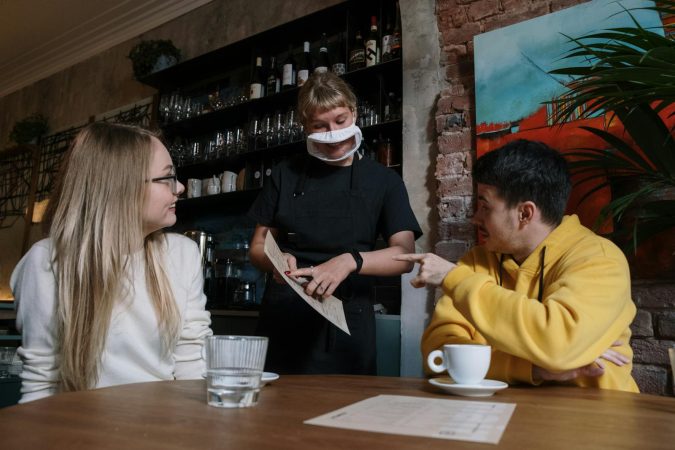
Does the person flag the server with a small wave and a clear, direct correction? Or does their voice tighten? Do they sigh theatrically? Do they speak to the server the way you'd speak to someone you hold responsible for a personal offense?
The behavior in that window isn't about the food. It's a readout of how someone processes disappointment when the stakes are almost nonexistent. And if the stakes are low and the reaction is high, that tells you something no amount of self-reported mindfulness can override.

The problem with self-reported calm
We live in a moment where emotional vocabulary has expanded dramatically. People can name their relationship patterns. They can identify thinking traps. They know the difference between a boundary and a wall. This is genuinely good. But fluency in the language of emotional health is not the same thing as emotional health itself.
Research suggests that mindfulness involves shifting from distraction and autopilot to being present and intentional, a principle reflected in the University of Utah's Mindfulness in Medicine Toolkit and their S.T.O.P. method (Stop, Take a breath, Observe, Proceed with more awareness) is designed for exactly the kind of high-pressure moments where automatic reactions take over. But notice the design: it's built for healthcare workers dealing with patient deaths and medical mistakes. The tool exists precisely because knowing about mindfulness doesn't automatically produce mindful behavior when things go sideways.
That distinction matters enormously in everyday life. The person who meditates every morning and then snaps at a barista isn't a fraud, necessarily. They might be someone whose practice hasn't yet transferred from the cushion to the counter. But if you're evaluating someone's actual capacity for regulation, the counter is where you look. Not the cushion.
Why low-stakes moments are high-information moments
There's a reason people pay such close attention to how a date treats the waitstaff. It's become almost cliché as dating advice, but the instinct behind it is psychologically sound. As we've previously explored, how someone treats people who can do absolutely nothing for them is one of the clearest indicators of character available.
But I want to push that idea further. It's not just about character in some fixed, moral sense. It's about regulation capacity, which is more dynamic and more specific.
A person can have wonderful character and still have poor regulation in certain contexts. Fatigue degrades it. Hunger degrades it. Chronic stress degrades it. The reason a wrong order is such a useful test isn't that it reveals who someone "really is" in some permanent way. It reveals who they are right now, in this moment, under this specific kind of minor friction. And that's actually more useful information than some grand character assessment, because regulation is what determines whether someone can be a safe, steady presence when life gets harder than a wrong order.
This is the pivot point: regulation isn't a trait you possess — it's a performance you deliver, or don't, under load.
My father is an architect. He designs spaces with this kind of thinking: you don't just plan for the ideal conditions, you plan for the stress cases. What happens when the building settles? When the ground shifts slightly? The aesthetic is only as good as the structure beneath it. People work the same way.
The physiology underneath the behavior
When a wrong order arrives, the body's autonomic nervous system responds before any conscious thought takes shape. The sympathetic branch activates. Heart rate nudges upward. Breath might shorten. This is not a character flaw. It's biology.
What differs between people is what happens after that initial spike. A systematic review published in Frontiers in Human Neuroscience, discussed by Psychology Today, found that slow breathing directly shifts the balance from sympathetic to parasympathetic nervous system activation. Research suggests that regular slow nasal breathing practices can measurably affect stress, mood, and physical health. The mechanism is real: the vagus nerve responds to breath patterns, and that response cascades into changes in heart rate variability, cortisol levels, and emotional reactivity. So the person who pauses, takes a breath, and calmly tells the server about the mix-up isn't just being "nice." They're doing something physiologically different. Their nervous system is completing a different circuit than the person who immediately escalates. And this isn't abstract — it's measurable, repeatable, and visible in real time to anyone paying attention at the table.
And the research on breathwork and stress reduction confirms that this isn't just a personality trait you're born with. It's trainable. The capacity to regulate under minor frustration can be built, the same way physical endurance can be built. But like physical endurance, it only improves through actual practice under actual load. Reading about running doesn't make you faster.
When the system breaks down
There's a concept called emotional gridlock that applies here. CEO World describes it as what happens when unresolved emotional patterns quietly undermine decision-making and relationships. It's the internal logjam that makes someone react to a wrong salad as though it were a personal betrayal. The gridlock isn't about the salad. It's about accumulated frustration, unprocessed stress, or old patterns of feeling unseen or disrespected that get triggered by anything resembling being overlooked.
This is where compassion becomes relevant, but not in the way it usually gets deployed in these conversations. The compassionate response isn't to excuse the behavior. It's to understand the mechanism. Someone who snaps at a server is almost certainly not having their best day, their best week, or their best year. The behavior is information about internal pressure, not about the quality of the risotto.
But understanding the mechanism doesn't mean accepting the behavior, particularly when it's directed at someone in a service position who has limited power to push back. The structural imbalance in a server-customer interaction is exactly what makes it so revealing. When someone has the social permission to be rude without consequences, their choice in that moment is pure signal.

The micro-signals worth reading
I spend a lot of time observing. It's an occupational habit that predates any professional obligation. Growing up between two cultures, two cities, two different family approaches to everything from abundance to emotional expression, I learned early to watch how people behave when they think the moment doesn't count.
At a restaurant, when the wrong dish lands, here's what I notice: the first three seconds. That's the window. Before social scripts kick in, before someone remembers they're being watched. The face does something involuntary. The shoulders do something. Some people's bodies barely register the disruption. Others tighten like a fist.
Neither reaction is morally superior in that first flash. The body does what it does. But what follows those three seconds is a choice, and the choice is the whole story.
Beyond that initial window, though, the specifics are worth cataloging, because they separate garden-variety annoyance from something more telling. Watch for displaced aggression: the person who says nothing to the server but then spends ten minutes complaining to the table, poisoning the mood for everyone. Watch for recruited allies: the person who turns to you and says, "Can you believe this?" — seeking validation for a reaction they sense is disproportionate. Watch for the tone shift: someone whose voice stays the same volume but drops in temperature, becoming clipped and formal in a way that's designed to make the server feel small without technically saying anything rude. These are all regulation failures wearing the costume of composure.
The most sophisticated version is the person who is perfectly polite to the server and then punishes them silently through the tip. That's not regulation. That's delayed retaliation dressed up as restraint, and it reveals someone who manages their image better than their impulses.
As we've written before, the way someone treats the person serving their food tells you more than any formal evaluation ever could. The wrong-order moment is just the sharpest version of that test, because it adds frustration to the equation. The question moves from how do you treat people with less power? to how do you treat people with less power when you're also annoyed?
Building the muscle where it actually matters
If you recognize yourself as someone who doesn't always handle these moments well, that recognition alone is worth something. Emotional regulation isn't a personality type. It's a skill with a physiological basis, and it responds to training.
The University of Utah's toolkit recommends something almost absurdly simple: three mindful breaths. Not a twenty-minute meditation. Not a retreat. Three breaths taken with conscious attention. The research on slow breathing and vagal nerve activation supports this. Studies have shown that slow-paced breathing can increase cardiac vagal activity. Your nervous system can shift in under a minute if you give it the right input.
The trick is remembering to do it in the moment, which is exactly why the low-stakes situations are the best training ground. A wrong order at brunch is a perfect place to practice, because nothing is actually at risk. No one is in danger. Nothing irreversible has happened. It's a free repetition.
Treat it like one. Notice the flash of irritation. Take the breath. Choose the response. Do it enough times at brunch, and the pattern starts showing up in the moments that actually matter: a conflict with a partner, a misunderstanding with a colleague, a disappointment that carries real weight.
If you want to make this concrete, here are three techniques that work not because they're clever but because they're physiologically grounded and simple enough to use in real time:
The five-second name-and-release. When the wrong plate arrives and you feel that internal tightening, silently name the emotion in one word. Frustrated. Annoyed. Hungry. Research on affect labeling suggests that the simple act of naming an emotion reduces amygdala activation — it's a circuit breaker between the feeling and the reaction. Once you've named it, you've created a sliver of distance. That sliver is where the choice lives.
The role reversal pause. Before you speak, take two seconds to imagine you're the server. Not in a sentimental way — in a mechanical one. They're carrying six plates, tracking four tables, and making eleven dollars an hour. The wrong dish is almost certainly not their fault, and even if it is, your response is about to become the most significant thing that happens to them in the next ten minutes. That two-second reframe doesn't require sainthood. It just requires the willingness to briefly hold someone else's reality alongside your own.
The tone-match test. Before you say anything about the order, ask yourself: would I use this exact tone with someone I respect who made a small mistake? Not someone you love. Not your boss. Just someone you respect. If the tone you're about to use wouldn't survive that test, adjust it. This isn't about performing niceness. It's about using your own standards as a real-time calibration tool, catching the moments when irritation is steering your voice before it reaches someone who doesn't deserve it.
The real mindfulness test has no cushion
There's nothing wrong with meditation apps. There's nothing wrong with breathwork classes or mindfulness retreats. These tools have real, measurable effects on the nervous system and the brain. The research is solid.
But the transfer problem is real. A practice is only as good as its application, and application happens in the wild, not in controlled settings. The restaurant, the grocery checkout, the customer service call. These are the uncontrolled environments where your actual regulation shows up or doesn't.
The way someone treats a server when the order comes out wrong is a thirty-second window into years of accumulated habits, unresolved stress, practiced or unpracticed self-awareness, and the fundamental question of whether someone can hold mild discomfort without passing it on to the nearest available target. It's not everything about a person. But it's not nothing.
So here's the uncomfortable question: the last time your order came out wrong — not the version you'd narrate to a friend, but the actual unedited moment — would the server describe your reaction the same way you would?
If You Were a Healing Herb, Which Would You Be?
Each herb holds a unique kind of magic — soothing, awakening, grounding, or clarifying.
This 9-question quiz reveals the healing plant that mirrors your energy right now and what it says about your natural rhythm.
✨ Instant results. Deeply insightful.

Elena Santos
She/Her
Elena Santos is a writer and former sustainable fashion designer based in Brooklyn, New York. She studied environmental design at the Rhode Island School of Design, where she developed a deep interest in sustainable material systems and traditional craftsmanship. After working at a Brooklyn-based sustainable fashion startup, she spent a year traveling through Central America writing about Indigenous textile traditions, an experience that fundamentally reshaped her understanding of what sustainability actually means in practice.
At VegOut, Elena writes about sustainability, food culture, and plant-based living through the lens of design, tradition, and cultural preservation. Her Brazilian and Cuban heritage informs a perspective that connects food systems to broader questions about identity, community, and how cultures sustain themselves across generations.
Elena maintains a small Instagram account documenting textile craftsmanship and Indigenous knowledge systems. She does her best writing early in the morning in quiet coffee shops, before the day gets complicated. She believes sustainability is not a trend but a return to how people have always lived when they paid attention.
More Articles by Elena