The running commentary about your body doesn't stop because you've learned to love how you look—it stops when you realize you don't have to listen to the broadcast at all.
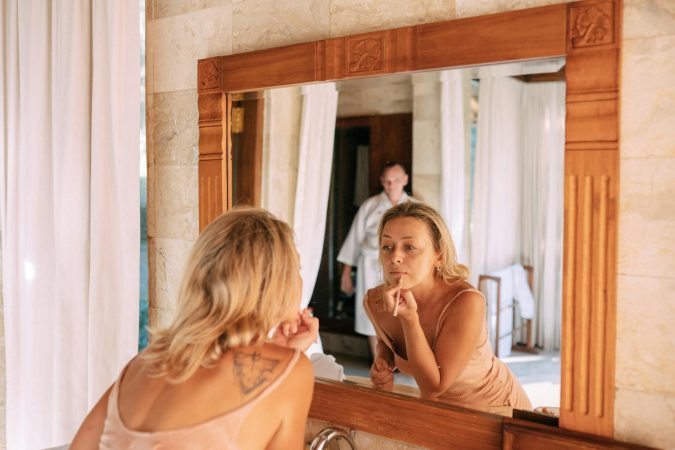
She catches herself in the mirror while reaching for a mug on the top shelf, and for a fraction of a second her brain fires off a small, silent report: the way her shirt rides up, the strip of skin above her waistband, the angle of her arm. She doesn't stop to admire or criticize. The assessment just happens, automatic as blinking, a running ticker of appearance data she never asked for and never consciously turned on. Then the coffee's poured and she's moved on, except some version of that broadcast has already played forty times before noon. By the time she sits down at her desk, she's reviewed her jawline in the bathroom mirror, registered her posture in the hallway's glass door, and silently catalogued the way her jeans fit differently than they did last Tuesday. She couldn't recall a single one of these moments if you asked. That's the point. The narration runs below the threshold of intention, burning cognitive fuel like an app you forgot to close.
Most of us carry this internal narrator around without questioning it. We assume that people who look relaxed in their skin got there by winning some private argument with the mirror, by finally deciding they were beautiful. The conventional wisdom says body confidence comes from learning to love what you see. The body positivity movement built an entire vocabulary around that idea: affirm yourself, celebrate your shape, find the beauty in every angle.
But a growing number of people are pushing back on that framework, and their objection isn't cynical. It's practical. Critics of body positivity argue that it can lead to an unhealthy focus on appearance while disguising it as self-improvement. The ask to love your body at all times can become its own trap, because it still requires you to keep looking, keep evaluating, keep narrating.
The people who actually seem at ease? A lot of them didn't win the narration game. They left it.
The broadcast you didn't know was running
Psychologists have a term for the casual, almost reflexive way we talk about bodies: appearance talk. Studies have documented this phenomenon since the late 1990s, and a body of work has confirmed what most people intuitively sense. The way we comment on bodies, our own and others', shapes how we feel inside them.
What's less obvious is that the most damaging version of appearance talk isn't necessarily the conversation you have with your friend over lunch. It's the one you have with yourself, silently, on repeat. Research shows that even passively listening to body-critical language increases dissatisfaction. Extrapolate that finding inward: if hearing someone else narrate your appearance affects how you feel, imagine the effect of narrating your own appearance to yourself hundreds of times a day.
The narration often disguises itself as neutral observation. My arms look weird in this. I look tired. That angle is unflattering. None of these feel like attacks. They're just reports. But stacked together across a morning, they form a constant feedback loop that keeps your appearance at the center of your awareness, crowding out almost everything else your body is doing.

And your body is doing a lot. Breathing. Digesting. Sensing temperature. Registering sound. Keeping you upright. The question worth sitting with is: what happens when you start paying attention to those signals instead?
Bodies that feel, not just bodies that look
Research suggests that people who reported stronger awareness of internal bodily signals, a capacity called interoception, also tended to have better sleep, improved emotional regulation, and a more balanced relationship with time itself. Studies on embodied consciousness describe a model where your sense of being alive comes not just from neural activity but from an ongoing feedback loop between your body's internal signals and your cognitive sense of past, present, and future.
In practical terms, people who could feel their heartbeat, notice their hunger, register the weight of their own hands on a table were less likely to be mentally stuck in negative experiences. They reported better sleep quality. Some reported improved digestion. If your conscious experience of your body is occupied by how you look, there's less bandwidth for how you feel. The internal narrator isn't just annoying. It may be actively displacing a different, more grounding kind of body awareness.
The people who seem most comfortable in their bodies might not have better mirrors. They might have better interoception. They're tuned into the sensation of standing on cold tile, the rhythm of their breathing after climbing stairs, the warmth of a mug between their palms. Their body is something they inhabit rather than something they watch from the outside.
Why "just love yourself" misses the mechanism
The body positivity movement started from a real and important place. Marginalized bodies, fat bodies, disabled bodies, Black and brown bodies, needed visibility and affirmation in a culture that treated them as problems to solve. That foundation matters.
But as the movement scaled into mainstream wellness culture, something shifted. The message became less about structural inclusion and more about individual feeling. "Love your body" became the new mandate. And mandates, even kind ones, can backfire.
Body neutrality emerged as a counterpoint. Body neutrality advocates emphasize that weight doesn't determine a person's worth and that fat shouldn't be viewed as inherently negative. The distinction matters. Body positivity says: look at your body and find it beautiful. Body neutrality says: maybe stop making your body the main character of every internal scene.
When the goal is an emotion—love, admiration, gratitude—you're still evaluating. You've just changed the expected outcome of the evaluation from negative to positive. The narration continues. The camera stays on. Turning the camera off is a different project entirely.
What turning the camera off actually looks like
I notice this most at the weekend flea markets I wander through in Brooklyn. There's always someone, usually older, moving through the stalls with a kind of physical ease that has nothing to do with how they'd photograph. They pick up a ceramic bowl and turn it in their hands. They lean into a rack of vintage shirts and pull one out by texture, not by how it might look on them. Their attention flows outward, toward the objects and people around them, not inward toward an imagined audience.
That's what it looks like. It's not confidence. It's absorption. The body becomes the vehicle, not the subject.
Compare that to the way many of us move through the same kind of space. Catching our reflection in a shop window. Adjusting a shirt. Wondering if the person across the table is noticing the thing we noticed in the mirror that morning. The narration eats up real estate in your day that could go toward tasting food, hearing music, feeling the weather on your face.
Research on body image increasingly frames body dissatisfaction as a belonging problem, not just an appearance problem. When people feel disconnected, when they sense they don't fit, the body becomes a convenient explanation. The thought that one would belong if they looked different becomes a convenient narrative. The narration intensifies because it's serving a social function: scanning for the reason you feel like an outsider.
Growing up between São Paulo and Miami, I was always slightly out of place in both directions. Too American in Brazil, too Brazilian in the States. That permanent outsider feeling found its way into how I dressed, how I held myself, the silent commentary track that ran while I figured out which version of me each place wanted. It took years to realize the narration wasn't protecting me. It was keeping me on surveillance duty inside my own body.

The commercial incentive to keep you watching
There's a reason the narration is so hard to shut off, and it isn't just psychological. Entire industries depend on you maintaining a running evaluation of your appearance. Skincare. Fashion. Fitness. Cosmetic procedures. And now, pharmacology.
A recent study on GLP-1 weight loss drugs found that young adults with higher body shame and weight concerns were significantly more likely to consider taking medications like semaglutide, despite their side effects. The only protective buffer? Strong body appreciation. People who had developed a sense of their body as functional and worthy, rather than as a visual project, were less drawn to pharmaceutical fixes.
That finding is worth pausing on. The difference between wanting the drug and not wanting it wasn't body size. It was whether the person had learned to stop treating their body as a problem to be solved visually. The narration itself was the risk factor.
When you understand this, the commercial ecosystem looks different. Every ad, filter, and "before and after" image isn't just selling a product. It's reinforcing the habit of narration. It's whispering: keep watching yourself. Keep scoring. Keep reporting.
The most sustainable response isn't better self-talk. It's less self-talk. Not silence born from suppression, but the natural quiet that comes when your attention is genuinely elsewhere—on the taste of something, the texture of a fabric under your fingers, the structure of a life that doesn't constantly demand you perform.
Practice, not revelation
None of this arrives as a single epiphany. The people who move through the world with ease didn't wake up one morning free of the narrator. They built the skill the way you build any skill: through repetition, failure, and a slow rewiring of default settings.
Research on interoception hints at one pathway. Practices that increase awareness of internal body signals—things like mindfulness, breathwork, or simply paying attention to the feeling of your feet on the ground—can shift the ratio of appearance-based awareness to sensation-based awareness. Studies suggest this kind of body-signal attention may even improve sleep and emotional stability, a bonus most affirmation routines don't deliver.
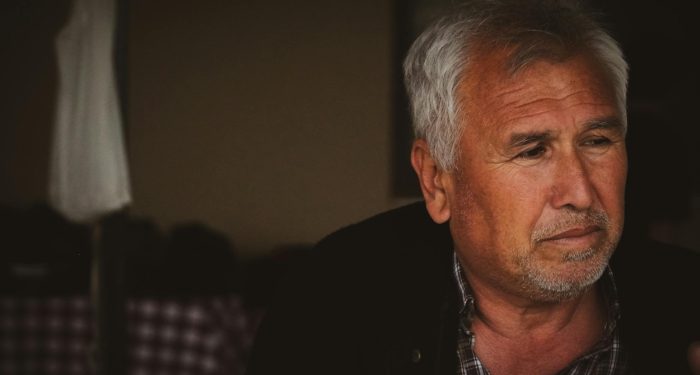
Another pathway is environmental. If appearance narration intensifies in certain contexts—mirrors, social media, certain social groups—then reducing exposure to those contexts can quiet the narrator faster than any mantra. The people over 60 who look most striking tend to be the ones who stopped performing youth and started wearing their actual lives on their faces.
And there's a social pathway. Research on appearance talk shows that challenging or redirecting body commentary in conversation can reduce its frequency over time. When one person in a friend group stops engaging in body narration, it changes the group's default script. The narrator feeds on social reinforcement. Starve it of that reinforcement and it gets quieter.
The quiet underneath
What's on the other side of the narration? Not self-love, necessarily. Not even self-acceptance in the greeting-card sense. Something less dramatic and more useful: presence.
Your hands working dough. The way cold water feels on your wrists. The specific weight of your body in a chair at the end of a long day. These aren't affirmations. They're experiences. And they're available right now, underneath the broadcast, waiting for you to tune in.
The people who seem most at ease didn't necessarily resolve their relationship with the mirror. They just stopped checking it so often. Not out of avoidance. Out of being genuinely occupied with the texture of being alive.
That's the shift. Not from hating your body to loving it. From watching your body to living in it.
If you want to start somewhere, start small. Tomorrow morning, pour your coffee and before the narrator can file its first report, feel the heat of the mug against your palm. Notice the weight of it. The steam rising. Stay with that for ten seconds. You won't have silenced anything. You'll just have, for a moment, tuned to a different channel—the one where your body isn't a thing to be looked at but a thing that's doing the looking. That channel has been playing all along. It's just been drowned out by the noise.
The narration won't disappear overnight, and it doesn't have to. What changes is the ratio. More moments spent inhabiting your senses, fewer spent surveilling your reflection. More attention flowing outward toward the world, less circling back to an imagined audience. Over time, the quiet patches grow wider. The ticker slows down. And you discover something the mirror never could have shown you: that the most comfortable relationship with your body isn't an opinion about it. It's the freedom to forget you have one.
What’s Your Plant-Powered Archetype?
Ever wonder what your everyday habits say about your deeper purpose—and how they ripple out to impact the planet?
This 90-second quiz reveals the plant-powered role you’re here to play, and the tiny shift that makes it even more powerful.
12 fun questions. Instant results. Surprisingly accurate.