Accepting your changing appearance isn't about giving up—it's about stopping the exhausting performance of maintaining a version of yourself that no longer exists.
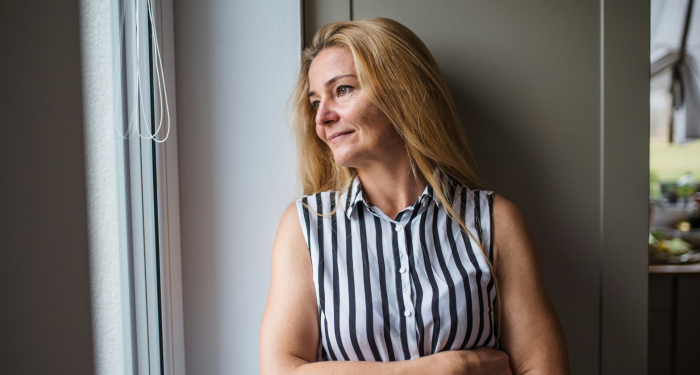
Keiko was sixty-three when she stopped dyeing her hair. She told me she'd spent thirty years covering her grays every six weeks, and the morning she quit wasn't some grand epiphany. She just got tired. Tired of maintaining an image of a younger self that no longer existed, of performing a version of herself for no one but herself. She ordered another oat milk latte. The light shifted. She looked exactly her age, and it suited her completely.
The conventional wisdom around aging well usually sounds like a battle plan. Fight wrinkles. Combat sagging. Defy your years. The language is militaristic on purpose: it frames the passage of time as an enemy to be defeated, and your older face as a loss to be mourned. Entire industries depend on this framing. The global anti-aging market has grown into a multibillion-dollar industry, and it keeps growing because the message works: you were better before, and for the right price, you can get back there.
But what if the mechanism that makes aging feel so painful has less to do with the physical changes themselves and more to do with the specific type of comparison we're running?
The comparison that ages you fastest
Most conversations about body image focus on comparing yourself to other people. Your neighbor's jawline, a celebrity's skin, a stranger on Instagram. And that comparison is well-documented as harmful. Research on body image and social media has shown that exposure to narrow, idealized beauty standards, whether from traditional media or digital platforms, consistently correlates with lower body satisfaction across genders and age groups.
But there's a quieter, more private version of this comparison that doesn't get talked about as much. It's the one you run against yourself. Not yourself versus someone else, but yourself now versus yourself at twenty-four.
Psychologists have studied this pattern of comparing your present self to your past self, and it operates differently than social comparison. When you compare your face to a model's, some part of your brain can acknowledge the distance, the genetics, the lighting, the filters. When you compare your face to your own wedding photo, there's no escape hatch. That was you. That jawline was yours. Those were your hands without the spots.
The cruelty of it is that you're comparing against something real but irretrievable. You're using your own past as evidence that your present is a decline. And the photograph always wins, because photographs don't age.
What "successful aging" actually means (and who it leaves out)
Gerontology has spent decades trying to define what it means to age well. One influential model from the late 1990s defined "successful aging" as the absence of disease, high cognitive and physical function, and active engagement with life. It became a standard framework. It also became another form of comparison, another benchmark your present self could fail to meet.
And it left a lot of people out. Research from Miami University's Scripps Gerontology Center points out that for millions of older adults who rely on the support of a family caregiver, successful aging is not an individual achievement but a cooperative process. The paper argues that family caregivers are rarely incorporated into theoretical models of successful aging, even though they play a central role in making it possible.
This connects directly to the comparison problem. The popular narrative around "aging gracefully" tends to be hyper-individual: your skincare routine, your mindset, your discipline. It invites you to measure yourself against an ideal of aging that's just as curated and unreachable as that wedding photo. The question worth asking isn't "are you aging gracefully?" It's "what conditions make it possible for someone to stop running backward-looking comparisons in the first place?" Those are different questions, and they lead to very different answers.
The quiet power of stopping the comparison
The people I've watched age with the most ease share one quality. They stopped using their younger face as a benchmark. Not because they don't remember what they looked like, but because they stopped treating that earlier version as the standard against which every morning mirror check is measured.
This isn't denial. It isn't "I don't care how I look." It's a specific cognitive shift: releasing the idea that the best version of your face already happened.
Psychologist Kristin Neff's framework for self-compassion offers a useful lens here. According to the University of Utah Health's Resiliency Center, self-compassion involves three elements: mindfulness (acknowledging what you feel without exaggerating it), common humanity (recognizing that your experience is shared, not uniquely yours), and self-kindness (treating yourself as you'd treat a friend). Research on self-compassion suggests it serves as a powerful source of coping and resilience and that during major life crises, studies indicate that self-compassion during major life transitions appears to significantly impact our ability to survive and thrive.
Aging isn't a crisis in the clinical sense, but it is a slow-motion identity shift. Your face changes. Your body changes. The gap between who you see and who you remember seeing widens every year. Self-compassion doesn't close that gap. It just stops you from treating the gap as evidence of failure.
The Resiliency Center also draws an important distinction between self-compassion and self-esteem. Self-esteem, they note, is usually based on comparison, which makes it vulnerable during moments of perceived failure or loss. Self-compassion doesn't depend on evaluation at all. It doesn't ask "how do I measure up?" It asks "how can I respond to this with kindness?"
That distinction is everything when it comes to aging. Self-esteem says: you still look great for your age. Self-compassion says: your worth was never about how you looked.
The economics of the "younger you" narrative
It's worth pausing to consider who benefits when millions of people walk around comparing themselves to a younger version they'll never be again.
The beauty and wellness industries have a financial interest in keeping that comparison alive. Every before-and-after ad depends on the idea that "before" is a problem. Every anti-aging product promises some version of reversal, return, restoration. The language is always backward-looking. Turn back the clock. Recapture your youth. Get back the skin you had at twenty-five.
This framing sells product, but it also does something subtler: it keeps the finish line behind you. You're not running toward something. You're running back toward a self that no longer exists, which means you can never arrive, which means you'll keep buying.
The people who seem most at peace with their age are often the ones who've opted out of that particular race. Not out of some moral superiority, but because they recognized the math doesn't work. You can't win a game whose goal is to reverse time.
What acceptance actually looks like
There's a popular misread of acceptance that treats it as passivity. As giving up. As letting yourself go. The counterargument worth taking seriously is that some resistance to aging is healthy: staying active, eating well, maintaining social connections. Nobody benefits from nihilism dressed up as wisdom.
But there's a difference between taking care of yourself because you value your body and taking care of yourself because you're trying to freeze a version of it that's already gone. The first is maintenance. The second is grief disguised as a skincare routine.
Research on resilient coping distinguishes between acceptance-based strategies and avoidance-based ones. Acceptance doesn't mean you like what's happening. It means you stop spending energy fighting the reality of it so you can redirect that energy toward something useful. Applied to aging, this might look like moisturizing because your skin is dry instead of moisturizing because you're trying to prevent looking your age. Same action, entirely different relationship to the mirror.
The Greater Good Science Center at UC Berkeley has explored how self-compassion shifts not just individual well-being but broader social attitudes. When people stop evaluating themselves so harshly, they tend to evaluate others less harshly too. The implication for aging is worth sitting with: the way you talk to yourself about your own face ripples outward. It shapes how you see other people's faces, other people's bodies, other people's right to simply look their age.
The version you were never going to keep
I think about Keiko sometimes, sitting in that window. How she described her younger self not as a loss but as a person she used to be. Past tense, the way you'd talk about a city you lived in once and loved but wouldn't move back to.
We treat our younger faces like something that was taken from us. But nothing was taken. A face at twenty-four is no more "yours" than a face at sixty-three. Both belong to you. Both are temporary. The only difference is that one has a longer paper trail of photographs.
The people who age most gracefully aren't performing serenity. They haven't unlocked some secret. They've just stopped running a comparison that was rigged from the start: current face versus past face, with the past face always winning because it exists only as a still image, frozen at its best angle, in its best light, on its best day.
Your memory of how you looked at twenty-five isn't even accurate. It's a highlight reel. You didn't look like your best photo any more than you look like your worst photo now.
There is something quietly radical about a person who walks into a room without mentally apologizing for the distance between their face and its younger version. Not defiant. Not making a statement. Just present. Just there, in a body that has done the perfectly ordinary work of living for a certain number of years, and has no interest in pretending otherwise.
Keiko told me she sometimes misses her dark hair. She said it the way you'd say you miss a restaurant that closed. Fond, not devastated. She recognized the difference between nostalgia and grief, and she'd chosen the lighter one.
The people who flourish in their later decades tend to share this quality. They've made peace not with aging itself, which is abstract, but with the very specific, very personal act of releasing a face. Their face. The one in the photograph on the mantel. The one that exists now only in the past tense.
That release isn't a single event. It's a practice. Some mornings you look in the mirror and you're fine. Some mornings you look in the mirror and you see your mother's jawline emerging and it catches you sideways. Both of those mornings are normal. Both are part of the same slow, imperfect process of letting time be something that happens to you rather than something done to you.
The fight was never winnable. The comparison was never fair. The younger version was never going to stay.
The only face you get to keep is the one you're wearing right now.
What’s Your Plant-Powered Archetype?
Ever wonder what your everyday habits say about your deeper purpose—and how they ripple out to impact the planet?
This 90-second quiz reveals the plant-powered role you’re here to play, and the tiny shift that makes it even more powerful.
12 fun questions. Instant results. Surprisingly accurate.