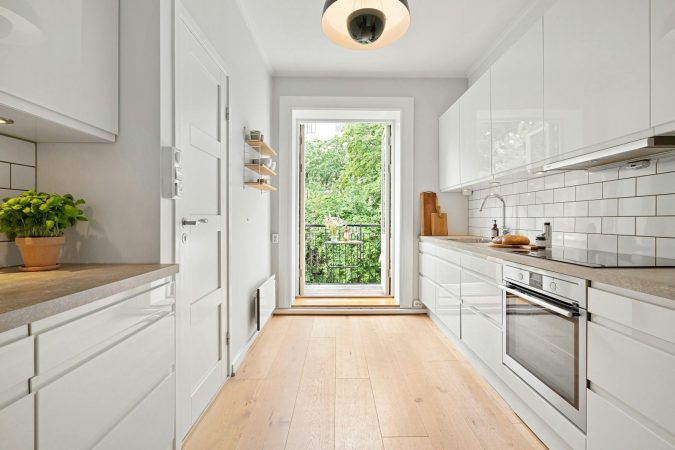
Most people think boundaries are walls to build higher, but the real struggle is keeping the door open after saying no—staying connected while protecting yourself.

Add VegOut to your Google News feed. 
The last time I visited my mother in Stockholm, she asked me to stay an extra week. I'd already been there ten days, sleeping in my old room, folding back into the rhythms of her kitchen — coffee at seven, bread from the bakery on Bondegatan, the radio murmuring Swedish public radio like a second pulse. I loved every minute of it. I also knew that by day eight, I'd started swallowing small irritations instead of naming them. So I said no to the extra week, and then I sat with her for two more hours talking about why I wanted to come back soon. The no wasn't the hard part. Keeping the door open after it — staying warm, staying connected, staying present — that was the work.
That's the distinction most boundary advice misses entirely. A boundary and a wall are not the same structure. The difference is the door — the functional, operational part that opens and closes, that requires a hand on the knob, a choice, repeated action. A wall is built once. A door is used daily. And most people who struggle with boundaries aren't struggling to build them. They're struggling to include the door.
What does the door look like in practice? It looks like saying "I can't do that, but here's what I can do." It looks like declining an invitation and suggesting an alternative. It looks like telling someone their behavior hurt you and then — this is the part most boundary advice skips — staying in the room long enough to hear their response.

Why walls feel safer than doors
Most popular advice about boundaries treats them as construction projects. Build the wall. Hold the line. Protect your energy. The language is architectural and defensive, and it resonates because so many people have spent years with no protection at all. But here's the conventional wisdom that rarely gets examined: the assumption that the primary struggle is about saying no. That once you learn to refuse, the boundary is complete.
A wall is simple. It requires no negotiation, no vulnerability, no ongoing maintenance. You cut someone off, you stop answering, you go cold. It works, in the short term, the same way that not eating solves the problem of cooking dinner. The discomfort vanishes. And so does something else.
Psychologists draw a clear distinction between healthy boundaries and avoidant barriers, noting that our psychological education on appropriate boundaries has fallen short of what we actually need to build strong relationships. Boundaries, the argument goes, are inevitably present in committed relationships — the question is whether they're functional or defensive.
Defensive boundaries look productive. They feel empowering. On social media, they get applauded. But they often serve the same function as the enmeshment they're trying to escape — they eliminate the complexity of relating to another person. One pattern absorbs you into someone else entirely. The other removes them from your life entirely. Neither requires you to stay in the uncomfortable middle where real relationships actually live.
The counterargument worth taking seriously: some situations genuinely call for walls. Abuse, manipulation, patterns that have been named and unchanged for years. There are relationships where the door should be locked and the key thrown somewhere difficult to reach. This piece isn't about those. This is about the far more common, far less dramatic scenario — the one where someone learns to say no and accidentally forgets how to stay.
My sister in Copenhagen and I have a running text thread where we trade observations about the cities we live in — small absurd things, mostly, like the way Danes queue versus Angelenos. But a few months ago she sent something that stuck with me: "I think I spent two years calling avoidance a boundary and wondering why I felt so lonely." She'd set limits with a difficult friend, which was necessary. But she'd also stopped reaching out to anyone new, stopped being available, stopped initiating. The wall had no door. The boundary had become a lifestyle. We explored something similar in an earlier piece about what happens when people stop people-pleasing — the relief that comes first, and then the quieter, harder question of what to build in its place.
The door skill: closing
The first door skill is the one people think of when they hear the word "boundary" — the ability to close. To say no, clearly, without apology, and to hold it. This is the skill that books get written about, that therapists help people rehearse in sessions, that feels revolutionary the first time you do it.
But even closing has a door version and a wall version, and the difference matters.
The wall version: my friend Katya, who lives in a row house in Brixton, told me about finally confronting her mother-in-law over her constant comments about the children's diet. She sent a long text message laying out every grievance, said she needed space, and then blocked the number. Three months of silence followed. When she finally unblocked her, the relationship had calcified into something cautious and brittle. The limit itself was reasonable. The delivery bricked the door shut.
The door version would have been the harder thing — saying the same truth, face to face or at least voice to voice, and then staying on the line. Not softening the limit. Not apologizing for having it. But making clear that the limit exists inside the relationship, not as an exit from it. "I need you to stop commenting on what the kids eat. This is not negotiable. And I'd like us to have dinner on Sunday."
That conjunction — the "and" between the limit and the invitation — is where the door lives. It's the most grammatically simple and emotionally difficult word in boundary-setting.

The door skill: opening
The second door skill is the one almost nobody talks about — the ability to open. To come back after the no. To reach out after the distance. To signal that the boundary was a boundary and not a goodbye.
Psychologists have outlined what they consider crucial emotional skills for relationships, and the through-line is clear: the capacity to set limits while remaining emotionally accessible. Not one or the other. Both, simultaneously, which is exactly why it's difficult.
This is the thing that gets flattened in the Instagram-slide version of boundary-setting. A boundary without a door is just rejection with better branding. The person on the other side doesn't experience your growth — they experience your absence. And absence, while sometimes necessary, is not the same as health.
I think about a man I knew briefly in Lisbon — a retired teacher who ate lunch alone at the same café in Alfama every day. We spoke a few times. He told me he'd "set boundaries" with his adult daughter three years earlier over a financial disagreement. What he'd actually done was stop calling. He was waiting for her to apologize first. She was waiting for him to reach out. Three years of two people sitting on opposite sides of a wall, both convinced they were the one with the healthy boundary.
The opening skill would have been a phone call. Not a capitulation. Not pretending the disagreement didn't happen. Just: "I'm still angry about the money, and I miss you, and I'd like to have coffee." The door opens not because the problem is solved but because the relationship is worth the ongoing negotiation.
The door skill: reading the hinge
There's a concept gaining traction in relational psychology that I think deserves more airtime: interpersonal flexibility — the ability to move between closeness and distance based on context rather than defaulting to one mode. Research from Berkeley's Greater Good Science Center explores how maintaining connection while enforcing limits affects both mental health outcomes and relationship satisfaction — and the data points toward flexibility, not rigidity, as the marker of wellbeing.
Flexibility sounds less decisive than "boundary." It doesn't make as good a caption. But it's a more honest description of what healthy relating actually requires — the willingness to adjust, to read the room, to hold your limits without holding them like weapons.
This is where relational therapy has offered a useful reframe. The approach emphasizes relationships themselves as the mechanism for healing — not the avoidance of relationships, not the perfection of them, but the ongoing, messy, renegotiated experience of being in them. A boundary, in this framework, isn't an endpoint. It's a tool that keeps the relationship viable.
Reading the hinge means knowing how far to open the door, and when. My mother in Stockholm, for instance — I know her rhythms well enough now to understand that when she asks me to stay an extra week, it's not really about the week. It's about reassurance that I'll come back. So the door skill isn't just saying no to the week. It's pulling out my phone while we're still sitting together and booking the next flight. Showing her the confirmation. Making the return concrete, not hypothetical. The no and the next visit aren't separate conversations. They're the same one.
We've seen this play out in stories about people who seem effortlessly generous with their time — almost all of them went through a period of painful recalibration, learning to distinguish between kindness and the erasure of self. What they found on the other side wasn't a wall or an open field. It was a door they could actually operate.
The practice of staying
The practice isn't dramatic. It's small and daily. It sounds like: "I love you and I'm not available for that conversation right now. Can we talk Thursday?" It sounds like: "I've decided not to come for the holidays this year, and I want to plan a visit in February." It sounds like a no that comes packaged with a next step.
I'll give you what it looked like last Tuesday. A close friend asked me to read a draft of something she'd written — forty pages, needed by Friday. I didn't have the time. The wall version would have been: "I can't, sorry," and then the low-grade guilt, the slight distance the next time we spoke, her wondering if she'd overstepped, me wondering if I'd been cold. What I actually said was: "I can't do forty pages by Friday, but I can read the first ten tonight and give you real notes on those. And I want to read the rest — can I have it for two weeks?" She said yes. The limit held. The door stayed open. Nobody felt abandoned.
That packaging isn't performative. It's the actual skill. Anyone can refuse. The maturity is in refusing while simultaneously communicating: I'm still here. This relationship still matters. I'm not leaving — I'm just standing a little further back so I can see you more clearly.
I walk cities alone. It's how I've always learned them — no map, no agenda, just movement and attention. And what I've noticed, across five countries and more cities than I can count, is that the places I love most are the ones that let me leave and come back. The café that doesn't require a reservation. The neighborhood that doesn't change its character based on who's looking. The door is always there. Relationships aren't cities. But the principle transfers. The people I trust most are not the ones who never say no. They're the ones who say no clearly, warmly, and then show up again tomorrow.
Knowing which door to practice
Nobody does this well all the time. I certainly don't. There are weeks I overcorrect toward walls — screen calls, let texts pile up, confuse solitude with safety. There are weeks I overcorrect the other direction, say yes to things I don't have capacity for, and then resent the people I said yes to. The middle isn't a place you arrive at. It's a place you keep returning to.
What helps is noticing which direction you tend to drift. If your default is overgiving, the door you need to practice is the one that closes. If your default is withdrawal, the door you need to practice is the one that opens. Most boundary advice assumes everyone is working on the same side of the equation. They're not.
The people who do this well — and I've watched them, in every city I've lived in — share a quality that's hard to name but easy to feel. They're present without being enmeshed. Available without being consumed. They hold their own shape in the room. And when they say no, you don't feel rejected. You feel respected.
That's the door. Not a grand architectural feat. Just a small, repeated choice to stay connected to someone while staying connected to yourself. The boundary says: this is where I end. The door says: and you're still welcome here.
Building the wall was the first step. Including the door is the rest of the work.
What’s Your Plant-Powered Archetype?
Ever wonder what your everyday habits say about your deeper purpose—and how they ripple out to impact the planet?
This 90-second quiz reveals the plant-powered role you’re here to play, and the tiny shift that makes it even more powerful.
12 fun questions. Instant results. Surprisingly accurate.