How family rituals around food can shape eating patterns into adulthood, and why some people struggle to stop eating even when they're full—not from hunger, but from deeply ingrained lessons about respect and gratitude.
Most conversations about overeating start in the wrong place. They start with pleasure, with indulgence, with the assumption that people eat too much because food is too good and willpower is too weak. The framing is almost always individual: a failure of discipline, a problem to be solved with portion control or mindful eating apps. But for a significant number of people, overeating has almost nothing to do with how food tastes. It has to do with what finishing meant in the house where they grew up. For them, a clean plate was never about appetite. It was about loyalty.
I know this because I lived it. When I was a kid, visiting my father in São Paulo, the dinner table was never casual. My avó would pile plates until they bent under the weight of rice, beans, farofa, and whatever she'd spent the afternoon perfecting. And the rule, unspoken but absolute, was that you finished. You didn't push food around. You didn't say you were full when there was still something on the plate. Finishing was how you said thank you. Finishing was how you proved the food mattered, that her effort mattered, that you understood what it cost to put all of this in front of you.
I carried that into adulthood without questioning it.
Past the point of fullness, past comfort, past enjoyment. Not because the food was irresistible. Because stopping felt like ingratitude. For many of us, the plate was never just a plate. It was a test of loyalty.
The household economy of food
In homes where money was tight, or where food had once been scarce, or where someone had crossed borders or survived wars to be able to cook dinner at all, finishing your food carried moral weight. It wasn't about nutrition. It was about respect. Wasting food meant wasting sacrifice.
Research has documented how people who grew up with food insecurity often carry those experiences into adulthood in concrete, physical ways. Some hoard food. Others can't leave anything uneaten. The behavior persists long after the scarcity ends, because the nervous system learned its lesson early: food might not be here tomorrow.
But scarcity isn't the only driver. Even in homes where there was enough, the culture around the table could encode the same message. Immigrant households. Working-class families. Homes where the cook spent hours preparing a meal and the only acceptable response was a clean plate. The mechanism is different from food insecurity, but the outcome looks similar: an adult who physically cannot stop eating when full, because stopping was never about hunger. It was about belonging.
Research on how scarcity mindset forms shows that early deprivation, whether material or emotional, rewires how people relate to consumption well into adulthood. The inability to leave food on a plate, to throw something away, to recognize when they've had enough sits in the same psychological neighborhood as the inability to spend money, to take a day off, to let an opportunity pass. Everything might run out. Every resource must be used completely.
A child doesn't analyze this. A child just learns the rules.
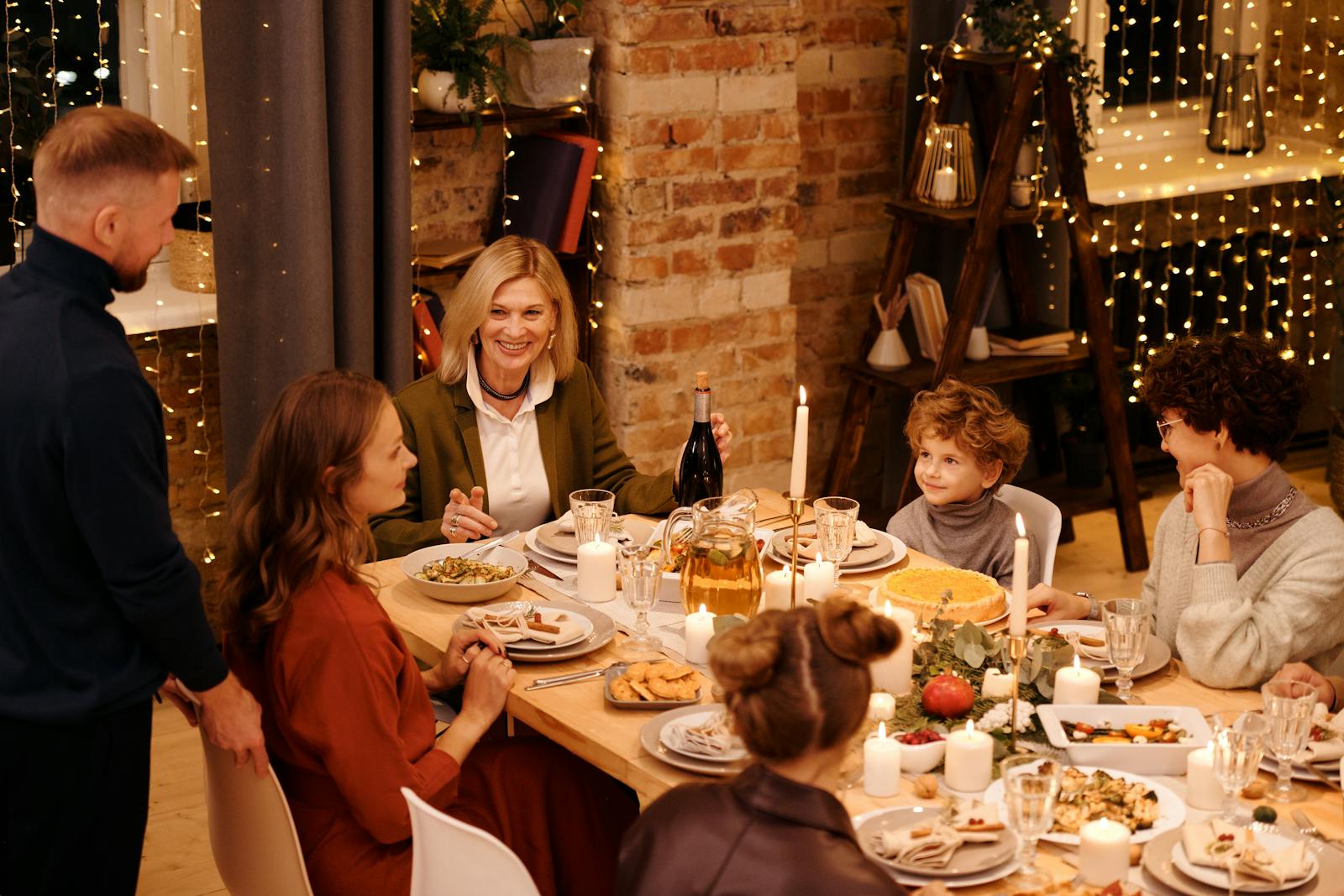
When love speaks in portions
My mother, Carmen, showed love through cooking. That's not a metaphor. It was literal. A bad day at school meant arroz con pollo. A fever meant sopa de pollo. A heartbreak meant whatever took longest to prepare. The food was the care. And refusing food, or not finishing it, landed somewhere between rude and hurtful.
This is true in a lot of cultures. And it creates a specific kind of bind for the person at the table. You learn that your body's signals (I'm full, I don't want more, this is too much) are less important than the emotional transaction happening through the meal. Hunger stops being a physical sensation you trust. It becomes something you override in service of connection.
Psychology research on childhood affection patterns suggests that when emotional responsiveness is inconsistent or conditional, children often develop difficulty trusting their own internal signals. They learn to read the room instead of reading themselves. Their emotions become confusing, shapeless things that are easier to ignore than articulate. The same dynamic applies to hunger. If the household taught you that your appetite existed to validate someone else's love, you never really learned to eat for yourself. And the thing is, the people who taught us this weren't villains. They were parents and grandparents doing what they knew, often passing down survival strategies from harder times. My avó grew up in a family where food was genuinely uncertain. Of course she measured love in abundance. Of course a full plate meant safety. The intention was care. The mechanism was control, though no one would have called it that. And because the intention was so clearly good, the pattern became almost impossible to examine. You can't critique something that was built from love without feeling like you're critiquing the love itself, which is exactly why so many people never do.
The problem isn't the intention. The problem is that the lesson outlives its context.
The guilt that sits at the bottom of the bowl
People who overeat from this place don't usually describe it as pleasure. They describe it as obligation. A tightness. A voice that says leaving food is wasteful, disrespectful, wrong. The guilt arrives before they've even considered stopping.
This guilt is different from the kind that diet culture manufactures—the superficial shame about eating a cookie. It's older. It's tied to identity, to family, to the sense that you owe something to the people who fed you. And it's remarkably resistant to rational thinking, because it was never rational in the first place. It was relational.
Research on recovering from childhood emotional patterns points to how behaviors learned under emotional pressure become deeply internalized, often operating below conscious awareness. The adult who cleans their plate at every meal may not even realize they're doing it until someone points it out. And when they do notice, the first response is usually to defend the habit, because it doesn't feel like a habit. It feels like who they are.
That's the thing about patterns absorbed in childhood. They don't present themselves as patterns. They present themselves as personality. People tell themselves they're just someone who doesn't waste food. They convince themselves they simply don't like leaving things unfinished. The identity forms around the behavior until questioning the behavior feels like questioning the self.
We've written before about how early competence borrows from a future that eventually asks to be repaid. The same principle applies here. The child who learned to eat everything, to perform gratitude through consumption, was meeting an adult emotional need at the expense of their own developing relationship with hunger, fullness, and food. That debt comes due eventually, often as chronic overeating, digestive problems, or a fraught relationship with meals that no diet can fix because the problem was never about the diet.

What the food system reinforces
It would be incomplete to talk about this as purely a family dynamic. The food industry benefits enormously from people who can't stop eating. Studies suggest that portion sizes at American restaurants have roughly doubled since the 1980s. "Value" meals train consumers to equate more food with a better deal. The entire economic model of fast food depends on people eating past satiety.
So the child who learned that finishing everything equals goodness grows into an adult living in a food environment designed to exploit exactly that impulse. The guilt of waste meets the incentive of volume. The emotional pattern meets the structural reinforcement.
It's worth asking who benefits from keeping overeating framed as an individual willpower problem. The answer, predictably, is the companies selling both the excess food and the solutions to it. The diet industry and the food industry aren't opposites. They're a feedback loop.
If overeating were understood more widely as a response to household emotional dynamics and structural food design, the conversation would shift to examining what systems taught this behavior and what systems continue to reinforce it. That's a harder sell. There's no app for it.
Unlearning the clean plate
So what does it actually look like to change this?
It doesn't look like throwing food away to prove a point. It doesn't look like rebellion against your grandmother's memory. It doesn't require rejecting the culture you came from or deciding that the people who fed you were wrong.
It looks quieter than that. It starts with noticing the moment fullness arrives and watching what happens right after. Not the physical sensation, but the emotional one. The flash of guilt. The calculation of how much is left. The story you tell yourself about what it means to stop.
Research on emotional development consistently shows that naming an internal experience is the first step toward changing the behavior around it. When adults learn to identify and articulate what they're feeling, they create space between the trigger and the response. That applies to children in classrooms. It also applies to a 34-year-old staring at a half-eaten bowl of pasta, trying to figure out why stopping feels like betrayal.
For some people, this means working with a therapist who understands the cultural dimensions of eating, not just the caloric ones. For others, it means having an honest conversation with a family member—acknowledging that finishing meant respect in their household, but explaining that they need to learn to listen to their body, and that listening is its own kind of respect.
There's something we explored in a previous piece about what adults most regret about their parents, and most of it wasn't about what their parents did. It was about what was never discussed. The unspoken rules that everyone followed and nobody examined. Food rules sit right at the center of that silence for so many families.
Gratitude doesn't have to be consumption
I still make Abuela Rosa's farofa when I'm homesick. I still associate the smell of toasted cassava flour with love, with being held inside a family even when I felt like I didn't quite fit anywhere. That hasn't changed.
What's changed is that I can make the farofa, eat until I'm satisfied, and put the rest away. The food doesn't disappear if I don't finish it tonight. The love doesn't diminish. The gratitude isn't measured in grams.
That took time. It took sitting with the discomfort of a plate that wasn't clean and realizing that the world didn't end, that nobody was disappointed, that the only voice insisting I finish was one I'd internalized decades ago. Last week I made a pot of rice and beans, ate half a bowl, covered the rest, and set it in the fridge without thinking about it. It was only later that I noticed what hadn't happened. No guilt. No arithmetic about what was left. Just a quiet plate on a quiet counter, and the understanding that the meal would be there tomorrow.