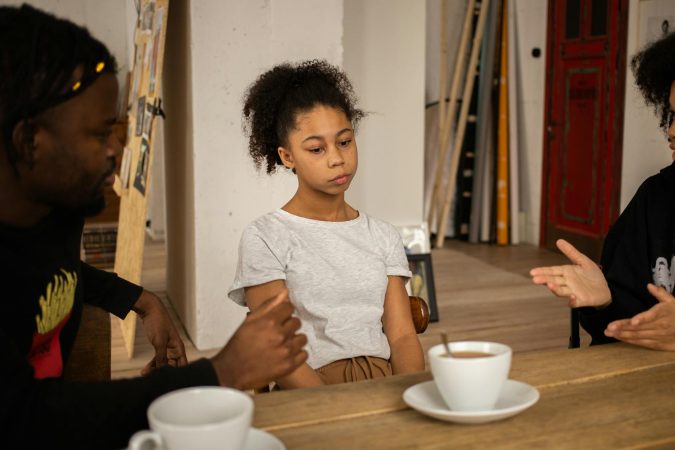
You grew up translating more than words—you interpreted emotions, expectations, and the invisible gaps between two worlds. This is the burden and gift of being a bridge no child should have to build alone.
Children who grow up translating for their families rarely describe it as a single skill. It is many skills wearing the same coat: listening for what was said, listening harder for what wasn't, adjusting your face so neither side sees you flinch, and then delivering a version of the truth that keeps everyone's dignity intact. You were not just converting words from one language to another. You were converting entire emotional operating systems, in real time, without training, often before you were tall enough to see over the counter you were standing at.
The conventional wisdom around bilingual children tends to frame their experience as a cognitive gift. You'll hear about "executive function," about mental flexibility, about the bilingual advantage and the way switching between languages strengthens the brain's capacity for planning, self-control, and problem-solving. And there's real evidence for some of that. But framing it only as an advantage flattens something enormous. It skips over the weight of the thing. It treats a survival mechanism like a party trick.
Because when you were eight and translating your mother's frustration into something a school administrator could hear without becoming defensive, you were not doing a cognitive exercise. You were performing emotional triage.
The job you never applied for
Children who translate and interpret for their families in medical offices, at banks, on phone calls with landlords and insurance companies carry a complex burden. A study following Mexican-origin adolescents found that the experience cuts both ways: some young people thrived in brokering roles, building confidence and competence, while others struggled with stress and anxiety from carrying responsibilities that should never have been theirs. The same skill that connects a family can empower or crush, depending almost entirely on how it's supported.
But translation within a family is rarely just about language. You know this if you lived it. The harder work was always emotional. You learned to read tone the way other kids learned to read chapter books. You could tell when your father's silence at dinner meant something different from his silence in the car. You knew which of your mother's laughs was genuine and which was the one she used when she didn't understand what someone had said but didn't want to ask again.
And you translated those things, too. You softened your father's bluntness when he spoke to your teacher, because you knew his directness came from a culture where respect didn't require small talk, but you also knew your teacher would read it as rudeness. You added warmth to your mother's emails that she never wrote into them herself, because you understood that in this country, "Thank you so much!" with an exclamation point was not excessive. It was expected.

Nobody taught you this. You simply saw the gap between how your family meant things and how the world received them, and you stepped into it.
The neuroscience of living between languages
Neurolinguists have studied what happens in the brain when bilingual people switch between languages mid-sentence. Research using brain imaging techniques has tracked activity in bilingual participants as they combined words across languages. What researchers have found is striking: the brain regions responsible for combining concepts appear to operate similarly whether someone is working within one language or switching between two. Code switching, scientists have concluded, is not a glitch. It's a natural process.
Many researchers who study bilingualism grew up in multilingual households themselves, navigating code switching between languages as a constant in their lives, and their research emerged directly from that experience. Research on code switching suggests that alternating between languages is a natural process for bilingual individuals, and maintaining a single language may actually require more cognitive effort.
This matters because the family translator isn't just switching languages. They're switching cultural registers, emotional vocabularies, entire systems of meaning. And they're doing it under social pressure, often in high-stakes situations, while being watched by both sides. The origins and cultural weight of code-switching extend well beyond bilingualism. It happens in any context where a person adjusts their communication style to move between groups that operate by different rules, whether those rules are linguistic, racial, or class-based.
Your brain made it look easy. It wasn't.
When the translation becomes your identity
I grew up between Stockholm and Australia. My mother is Swedish, my father Australian, and when they separated I was eight. After that, I moved between two countries, two languages, two entirely different emotional registers. Swedish restraint in one home. Australian informality in the other. I became fluent in both, which sounds like a blessing, and in many ways it was. But the part nobody talks about is the way fluency in two cultures can make you feel permanently provisional in both. You learn to read every room before you speak. You calibrate your warmth, your humor, your volume. You become so good at adjusting that you sometimes forget what you sound like when you're not performing for an audience of one culture or the other.
That kind of adjustment, sustained over years, changes the shape of your personality. You develop an unusual sensitivity to subtext. You can hear the difference between someone who says "That's interesting" and means it, and someone who says "That's interesting" as a way to end a conversation. These are useful skills. They make you a good journalist, a careful friend, a person strangers trust quickly. But they also mean you're rarely fully off-duty.
For children who translated not just language but emotion and expectation, this vigilance starts earlier and runs deeper. You weren't just bilingual. You were bi-emotional, bi-cultural, bi-contextual. You held two entire worlds in your head and ran a continuous translation program between them, and no one ever acknowledged that as labor because it looked, from the outside, like you were just talking.

What parentification looks like in two languages
Psychologists describe what happens when children take on adult responsibilities in their families, whether that's managing a household, mediating between parents, or handling emotional crises that adults should be handling themselves. Research on early bonding and child development has shown that disruptions in the parent-child dynamic during early years can shape emotional and behavioral outcomes well into middle childhood and beyond. When the relationship is inverted, when the child becomes the capable one, the interpreter, the adult in the room, the long-term effects ripple outward in ways that are hard to name but easy to feel.
For the family translator, this dynamic wears a particular disguise. It looks like competence. It looks like maturity. Teachers praise you. Relatives say you're so grown up. Your parents rely on you and tell you how proud they are, and that pride feels good, it does, but it also means you can't put the role down. You can't say, "I'm ten, and I don't want to explain to the doctor what's wrong with you because the words are too big and I'm scared." You can't say that because the system needs you not to say it.
And this is where it becomes a structural problem rather than a personal one. It's not that your parents failed you. Many of them were dealing with the trauma and stress of displacement, of building a life in a language and a system that was never designed to welcome them. They leaned on you because you were what they had. The failure isn't theirs. It belongs to the systems that made a child the most qualified person in the room to handle an adult crisis.
The grief no one names
There's a specific kind of loneliness that comes from being the bridge between two worlds that don't fully understand each other. You carry messages in both directions, and the messages often contradict. Your family says one thing about how the world works. The world says another. Your job is to make both sides feel heard, and in doing that, you sometimes lose track of what you actually believe.
I think about this when I'm in a new city, sitting in a café for the third morning in a row, watching how people greet each other, listening for the register, the pace, the things that go unsaid. I do this because it's my job, but also because it's the only mode I've ever known. Observation is what the translator does when they're not actively translating. They're gathering data. They're preparing for the next moment someone will need them to explain something that shouldn't need explaining.
The grief is that you never got to just be in a culture. You were always between. Some people carry invisible weight so long it becomes part of their posture, and the family translator's version of this is an emotional hypervigilance that never fully switches off. You scan every interaction for misunderstanding, for the gap between intention and reception, because that gap was once your entire job description.
Some part of you is still standing at a counter somewhere, too young for the task, doing it anyway.
What you deserve to hear
You were not just helpful. You were essential, and that is both the pride and the problem. A child should not be essential to the functioning of an adult system. A child should be allowed to misunderstand, to get things wrong, to not know the word. You were denied that. And yet you built something extraordinary from the denial: an ability to hold complexity, to sit with ambiguity, to see the love hidden inside gestures that other people miss.
Your sensitivity is not a weakness. It was forged under specific, demanding conditions, and it has made you someone who can read a room, hold space for contradiction, and sit with discomfort that would send most people running for a simpler story.
But you're also allowed to put the dictionary down. You're allowed to not be the one who explains, who softens, who bridges. You're allowed to let two people misunderstand each other and not make it your emergency.
The translator's hardest translation is this: learning to convert your own needs into language someone else can hear. Not your mother's needs. Not your father's tone. Not the school's expectations. Yours.
You spent your childhood making other people legible to each other. The work of adulthood is making yourself legible to yourself.
That's harder than any language you've ever learned. And it's the one no one will grade you on, no one will praise you for, no one will stand at a counter and desperately need you to get right.
You'll do it anyway. You always do.