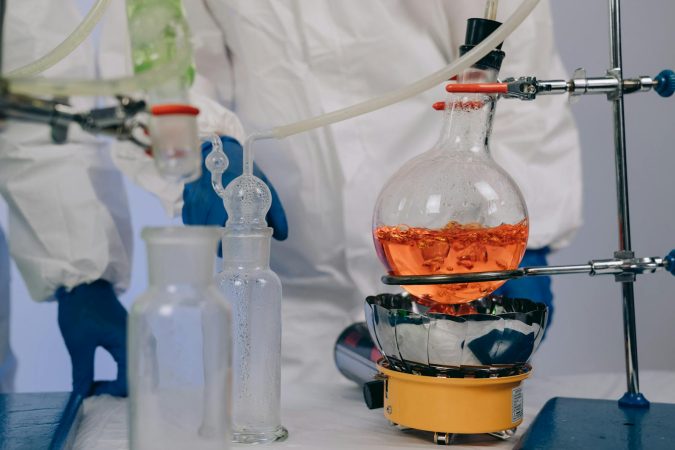
Novonesis and Denmark's Technical University are engineering microbes that convert waste CO2 into edible protein, as part of a $55 million initiative backed by the Gates Foundation and Novo Nordisk Foundation.
In 2024, avian flu outbreaks culled over 300 million poultry worldwide, pushing U.S. egg prices up more than 60 percent year over year. Meanwhile, global protein demand is on track to increase 50 percent by 2050. These aren't slow-moving trends. They're converging crises. Land use for animal feed crops continues to drive deforestation, freshwater reserves are thinning, and the conventional response of squeezing more efficiency out of existing agriculture is hitting hard physical limits.
Plant-based proteins and cultivated meat have attracted the most public attention as alternatives, but neither fully escapes the resource trap. Plant proteins still require cropland and compete with food production. Cultivated meat remains expensive and dependent on energy-intensive bioreactors fed with sugar-based media. A fundamentally different input, one decoupled from agriculture entirely, would change the equation. That's where gas fermentation enters: microorganisms converting carbon-based gases into protein-rich biomass. And a new $55 million partnership between Novonesis and Denmark's Technical University is betting it can make this actually work at scale.
The Bottleneck That Has Held Gas Fermentation Back
The idea of feeding microbes waste CO2 instead of sugar is elegant, but it has a persistent problem. Most microorganisms that can consume carbon gases directly require highly specialized reactors, extreme conditions, or both. Growth rates are slow. Yields are low. The economics collapse long before you reach commodity scale. Companies like Finland's Solar Foods and Denmark's Unibio have made progress, but the sector as a whole has struggled to close the gap between biological proof-of-concept and industrial cost competitiveness.
The Acetate Consortium, backed by the Bill & Melinda Gates Foundation and the Novo Nordisk Foundation, is built around a specific insight that reframes this challenge. Rather than feeding CO2 directly to microbes, the consortium first converts captured CO2 into acetic acid, the main component of vinegar, using chemical or electrochemical processes. Then conventional fermentation organisms, like yeast and fungi, consume that acetate and produce protein. The two-step approach is designed to be easier to scale and integrate with existing industrial fermentation infrastructure, sidestepping the specialized reactor problem that has stalled direct gas fermentation.
But there's a catch, and it's biological. Most microbes prefer glucose. They can survive on acetic acid, but they don't thrive on it. Growth is slow, protein yields are inadequate, and the process can't compete economically with sugar-fed fermentation.
The core challenge is deceptively simple: make microbes eat carbon waste as efficiently as they eat sugar.
Engineering Biology to Close the Gap
Novonesis, a major biosolutions company, is partnering with DTU's Bright Biofoundry, a research hub established as a joint initiative between DTU and the Novo Nordisk Foundation. Bright's researchers are applying evolutionary engineering techniques to optimize yeast strains specifically for acetate-based fermentation. I find the method striking. They're using a high-throughput automated evolution platform that can test and iterate microbial strains far faster than traditional lab work allows. The platform runs thousands of evolutionary experiments simultaneously, compressing what would otherwise be years of traditional selection into months.
Researchers leading the collaboration from Bright explain that evolution is being used as a design tool. The goal isn't just determining whether microbes can grow on low-carbon inputs. It's evolving them to do it faster, more efficiently, and in ways that actually make industrial sense. The specific targets are yeast that can tolerate higher concentrations of acetate, consume it faster, and convert more of it into protein.
This isn't starting from zero. The consortium's first phase has reportedly produced microbial strains that can grow on acetate and contain significant protein content. That potentially puts these microbes in a similar range as soybean meal, one of the most widely used protein sources in animal feed and food manufacturing. Those results are what justified the scale-up.
Why the Acetate Approach Solves What Others Haven't
The critical advantage is compatibility. Companies pursuing direct gas fermentation, like Jooules and Aerbio, are developing purpose-built organisms and reactors for converting CO2 or methane into protein. Aerbio, for instance, has developed a gas fermentation process that produces what it calls Proton, a protein ingredient aimed at both feed and food applications. These are legitimate technologies, but they require building new infrastructure from the ground up.
The acetate pathway takes a different bet: that it's easier to adapt the feedstock to existing fermentation infrastructure than to build entirely new systems around difficult organisms. The global fermentation industry already operates enormous yeast-based production at scale for ethanol, brewing, and industrial enzymes. If yeast can be engineered to thrive on acetate instead of sugar, the consortium's process could plug into that existing capacity rather than compete with it.
The counterargument worth taking seriously is cost. Converting CO2 to acetate adds a processing step and expense that direct gas fermentation avoids. The consortium's second phase explicitly includes economic modeling alongside technical optimization, which suggests the backers know that scientific feasibility alone won't be enough. There's also the question of consumer acceptance. Protein grown from engineered microbes fed on captured carbon is a hard sell in markets where "natural" still carries enormous weight. Regulatory environments and cultural attitudes toward novel foods vary enormously, and technical success won't automatically translate into market access.
The Institutional Alignment That Makes This Different
What gives the Acetate Consortium unusual credibility isn't just the science. It's the structure behind it. The consortium's second phase members include Novonesis, Orkla Foods, Topsoe, Aarhus University, and Spora, a food innovation center. That lineup spans the full chain from CO2 conversion (Topsoe's expertise in industrial catalysis) through fermentation (Novonesis) to food product development (Orkla, Spora). Most alternative protein research programs have one or two of these links. This one has all of them in a single coordinated effort. Significant combined funding from the Gates and Novo Nordisk Foundations gives the project more runway than most alternative protein research programs can claim. And there's a structural detail that matters: Novonesis is reportedly majority-owned by Novo Holdings, the holding company of the Novo Nordisk Foundation, which means the foundation is both funder and stakeholder. That alignment of financial interest and philanthropic mission could accelerate decision-making. The foundation isn't just writing checks and hoping. It has direct commercial exposure to the outcome. I've covered enough research consortia to know that this kind of structural alignment is rare, and when it exists, it tends to be the difference between a published paper and a shipped product.
Leadership at the Bright Biofoundry has described the collaboration as a model for the kind of cross-institutional work the green transition demands, emphasizing aligned partners, complementary expertise, and the courage to work through complexity together. Food prototypes and impact assessments are expected alongside the technical strain development work.
Here's what should unsettle anyone watching this space. If the Acetate Consortium fails, it won't just be a $55 million write-off. It will signal that the most well-funded, structurally aligned, full-value-chain effort at carbon-to-protein conversion couldn't clear the bar. That would set the field back years, not months. And the global food system doesn't have years to spare. The harder question is whether the food industry actually wants this to succeed. Cheap, scalable protein from waste carbon would disrupt soy supply chains, animal feed markets, and the economics of industrial agriculture. Every institution in those sectors has a reason to slow-walk adoption. The real test for this consortium isn't biological. It's whether the industries it threatens will let it through the door.
What’s Your Plant-Powered Archetype?
Ever wonder what your everyday habits say about your deeper purpose—and how they ripple out to impact the planet?
This 90-second quiz reveals the plant-powered role you’re here to play, and the tiny shift that makes it even more powerful.
12 fun questions. Instant results. Surprisingly accurate.