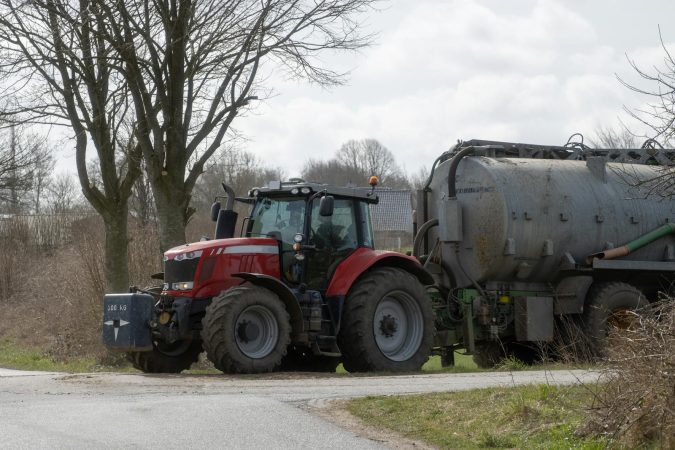
University of Colorado Boulder researchers detected toxic Medium Chain Chlorinated Paraffins in Oklahoma's air for the first time in the Western Hemisphere, tracing the likely source to sewage sludge fertilizer spread on agricultural fields.
During a month of continuous air monitoring at a site in Oklahoma, researchers detected Medium Chain Chlorinated Paraffins (MCCPs) in the gas phase — marking a significant measurement of these toxic industrial compounds in North American ambient air. The chemicals, widely used in metalworking fluids and PVC production, weren't what the team was looking for. They showed up unexpectedly in advanced mass spectrometry data, and the probable source traced back to something I wouldn't have guessed: fertilized farmland.
The likely pathway runs through sewage sludge. Repackaged as biosolid fertilizer and spread across cropland, the material bakes under sun and heat, volatilizing persistent chemical compounds into the atmosphere. It's a pollution route that sits uncomfortably close to the food system — and one that most air quality conversations completely ignore.
The strongest counterargument here is that a single month of monitoring at one site in Oklahoma doesn't prove a systemic problem. That's fair. But what makes the finding alarming is the broader pattern it reveals, one where regulated chemicals get swapped for unregulated cousins, and the pollution simply changes form rather than disappearing.
What Are MCCPs and Why Should You Care?
MCCPs belong to a family of chlorinated paraffins widely used in metalworking fluids, PVC production, and textile manufacturing. They are close chemical relatives of Short Chain Chlorinated Paraffins (SCCPs), which have come under regulatory scrutiny and are restricted under international agreements on persistent organic pollutants. Here's the catch. When SCCPs faced restrictions, industry needed substitutes — and MCCPs stepped in. They serve the same industrial purposes and share many of the same troubling characteristics, including slow environmental breakdown that draws comparisons to PFAS, the so-called "forever chemicals" that have contaminated water supplies across the country. The chemical name changes. The risk migrates. The public stays in the dark. Sound familiar? It should. This is the same substitution logic that gave us GenX after PFOA was phased out, and bisphenol S after BPA fell from favor.
The Sewage Sludge Connection
MCCPs had previously been detected in various regions globally, but their presence in airborne form in North America represents a new development. Researchers used advanced mass spectrometry to identify compounds during continuous air monitoring at the Oklahoma site. They weren't looking for MCCPs specifically.
The chemicals showed up unexpectedly.
The probable source? Biosolid fertilizer. I've driven past fields receiving sludge applications in the Midwest — there's often a faint chemical smell that locals wave off as "just the fertilizer." But what's actually happening is more complicated than a bad odor. Sewage treatment plants collect industrial and residential waste, process it into sludge, and that sludge gets applied to farmland as a cheap, nutrient-rich soil amendment. The problem is that sewage sludge concentrates industrial chemicals, including MCCPs, that survive the treatment process. When that sludge is spread across fields and exposed to heat and sunlight, those compounds can volatilize — releasing them into the air breathed by nearby communities. According to EPA estimates, roughly 2.8 million dry tons of biosolids are applied to U.S. agricultural land annually, covering millions of acres of farmland across every region of the country.
The connection between biosolids and contamination is already on some lawmakers' radar. Legislative efforts have emerged to address biosolid fertilizer over concerns about PFAS contamination in soil. The MCCP finding adds another layer to that debate; it suggests the contamination problem extends beyond what's seeping into groundwater to what's evaporating into the air people breathe.
A Familiar Pattern in Environmental Regulation
The SCCP-to-MCCP substitution follows a well-worn playbook in chemical regulation. A substance gets flagged as harmful. Rules restrict it. Manufacturers switch to a structurally similar compound that falls outside the regulatory definition. Years pass before anyone studies the replacement closely enough to realize the problem has simply moved. Why does this keep happening? The pattern persists because chemical regulation in the U.S. tends to be reactive rather than precautionary — addressing individual compounds after harm is demonstrated rather than treating entire chemical families as suspect from the start.
MCCPs are currently being evaluated for possible regulation under international treaties that already cover SCCPs. But evaluation and restriction are separated by years of scientific review, political negotiation, and industry lobbying. In the meantime, these compounds continue to circulate through industrial supply chains, into wastewater, through treatment plants, onto fields, and now, as research shows, into the air.
What This Means for Food and Soil
For anyone paying attention to where food comes from and what goes into the soil that grows it, this finding raises uncomfortable questions about biosolid fertilizer as a practice. The economics are straightforward: cities need to dispose of sewage sludge, and farmers need cheap fertilizer. Biosolids solve both problems at once. A substantial portion of the sewage sludge produced in the U.S. ends up on agricultural land.
The trade-off is that this practice turns farmland into a sink for whatever chemicals pass through the wastewater system. PFAS contamination from biosolids has already forced some farms to shut down. The MCCP discovery suggests the list of problematic compounds in biosolids may be longer than previously understood.
This is a systems issue, not a personal-choices issue. Individual consumers can't test their local soil for MCCPs or choose produce grown without biosolid fertilizer (there's no label for that). The question is whether regulators will treat the MCCP finding as an isolated data point or as evidence that the biosolid-to-farmland pipeline needs a more thorough reckoning.
What Comes Next
Recent research represents an important milestone in measuring gas-phase MCCPs in ambient air, which opens the door for broader monitoring across different geographies and agricultural settings.
Whether that monitoring happens quickly enough to inform policy is another question. The gap between scientific detection and regulatory action on environmental contaminants can stretch across decades. MCCPs sit at the early stage of that timeline. They've been identified. They've been measured. The pollution pathway from industry to wastewater to farmland to atmosphere has been sketched out. What happens next depends on whether this discovery accelerates international evaluation processes, whether the EPA takes interest, and whether state-level efforts to address biosolid fertilizer gain momentum.
The finding also reinforces a broader lesson about chemical regulation: banning one substance without addressing the entire class of related compounds is like plugging one hole in a net. The water finds another way through. Until regulators adopt a class-based approach to chlorinated paraffins, the substitution game will continue.
But the abstract policy debate matters less than the concrete reality on the ground. An estimated 60 percent or more of U.S. sewage sludge is land-applied, spread across farmland in every state. Tens of millions of Americans live in rural communities adjacent to fields receiving biosolid applications, and they have no way of knowing what's volatilizing into the air around their homes, schools, and workplaces. There's no ambient air monitoring network for MCCPs, no warning label on the field next door, no disclosure requirement telling residents what was in the last truckload of sludge. The Oklahoma study caught these chemicals by accident. The question now is how many other communities are breathing them on purpose, as a predictable consequence of a disposal system designed to be cheap rather than safe.