Nebraska's 2026 wildfire season has already shattered state records, burning nearly a million acres and devastating cattle ranches during calving season. The crisis reveals how a century without prescribed burns, combined with warming temperatures and drought, is forcing a reckoning for the nation's top beef exporter.
In March, as wildfires tore across central and western Nebraska, ranchers found themselves fighting flames miles from their own property. Then they'd hear over the radio that the fire had shifted toward their homes. As volunteer firefighters, they were on duty. As cattle producers in the middle of calving season, they were watching their livelihoods burn. The people fighting the fire are the same people whose land is at stake. That fact reveals something fundamental about how America's beef industry is wired. And it's a wire that's fraying.
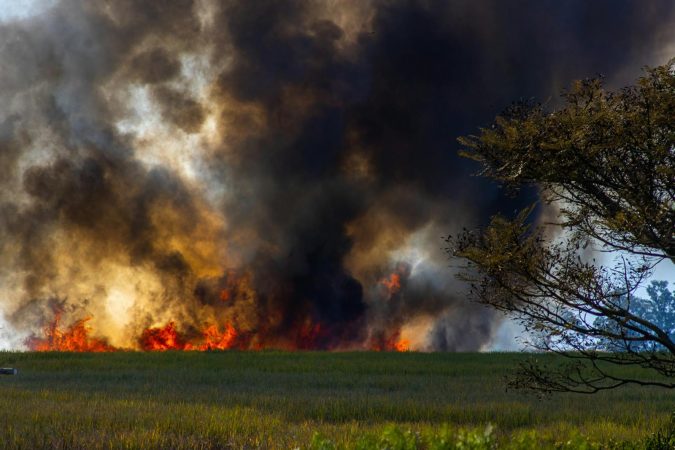
By March 30, wildfires had scorched 945,381 acres across Nebraska, breaking the state's all-time record in just three months. The fires hit the heart of cattle country during calving season, compounding years of drought. The conventional explanation is weather: dry winter, high winds, low humidity. But the real story is structural. A century of fire suppression on grasslands that evolved with fire, combined with warming temperatures and shifting precipitation, has created conditions where individual resilience — the very quality Nebraska ranchers are built on — is no longer enough to hold the system together.
A Record-Breaking Fire Season in Three Months
The Morrill, Cottonwood, Anderson Bridge, and Road 203 wildfires all erupted across central and western Nebraska within days of each other in March. The season followed an exceptionally warm and dry winter. Wind, low humidity, and bone-dry grassland did the rest.
Major fires, including what has been reported as one of the largest in the state's history, illustrated how fast these fires move. Ranchers across the region watched grazing land burn in a matter of hours. Losses included hay, livestock, and infrastructure. Cattle came through with singe marks on their backs.
Neighbors and fellow volunteer firefighters worked to save properties, often having to defend the same locations multiple times as winds shifted. Most of the state's fire departments are volunteer-based. When a fire moves through cattle country, the firefighters and the victims are the same people. That should trouble anyone thinking about the scalability of the current system. These aren't career departments with deep benches. They're ranchers in turnout gear, choosing in real time between protecting a neighbor's fence line and saving their own calves.
How a Century Without Fire Made Things Worse
Nebraska sits on roughly 23 million acres of range and pasture land. About half of that is in the Sandhills, a vast grass-covered dune system that contains what has been described as one of the most intact temperate grasslands on the planet.
That grassland evolved with fire. For thousands of years, both natural wildfires and prescribed burns conducted by Indigenous groups shaped it. Fire promoted biodiversity, controlled invasive species like cedar trees, and prevented the uniform buildup of fuel that makes fires catastrophic when they do occur.
Over the last 150 years, as Nebraska built out its agricultural economy and infrastructure, the culture around fire shifted. Prescribed burning became rare in much of the state. Without regular fire disturbance, what ecologists call a shifting mosaic of diverse plant growth gave way to something monotonous. One grass type running to the horizon in every direction. Identical fuel, everywhere, all at once. Picture a match and a sheet of newspaper the size of a county.
Layer drought and record warmth on top of that, and the math gets ugly. Experts say we're entering a new kind of wildfire era for this generation, one that differs fundamentally from what past generations have experienced.
The counterargument worth taking seriously is that grasslands have always burned. The Sandhills are resilient by nature, and ranchers have weathered bad fire years before. Those familiar with the region express confidence that the grass will return with adequate moisture. That's true. But the scale and frequency of what's happening in 2026 is not a repeat of past cycles. Breaking an all-time acreage record in three months suggests something structural has changed. The gap between individual grit and systemic vulnerability is widening faster than anyone planned for.
What This Means for Beef, Prices, and Food Systems
Nebraska ranked first in the country for beef and veal exports in 2024, at $1.66 billion, according to the state Department of Agriculture. Cattle and calves are the state's most valuable commodity. Most of the corn Nebraska grows, its second-most valuable commodity, goes to feeding those cattle.
The fires compound a problem that was already underway. Drought over the past few years had already pushed ranchers to reduce herd sizes, according to agricultural economists. Fewer cattle on fewer acres. That dynamic had already been driving up beef prices. The 2026 wildfires and ongoing drought could accelerate it sharply.
The supply chain implications extend well beyond Nebraska. When the nation's top beef exporter loses nearly a million acres of grazing land in a single season, the effects ripple through feedlots, packing plants, grocery stores, and export markets. Ranchers who lost pasture will need to find feed elsewhere or sell cattle they can't support, often at a loss. Some will sell animals they spent years breeding. That genetic investment doesn't come back quickly.
The pattern here matters. Climate disruptions are making animal agriculture more volatile, more expensive, and more dependent on a patchwork of emergency responses. That doesn't mean beef disappears from the American diet. But the cost of producing it in traditional ways is rising. The system absorbing those costs — from volunteer fire departments to individual ranchers shouldering uninsured losses — was never designed for shocks at this scale or frequency.
Adaptation Is the Hard Part
Rangeland ecologists argue that Nebraska's cattle industry will need to adapt. Bringing back prescribed burns in some areas. Making buildings and infrastructure more fire-resistant. Rethinking how land is grazed. But they also caution that these changes need to be tested with actual producers before they can be rolled out widely. Ranchers are practical people. They need proof something works before they change how they operate.
The challenge is timing. The gap between what the land needs (regular fire disturbance, diversified plant communities) and what the economy demands (maximum grazing capacity, steady beef production) has been widening for decades. Closing it requires cooperation between ecologists, fire departments, state agencies, and ranchers who are, right now, focused on surviving this season.
There's a psychological dimension to this too. People who build their identity around resilience and self-reliance don't easily ask for systemic change. Ranchers affected by the fires have expressed a determination to take it a day at a time and wait for rain, adjusting their operations as needed.
That stoicism is admirable. But it's also the kind of individual coping that masks a collective problem. When most of your fire departments are staffed by volunteers, when your top commodity is uniquely vulnerable to drought and fire, and when the conditions producing those fires are getting worse, individual resilience alone isn't a strategy. It's a stopgap. And 2026 is showing what happens when the stopgap meets a system-level failure.
Ranching families have worked this land for generations. Their knowledge of the Sandhills is deep and earned. But the climate they built that knowledge around is changing. What happens next will depend on rain, on fire policy, and on whether the state's agricultural establishment treats 2026 as an anomaly or a warning. The grass may grow back. The harder question is whether an industry that depends on individual toughness can build the collective infrastructure — fire management, policy reform, diversified land use — that the new conditions demand. Because the rancher fighting a wildfire while his own calves are being born on burning ground isn't a symbol of resilience. He's a symbol of a system asking too much of the people inside it.
If You Were a Healing Herb, Which Would You Be?
Each herb holds a unique kind of magic — soothing, awakening, grounding, or clarifying.
This 9-question quiz reveals the healing plant that mirrors your energy right now and what it says about your natural rhythm.
✨ Instant results. Deeply insightful.

Mia Chen
She/Her
Mia Chen is a behavioral psychologist turned writer based in Oakland, California. She trained at UC Berkeley and spent four years in private clinical practice working with young professionals navigating identity crises and career transitions. She left therapeutic practice to write about behavioral patterns for a wider audience, finding that the patterns she observed in one-on-one sessions were playing out at a cultural scale in how people relate to food, health, and self-image.
At VegOut, Mia writes about food psychology, behavioral decision-making, and the hidden patterns shaping plant-based eating. She has a gift for making psychology research accessible without being reductive, and her writing often explores why people eat the way they do rather than prescribing what they should eat. Growing up as the daughter of Taiwanese immigrants who ran a restaurant for over two decades, she brings a personal understanding of food as both culture and identity.
Mia shares her Oakland home with two rescue cats named Soy and Almond. She reads research papers for pleasure, works best in the early morning hours, and believes that understanding your own behavior is the most practical skill you can develop.
More Articles by Mia