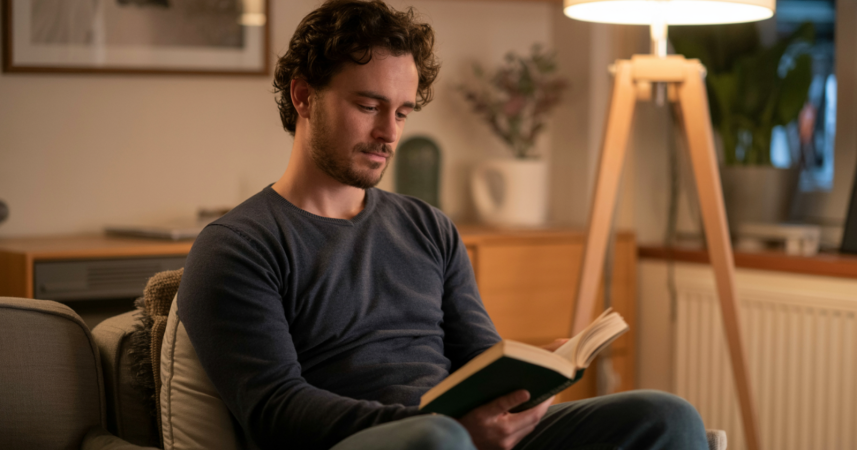
Tech-free evenings aren’t about rejecting technology altogether. They’re about reclaiming the most restorative part of your day from something that doesn’t deserve it.
We live in a world where our phones, laptops, and TVs fight for every spare second of our attention.
And most of the time, they win—especially in the evening.
The problem is, those last hours of the day aren’t just “extra time.” They’re some of the most powerful hours you have for shaping your health, your focus, and your relationships.
When I finally started protecting my evenings from screens, I realized how much I’d been giving away without even noticing. And once I made the switch, the benefits showed up faster than I expected.
Protecting sleep from technology
Sleep expert Matthew Walker calls sleep “the single most effective thing we can do to reset our brain and body health each day.” Think about that.
More effective than working out, meditating, or eating kale. Yet, most of us willingly sabotage it every night by staring into a glowing screen.
The science is pretty clear: blue light from phones, tablets, and TVs interferes with melatonin production, the hormone that signals to your body it’s time to rest. That’s why you can feel tired all day, only to suddenly feel “awake” the moment you start scrolling in bed.
I used to keep my phone on the nightstand. It felt harmless—just a quick check of Instagram or emails before sleeping. But it wasn't. No wonder my sleep felt broken.
Switching to tech-free evenings made falling asleep easier, but more importantly, it made waking up less painful. I didn’t feel like I was dragging yesterday’s exhaustion into today anymore.
Reclaiming lost time
Here’s a sobering number: on average, people spend four hours and thirty-seven minutes a day on their phones. That’s not a typo. That’s a quarter of your waking life.
Now imagine where most of that time happens: evenings. After work, after dinner, when you’re “relaxing.” Except it’s not really relaxing—it’s just numbing.
When I started tracking my own phone use, I realized I was easily wasting one to two hours every night. That’s fourteen hours a week. Two full workdays.
What could you do with two extra days every week? Learn a language? Write a book? Spend real time with people you love?
Even if you only reclaim half an hour a night, that’s a meaningful chunk of time that can go toward something you actually value.
Restoring human connection
Phones don’t just steal time; they steal presence.
According to Healthline, nearly 32% of people say they’re “phubbed”—phone snubbed—two to three times a day. That means conversations interrupted by glances at notifications, or dinners where everyone’s half-engaged.
I’ve seen this play out firsthand. I once went out with friends, and we spent half the night looking at things on our phones instead of at each other. At some point I thought: why did we even bother meeting up?
Evenings are prime time for connection—whether that’s laughing with your partner, playing with your kids, or just sitting in comfortable silence with someone. But none of that happens if your attention is constantly split.
When you remove devices from the equation, you give people the gift of your full attention. And in an age where we’re all half-distracted, that kind of presence feels rare—and valuable.
Reducing stress and mental overload
Here’s something you might not realize: constant notifications don’t just interrupt your focus, they stress your brain. Psychology lecturer Sharon Horwood has pointed out how every ping and buzz pulls your attention and amps up mental strain.
That’s the last thing you want in the evening, when your body is supposed to be winding down. Yet most of us treat this constant stimulation as normal. We even feel restless without it, as if silence itself is uncomfortable.
But silence is exactly what the brain craves at night. Cutting off the noise—both literal and digital—gives your nervous system space to relax.
For me, evenings without notifications feel like stepping out of a crowded bar into the quiet of a late street. My thoughts finally have room to breathe.
Rediscovering the power of reading
What do you replace screens with? One of the best answers is also one of the oldest hobbies: reading.
Studies show that reading print books—not digital ones—leads to better comprehension and deeper learning. Perhaps, that’s because physical reading is truly immersive. You don’t have hyperlinks, ads, or apps fighting for your attention every few seconds.
And here’s a stat that’s stuck with me: people who read seven or more books a year are more than 122% more likely to be millionaires compared to those who rarely read.
That doesn’t mean books alone make you rich, but it sure does suggest a connection between curiosity, growth, and success.
When I swapped late-night scrolling for half an hour of reading, I noticed more than better sleep. I started carrying ideas from books into my day, sparking conversations, and making connections I wouldn’t have made otherwise. A single evening ritual was compounding into long-term change.
The takeaway
Tech-free evenings aren’t about rejecting technology altogether. They’re about reclaiming the most restorative part of your day from something that doesn’t deserve it.
Screens can wait. Your sleep, your relationships, your peace of mind, and even your future success cannot.
So here’s the challenge: tonight, turn off your phone an hour before bed. Pick up a book, cook a meal, or just sit in quiet. Notice how different you feel when you choose presence over distraction.
You might be surprised at how powerful those last few hours of the day can be.
If You Were a Healing Herb, Which Would You Be?
Each herb holds a unique kind of magic — soothing, awakening, grounding, or clarifying.
This 9-question quiz reveals the healing plant that mirrors your energy right now and what it says about your natural rhythm.
✨ Instant results. Deeply insightful.