When your dietary choices become a first-date dealbreaker, you learn that compatibility isn't about sharing preferences—it's about how we hold space for each other's non-negotiables.

Add VegOut to your Google News feed. 
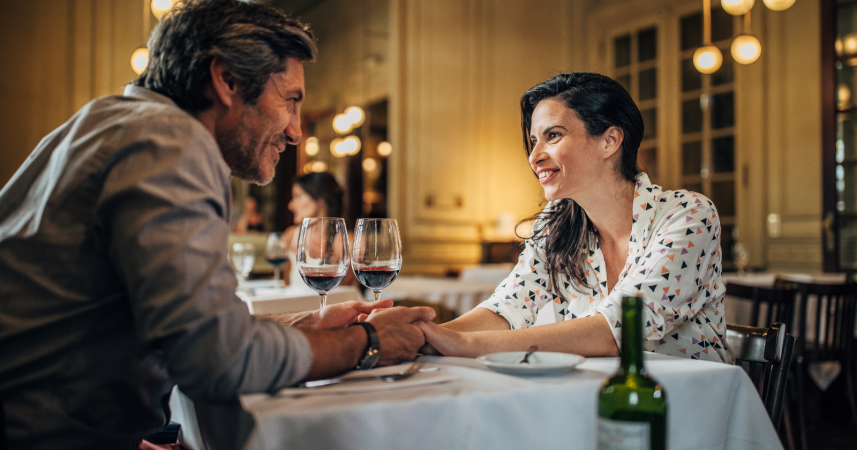
I was three bites into what I thought was going pretty well—first date, trendy gastropub, conversation flowing—when she said it: "Oh my god, you have to try this." She was already cutting a piece of her medium-rare steak, fork extended toward me, that particular kind of enthusiasm people get when they want to share something transcendent. I hadn't mentioned the vegan thing yet. I'd learned to wait until at least the second round of drinks.
"I'm actually plant-based," I said, trying for casual, achieving something closer to apologetic.
The fork hovered between us for a beat too long. "Oh," she said, retracting it slowly, like she'd just offered a handshake to someone with no arms. "Like, fully?"
This is how it goes. Not always with steak, but always with something—the cheese board someone insists on ordering "for the table," the surprise reservation at the new omakase place, the morning-after eggs they're so proud of making. Dating while vegan isn't just about navigating menus; it's about navigating the moment when someone realizes you've opted out of what might be humanity's most universal social contract: breaking bread together, no restrictions, no complications, no pointed questions about where the bread came from.
The numbers game nobody talks about
Here's what the data tells us: vegans make up about 3% of the U.S. population, though that number jumps to nearly 10% for millennials and Gen Z. If you're straight and vegan, the dating pool arithmetic gets brutal fast. Factor in the usual dealbreakers—location, attraction, emotional availability, the ability to maintain a text conversation that doesn't die after three exchanges—and suddenly you're doing combinatorial mathematics that would make a statistician weep.
But the numbers only tell part of the story. What they don't capture is the peculiar social weight of dietary choices in romantic contexts. Food isn't just fuel; it's culture, comfort, celebration. It's your grandmother's lasagna recipe, your city's best late-night taco spot, the ritual of Sunday morning bagels. When you say "I don't eat that," you're not just declining a meal—you're potentially declining a whole vocabulary of intimacy.
I've watched this play out in real time, tracked the micro-expressions like a behavioral scientist with a broken heart. There's the initial surprise, followed by rapid mental recalculation ("Can I date someone who won't split a pizza with me?"), then either curiosity or something that looks suspiciously like exhaustion. One woman literally said, mid-first-date, "I just can't imagine never cooking my mom's bolognese for someone I love."
The thing about boundaries
The strangest part about dating as a vegan isn't the rejection—it's the negotiation. People who wouldn't dream of asking you to compromise on religion or politics will casually suggest you "just try a bite" or "make an exception for special occasions." There's this underlying assumption that dietary choices exist on a different moral plane than other beliefs, that they're preferences rather than principles.
Research on moral foundations suggests that food choices increasingly signal deeper value systems, particularly around harm, fairness, and purity. When someone learns you're vegan, they're not just processing a dietary restriction—they're often confronting their own relationship with these moral dimensions, whether they realize it or not.
I once dated someone for three months who kept insisting she was "totally cool" with my veganism while consistently booking restaurants with no vegan options, then acting surprised. "They'll figure something out for you," she'd say, as if my dietary choices were a mild inconvenience the kitchen staff should accommodate, like a nut allergy or an aversion to cilantro. The relationship ended not over food, exactly, but over what the food represented: a fundamental mismatch in how we approached consideration and respect.
The unexpected filter
Here's what I didn't expect when I went vegan five years ago: it would become the most efficient compatibility filter I'd ever encountered. Not because dietary alignment equals romantic compatibility—I know too many thriving vegan-omnivore couples to believe that—but because people's reactions to your veganism reveal something essential about how they handle difference.
The people who get defensive ("Plants have feelings too," "What about protein?", "I could never give up cheese") are telling you they experience your choices as an implicit judgment of theirs. The ones who immediately launch into their own guilty confessions ("I really should eat less meat," "I did Meatless Mondays for a while") are showing you how they process moral discomfort. And the ones who get curious—genuinely curious, not performatively curious—those are the ones who understand that love means making space for someone else's values, even when you don't share them.
Studies on successful relationships consistently show that accepting influence from your partner is one of the strongest predictors of relationship success. The vegan thing becomes a perfect early test case: Can this person make space for a fundamental aspect of how I move through the world? Can they see it as part of what makes me interesting rather than what makes me difficult?
The compromise paradox
The most exhausting part of dating while vegan isn't finding restaurants—every major city has figured that out by now. It's the emotional labor of constantly managing other people's discomfort with your choices. You become fluent in preemptive reassurance: "I'm not one of those preachy vegans," "You can eat whatever you want," "I don't judge." You learn to laugh at the bacon jokes, to be cool about the cheese situation, to never, ever mention the documentary that changed your perspective on factory farming.
But here's the thing about constantly minimizing yourself to make others comfortable: it's a terrible foundation for intimacy. Real connection requires showing up as your whole self, inconvenient principles and all. The right person won't need you to apologize for taking up space with your values.
I stopped apologizing for being vegan around the same time I stopped dating people who made me feel like I should. It wasn't a conscious decision so much as an exhaustion-fueled surrender. On my profile, I moved "plant-based" from the bottom of my bio to the top. I started suggesting vegan restaurants for first dates. I stopped laughing at the bacon jokes.
The matches decreased, but the quality improved dramatically. Turns out, when you stop trying to be palatable, you attract people who actually like your flavor.
What compatibility actually means
Last month, I went on a date with someone who'd suggested a vegan restaurant before I could. Not performatively, not apologetically, just: "There's this place I've been wanting to try." She ordered decisively, didn't make it weird, didn't turn it into a thing. Halfway through dinner, she mentioned she wasn't vegan herself but had been thinking about the environmental impact of her food choices. The conversation unfolded naturally from there—no defensiveness, no judgment, just two people exploring ideas together.
We've been seeing each other for six weeks now. She still eats meat sometimes, though less than before. I still don't, though I've stopped treating it like something I need to navigate around. She texts me photos of vegan dishes she's tried. I send her articles about sustainable farming. We're figuring it out, not by compromising our values but by expanding our capacity to hold complexity.
Research on relationship satisfaction suggests that shared values matter less than how couples navigate their differences. The couples who thrive aren't the ones who agree on everything—they're the ones who've learned to be curious about their disagreements.
The deeper lesson
The impossible thing about dating as a vegan isn't really about veganism at all. It's about what happens when any aspect of who you are falls outside the assumed default. It's about the exhausting math of finding someone whose non-negotiables don't clash with yours, who can hold space for your differences without making them the whole story.
But maybe that's exactly the point. Maybe dietary restrictions, like all the other ways we're particular and difficult and specifically ourselves, aren't obstacles to connection but prerequisites for it. Maybe compatibility isn't about finding someone who shares all your preferences but finding someone who sees your non-negotiables as information rather than impediments.
The truth is, I don't need to date another vegan. I need to date someone who understands that the things we won't compromise on are usually the things that matter most. Someone who gets that principles aren't preferences, that boundaries aren't suggestions, that the person you fall in love with should never be the edited version.
These days, I put it in my profile, clear as day: vegan. Not "plant-based," not "mostly vegan," not buried in a list of other traits. Just: this is who I am, this is how I move through the world. Take it or leave it. The people who swipe left are doing us both a favor. The ones who swipe right already know what they're signing up for.
And isn't that what we're all looking for anyway? Someone who sees us clearly—inconvenient principles, impossible restrictions, and all—and chooses us anyway. Not despite our complications, but because our complications are part of what makes us real.