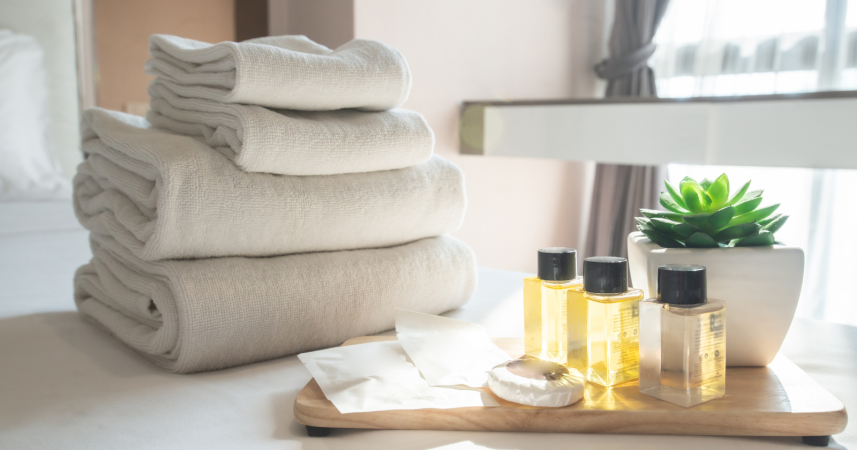
A deep dive into the drawer we all pretend we don't have.
The checkout ritual begins. Suitcase zipped, room key ready, one last sweep of the bathroom—and there they are. Those pristine little bottles you haven't touched all weekend, still arranged on the marble counter like a tiny spa display. You've brought your own full-sized products, used them exclusively, yet somehow these miniatures are definitely coming home with you. Into the bag they go, joining their brethren in that drawer at home. You know the drawer.
This behavior transcends economic brackets. People who can afford the hotels that stock Le Labo amenities are just as likely to pocket them as budget travelers grabbing Best Western basics. The compulsion isn't about need—it's about something deeper, more primal, more revealing than we'd like to admit. That overstuffed drawer of accumulated toiletries is essentially a personality museum, each bottle a tiny artifact of who we are.
The truth is, hotel toiletry collectors aren't just taking home shampoo. They're revealing fundamental aspects of how they move through the world, what they value, what they fear, and what small joys sustain them. These mini bottles might be free, but what they say about us? That's priceless. (Though we'll still feel guilty about the environmental impact while continuing to take them anyway.)
1. They have a complex relationship with abundance
Hotel toiletry collectors often grew up in households where resources required careful management—not necessarily poverty, but awareness. They learned early that things run out, that abundance is temporary, that you take what's offered because who knows when it'll be offered again.
Now, even with bathroom cabinets full of products, they can't shake the reflex. Those hotel bottles represent pure surplus—extras that don't count against any budget, didn't require any sacrifice. They're collecting proof that there's enough, more than enough, so much that they can have backups for their backups.
This mindset extends beyond bathrooms. They're the ones with extra phone chargers in every bag, snacks in desk drawers, backup plans for backup plans. They've built their adult lives around never being caught without, and those mini bottles are just the most visible symptom.
2. They're secretly sentimental memory hoarders
That Westin shampoo isn't just shampoo—it's the anniversary weekend in Chicago. The Marriott lotion is actually that conference where they met their best friend. Each bottle is a physical timestamp, a sensory memory waiting to be activated. They're not collecting toiletries; they're collecting moments.
These people often struggle to throw away ticket stubs, programs, and other "meaningless" paper. Their homes contain hidden archives of experiences, and the toiletry drawer is just another wing of the museum. They understand that memory is fragile and appreciate physical anchors to their past.
When they finally use that saved shower gel months later, they're transported back to that trip, that version of themselves, that moment in time. It's time travel for the price of some mini bottles—honestly, a bargain. The fact that they have seventeen half-used bottles already open doesn't diminish the magic.
3. They find joy in "beating the system"
There's a specific thrill in taking something offered freely by a large corporation. Hotel toiletry collectors experience a tiny revolution every time they clear that bathroom counter. They've paid for the room; these bottles are spoils of war against the hospitality-industrial complex.
This trait often manifests in other areas: they know every happy hour in town, have mastered credit card reward systems, and feel personally victorious when finding a great parking spot. They're not cheap—they're strategic. Life is a game with hidden bonuses, and they're determined to find them all.
The toiletries represent a small win in a world where wins often feel scarce. They've gotten something extra, something beyond the transaction, and that feeling is worth more than the monetary value of the products.
4. They prepare for theoretical emergencies
In the toiletry collector's mind, a shampoo crisis is always imminent. What if they run out mid-shower? What if guests arrive unexpectedly? What if there's a toiletry shortage? (Is that a thing? They're not sure, but they're prepared.) Those mini bottles are insurance against scenarios that will probably never occur.
This preparedness mindset runs deep. They have flashlights that work, first aid kits that aren't expired, and enough non-perishables to survive minor apocalypses. They're also the ones with TSA-approved bottles for their TSA-approved bottles, creating a nested doll situation of travel-sized preparation.
The hotel toiletries are just part of their larger defense system against life's uncertainties. Each tiny bottle is a shield against the chaos of running out, being caught unprepared, facing scarcity.
5. They struggle with letting go
Those bottles from 2015? Still there. The lotion that smells weird? Keeping it. The seventh identical conditioner when they don't even use conditioner? Absolutely staying. Hotel toiletry collectors often have difficulty discarding things that might, someday, somehow, be useful.
This extends beyond bathrooms. Their closets contain optimistic sizes, their garages house projects in permanent pause. They're archivists of possibility, curators of "just in case."
The toiletries are safe to keep—they're small, they don't expire (or do they?), they require minimal space. They're the acceptable face of a deeper reluctance to release anything that crossed the threshold into their possession.
6. They value tangible rewards
In an increasingly digital world, hotel toiletry collectors crave physical evidence of their experiences. They want something to hold, to see, to count. Those bottles are concrete proof of places been, nights slept elsewhere, life lived beyond their daily routine.
These are often the same people who prefer physical books, print concert tickets, and actual photo prints. They understand intellectually that digital is efficient, but emotionally they need the weight of real objects. The toiletries satisfy this need for physical accumulation without requiring significant space or investment.
Each bottle added to the drawer is a small physical trophy. They might not display them, but knowing they're there provides a satisfaction that no digital receipt could match.
7. They're optimistic about future use
"I'll definitely use these when I travel with just a carry-on." "These are perfect for the gym." "Guests will appreciate having options." Hotel toiletry collectors live in a future where all these bottles serve crucial purposes, where their collection transforms from quirky habit to practical resource.
The optimism extends to other areas of life. They buy vegetables with ambitious cooking plans, sign up for subscriptions they'll definitely maximize, keep equipment for hobbies they'll surely resume. They believe in a future version of themselves who needs exactly what they're saving. The pandemic didn't stop the collecting—it just added "hand sanitizer" to the hoard and created a two-year backlog of unused bottles.
The toiletries represent faith in future travel, future guests, future versions of themselves who are organized enough to actually use accumulated mini products. It's hope in bottle form.
8. They have permission issues
Taking hotel toiletries is sanctioned acquisition—the one time it's explicitly okay to take something that isn't technically yours. For people who struggle with treating themselves or spending on "unnecessities," these bottles represent guilt-free gains.
People who struggle with treating themselves or spending on "unnecessities" find these bottles represent guilt-free gains. The collection becomes a safe space for accumulation without the usual accompaniment of guilt. They're not being greedy or wasteful—they're taking what's offered, what's already factored into the room price, what would be thrown away anyway. (The fact that hotels are switching to refillable wall-mounted dispensers is a personal attack they're not ready to discuss.)
9. They find comfort in small consistencies
In a chaotic world, that drawer of toiletries represents order, predictability, abundance. No matter what else is happening, they know they have shampoo. Lots of shampoo. Various brands of shampoo. Shampoo security.
The collectors often create other small consistencies: the same coffee order, the same morning routine, the same brand loyalties maintained for decades. They understand that life is unpredictable, but some things—like having backup soap—can be controlled.
The toiletry drawer becomes a tiny kingdom where they reign supreme, where resources are plentiful, where they've created their own small abundance. It's a manageable universe in miniature form.
Final words
Here's the beautiful truth about hotel toiletry collectors: they've found a harmless way to satisfy deep psychological needs. That drawer full of mini bottles isn't a sign of hoarding or cheapness—it's a complex response to living in an uncertain world where small comforts matter.
They're collecting security in 30ml increments. They're archiving memories in shampoo form. They're asserting control over a tiny corner of the universe where abundance is guaranteed and taking is encouraged. They're preparing for futures that might not come while commemorating pasts that definitely did.
So the next time you eye those hotel toiletries, wondering whether to take them, remember: you're not just deciding about some free shampoo. You're revealing your relationship with scarcity and abundance, past and future, control and chaos. That drawer at home isn't just storage—it's a autobiography written in travel-sized bottles.
And honestly? There are worse ways to navigate the world than with a healthy backup supply of tiny soaps. Take the bottles. Your personality profile is already showing anyway.
If You Were a Healing Herb, Which Would You Be?
Each herb holds a unique kind of magic — soothing, awakening, grounding, or clarifying.
This 9-question quiz reveals the healing plant that mirrors your energy right now and what it says about your natural rhythm.
✨ Instant results. Deeply insightful.