For generations of women who were told to swallow their words, hold back their tears, and never ask for too much, the kitchen became the only place where their love was allowed to bubble over without apology.

Add VegOut to your Google News feed. 
The scent of onions browning in butter still takes me back to my grandmother's kitchen, where something was always simmering, baking, or cooling on the counter. Even at seven in the morning, she'd be there in her housedress, stirring oatmeal or pulling biscuits from the oven.
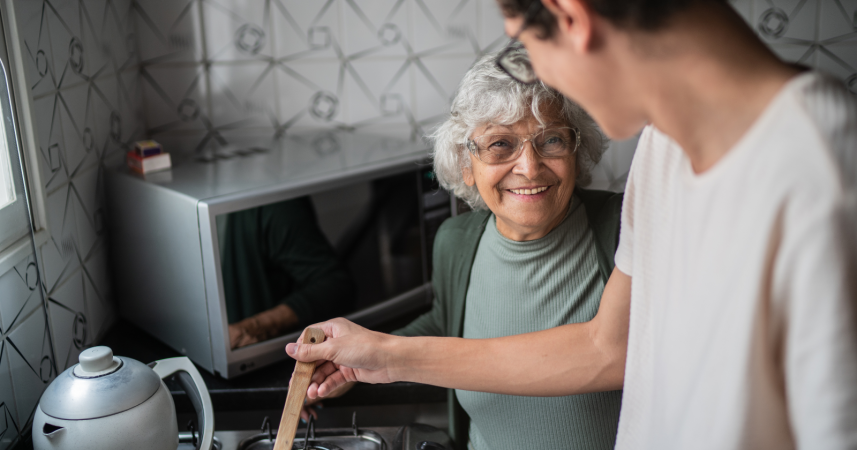
The kitchen wasn't just where she cooked; it was her domain, her altar, her language when words weren't enough or weren't allowed.
I've been thinking about this lately as I watch my own generation of women wrestle with boundaries and self-care, learning at sixty-something what we were never taught at twenty. We're the daughters and granddaughters of women who expressed love through casseroles and pot roasts, through packed lunches and midnight snacks for studying teenagers.
And while there's nothing wrong with cooking for those we love, I've come to understand something profound about why our mothers and grandmothers seemed physically unable to stop feeding people.
When cooking became the acceptable currency of care
Think about the messages women of previous generations received. Don't be too emotional. Don't be needy. Don't ask for too much. Don't take up space. But cooking? Cooking was safe. Cooking was expected. Cooking was praised.
My mother, a seamstress who taught me that creativity and practicality could coexist, once told me that her own mother would start preparing dinner at three in the afternoon.
Not because the meal was complicated, but because the kitchen was where she could pour all that unexpressed emotion into something tangible. Every chopped vegetable, every stirred pot, every kneaded dough was an "I love you" that didn't require vulnerability.
These women weren't allowed to say "I'm scared for you" when their husbands lost jobs, but they could make their favorite meal. They couldn't say "I miss you desperately" when children left for war or college, but they could pack care packages filled with cookies.
They couldn't even admit to themselves sometimes how lonely marriage could be, but they could perfect a recipe for apple pie that would earn praise at church socials.
The inheritance we didn't know we were receiving
When I found my mother's old recipe box after she passed, I discovered more than instructions for casseroles. Tucked between the index cards were bits of her heart. Notes like "Make this when someone's sick" or "John's favorite - double the sugar." Each recipe was a map of her emotional life, showing where she was allowed to express care without judgment.
I realize now that I inherited this tendency. Every Monday, I make soup using whatever needs to be used up from the week before, but it's really about more than frugality. It's about that meditative chopping, that transformative simmering, that ability to create something nourishing from scattered pieces.
During a particularly hard winter after my husband passed, I started baking bread every Sunday. The kneading became a prayer, the rising a meditation on hope, the sharing with neighbors a connection when I felt most alone.
But here's what I've learned that perhaps my grandmother never could: it's okay to also use words. It's okay to say "I love you" without following it with "Would you like something to eat?" It's okay to receive care without immediately rushing to the stove to reciprocate.
Breaking the pattern without breaking the bond
Do you find yourself automatically offering food when someone shares difficult news? Do you feel anxious when guests leave without eating something you've made? These impulses run deep, passed down through generations like cast iron skillets and hand-written recipes.
The challenge isn't to stop cooking for others - food as love isn't inherently wrong. The challenge is to recognize when we're hiding behind our spatulas, when we're using meals as a substitute for conversations we're afraid to have or affection we're scared to show in other ways.
I think about young mothers today who post about the mental load of feeding their families, and I want to tell them: yes, it's exhausting, but also look deeper.
Are you trying to prove your worth through perfectly packed lunchboxes? Are you apologizing for working outside the home through elaborate dinners? Are you expressing feelings through food that you could also express through words, through presence, through simply being?
Reclaiming the kitchen on our own terms
Virginia Woolf wrote about needing a room of one's own. Our grandmothers had kitchens, but they weren't entirely their own - they were spaces of service, duty, proof of worthiness. What would it look like to cook from joy rather than obligation? To feed people because we want to share pleasure, not because it's the only acceptable way to share love?
I still cook for my family when they visit. My adult children know they'll find my refrigerator stocked with their favorites. But now I also tell them directly that I love them. I ask for hugs. I share my fears and my joys with words, not just through the language of meals.
My family didn't have much money growing up, but we always had Sunday dinner together.
I treasure those memories, the gathering around a table laden with my mother's efforts. But I also remember the tiredness in her eyes, the way she'd barely sit down before jumping up to fetch something else, the way compliments on her cooking seemed to sustain her more than the food itself.
Final thoughts
Your grandmother's constantly cooking kitchen was a sanctuary and a prison, a place of creation and limitation. We can honor these women by understanding their language of love while also expanding our own vocabulary.
We can keep their recipes while writing new rules. We can feed people because we choose to, not because it's the only permission slip we have to show care. The aroma of something always cooking doesn't have to be our only love song anymore.
What’s Your Plant-Powered Archetype?
Ever wonder what your everyday habits say about your deeper purpose—and how they ripple out to impact the planet?
This 90-second quiz reveals the plant-powered role you’re here to play, and the tiny shift that makes it even more powerful.
12 fun questions. Instant results. Surprisingly accurate.