That folded atlas tucked behind the registration isn't just outdated technology — it's a paper monument to thousands of moments when knowing the way home was an act of love, and being the one who could find it meant everything.

Add VegOut to your Google News feed. 
The worn Rand McNally atlas slides out from behind the registration papers with that familiar whisper of glossy paper against vinyl.
Its corners are soft from years of handling, and when you flip it open, the creases along Route 66 and I-95 tell their own stories of family road trips and cross-country moves. This isn't just any map.
This is the one that guided your father through his first job interview three states away, the one he consulted when he drove your mother to the hospital the night you were born, the one he spread across the hood of the car during that summer thunderstorm when the kids were small and cranky and everyone just needed to find a motel.
I've been thinking about these maps lately, especially after watching my neighbor carefully fold his atlas back into his glove compartment last week while his grandson laughed and waved his phone, showing him the GPS app for the hundredth time. The grandson doesn't understand that this isn't about refusing to embrace technology. It's about something much deeper.
When navigation was an act of independence
There was a time when getting from point A to point B required more than speaking into a device or typing an address.
It demanded planning, spatial reasoning, and the confidence to trust your own judgment. You had to understand scale, recognize landmarks, and make decisions at every intersection. My late husband used to say that reading a map was like having a conversation with the landscape itself.
I remember teaching my oldest granddaughter to drive a few years back, and one afternoon, I deliberately left my phone at home. "We're going to find the DMV the old-fashioned way," I told her, pulling out a folded map from my purse. She looked at me like I'd suggested we navigate by the stars.
But by the end of that afternoon, she understood something about orienting yourself in space, about knowing where north is, about recognizing that streets have patterns and cities have logic. She understood what it felt like to figure something out for yourself.
The men of my father's generation didn't just use maps to get places. They used them to prove something fundamental about their capability. Every successful arrival at a destination was a small victory, a confirmation that they could provide, protect, and lead their families through unknown territory.
When my father worked as a mailman, he knew every street in our town not because of any GPS, but because he'd walked them, studied them, committed them to memory. That knowledge was part of his identity.
The weight of competence in your hands
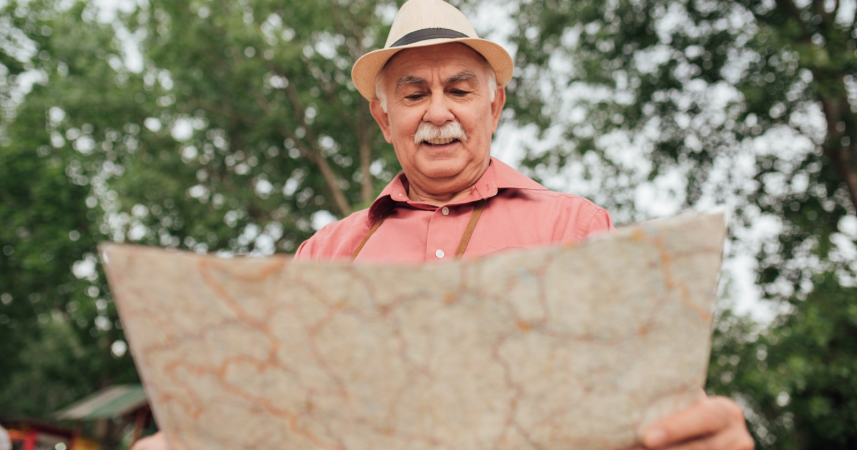
Have you ever noticed how differently people hold objects that matter to them? There's a particular way these men handle their maps, unfolding them with practiced precision, running their fingers along the routes with the same care they might use to smooth their daughter's hair. This physical relationship with navigation tools represents something we've largely lost.
When everything is automated, when a pleasant voice tells you exactly when to turn and recalculates without judgment when you miss it, where is the space to prove your competence? Where is the small daily challenge that reminds you that you can figure things out, solve problems, make decisions that matter?
During those seven years I cared for my second husband through his Parkinson's disease, I watched him struggle with losing various abilities. But one of the hardest losses for him wasn't physical. It was the day he could no longer navigate on his own, could no longer be the one who knew the way.
That paper map in his glove compartment became almost sacred to him, a reminder of who he had been, of the thousands of times he'd successfully guided us somewhere new.
Memory lives in objects
Objects hold our histories in ways that digital files never quite can. That map isn't just paper and ink; it's a repository of memory. Every fold, every coffee stain, every penciled note in the margin represents a moment when that person was fully engaged with the world, making decisions, taking responsibility, being needed.
I wrote once about how we often mistake practical skills for mere tasks, when really they're expressions of love and care. The same is true for navigation. When your father pulls out that map, he's not just finding a route. He's reconnecting with a version of himself who was essential, who was the one everyone turned to when they were lost, who could always find the way home.
Think about the last time you were genuinely lost, I mean really lost, without cell service, without GPS. Remember that flutter of panic? Now imagine transforming that panic into competence using nothing but your wits and a piece of paper. That's the feeling these maps represent. That's the power they hold.
The art of being needed
As we age, the world seems increasingly eager to convince us we're no longer necessary. Technology promises to do everything for us, from remembering our appointments to navigating our routes. But human beings need to be needed. We need to contribute, to solve problems, to be the person others turn to for guidance.
Those paper maps represent an era when fathers were the navigators, when being asked "Do you know how to get there?" was an opportunity to demonstrate knowledge and reliability. In our rush to make everything easier, we've perhaps made it too easy to feel superfluous.
When I finally overcame my fear of technology by taking classes at the senior center, I learned to appreciate what GPS could offer. But I also kept my old atlas, because there's something irreplaceable about understanding the bigger picture, about seeing how cities connect, about choosing your own route rather than blindly following the suggested one.
Final thoughts
That paper map in your father's glove compartment is a talisman against irrelevance. It's a physical reminder of countless moments when he was the one who knew the way, when his knowledge and judgment mattered, when getting somewhere was an accomplishment rather than an afterthought.
So the next time you see him carefully refolding that worn atlas, resist the urge to show him your phone again. Instead, maybe ask him about a trip he remembers, a route he discovered, a time when knowing the way made all the difference.
You might be surprised by the stories that unfold, as intricate and meaningful as the roads on those well-creased pages.