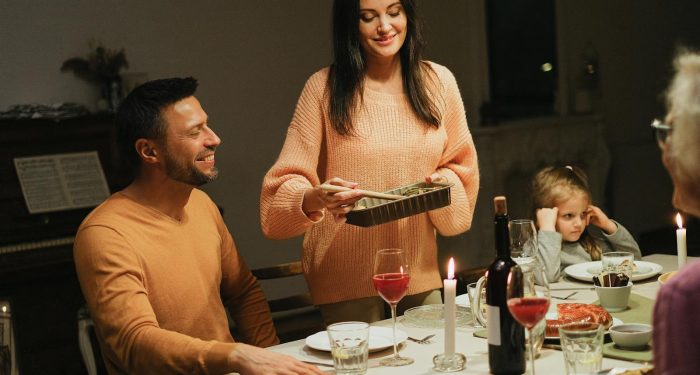
This hidden legacy of factory whistles and shift changes still dictates when millions of American families sit down for dinner, revealing an invisible class divide that most people never realize shapes their daily lives.

Add VegOut to your Google News feed. 
Last week, I found myself at the grocery store around 4:30 PM, and the parking lot was absolutely packed.
As I navigated through aisles crowded with people rushing to grab rotisserie chickens and pre-made salads, it struck me how many of these shoppers were clearly racing against the clock to get dinner on the table by 5:00 or 5:30.
The woman next to me at the deli counter checked her watch three times while waiting for her order, muttering something about needing to have everything ready before her husband got home.
This scene plays out in grocery stores across America every single day, particularly in working-class neighborhoods. And it got me thinking about something I've observed for years but never really examined: why do so many families, especially those from lower middle-class backgrounds, eat dinner so remarkably early?
The answer isn't what you might think. It's not about being particularly hungry at 5 PM, and it's not even really about modern work schedules. The truth runs much deeper, rooted in generational patterns that shape our daily rhythms in ways we rarely acknowledge.
The inheritance of industrial time
When you grow up in a working-class household, time operates differently. Your grandparents likely worked in factories, mills, or other industrial jobs where shifts started at dawn and ended by mid-afternoon.
The 7-to-3 shift wasn't just a schedule; it became the architecture of family life. Dinner at 5 PM made perfect sense when Dad walked through the door at 3:30, had cleaned up by 4, and Mom had been preparing the meal since she got home from her part-time job.
These patterns don't disappear just because the economy changes. They get passed down like family recipes, embedded in our muscle memory. Even when those factory jobs vanished and were replaced by service work with different hours, the rhythm remained.
Why? Because that's when Grandma cooked dinner, and that's when Mom learned to cook dinner, and that's when you learned that dinner happens.
I think about my own childhood, where dinner at 5:30 was as fixed as the sunrise. It didn't matter that my father's schedule had changed over the years, or that we weren't actually hungry yet. That was simply when families ate. To eat later would have felt wrong somehow, like wearing shoes in the house or leaving dishes in the sink overnight.
The economics of evening time
There's also a financial reality that people don't often talk about. When you eat dinner early, the evening stretches out before you, long and empty. For families without disposable income for evening activities, restaurants, or entertainment, this creates a particular kind of challenge. But eating early solves this in a peculiar way.
An early dinner means kids can be bathed and in bed by 7:30 or 8:00. It means adults can settle in for the evening without the expense of going out. It means the kitchen can be cleaned and closed for the night, reducing the temptation for expensive snacking or second dinners. The early dinner becomes a financial boundary as much as a temporal one.
Have you ever noticed how different this is from upper-middle-class households? There, dinner at 7:30 or 8:00 PM is common, partly because there's usually money for after-school activities that run late, for takeout when things run over, for the flexibility that comes with financial cushion. Time, like everything else, bends differently when you have resources.
The weight of respectability
In working-class culture, there's enormous pride in maintaining certain standards despite financial constraints. An early, home-cooked dinner is one of those standards. It signals discipline, properness, and family values. It says: we may not have much, but we sit down together for a proper meal at a proper time.
This isn't superficial. It's about dignity. When you can't afford to take your kids to Disney World or buy them the latest gadgets, you can still provide structure, routine, and togetherness. You can still say, "In this family, we eat dinner together at 5:30," and that becomes something solid in a world where so much else feels precarious.
I remember a conversation with a neighbor years ago who mentioned she'd started serving dinner at 7 PM after getting a promotion at work. Within a month, she'd switched back to 5:30. "It just didn't feel right," she said.
"Like we were trying to be something we're not." That comment has stayed with me because it captures something essential about how class identity is maintained through these small, daily practices.
Breaking the pattern costs more than you think
Here's what happens when someone from this background tries to shift to a later dinner schedule: it feels like betrayal.
Not dramatic betrayal, but a subtle disconnection from your roots. You might find yourself defending it to relatives: "Oh, we just got busy," or "The kids have activities." But underneath, there's often guilt, as if eating at 7:30 means you've forgotten where you came from.
The psychological cost of changing these patterns is real. It requires not just changing a schedule but reimagining your identity. It means potentially creating distance from family members who still maintain the early schedule. It means your kids might not fit in with their cousins who are already bathed and in pajamas by the time your family is sitting down to eat.
These embedded patterns shape everything from social relationships to career choices. How many people have turned down evening classes, networking events, or career opportunities because they conflicted with that 5:30 dinner time? How many relationships have strained because one partner came from an early-dinner family and the other didn't?
Final thoughts
Understanding these patterns isn't about judgment; it's about recognition. These early dinners are not a quirk or a preference but a inheritance, passed down through generations like bone structure or eye color. They're woven into the fabric of identity, carrying the echoes of factory whistles and shift changes, of making do and maintaining dignity.
The next time you notice a packed grocery store at 4:30 PM or see families filing into restaurants at 5:00, remember that you're witnessing something more than a scheduling choice.
You're seeing the persistent patterns of class and culture, the invisible architecture that shapes our days. And perhaps, in understanding this, we can be more gentle with ourselves and others about the rhythms we keep and the reasons we keep them.