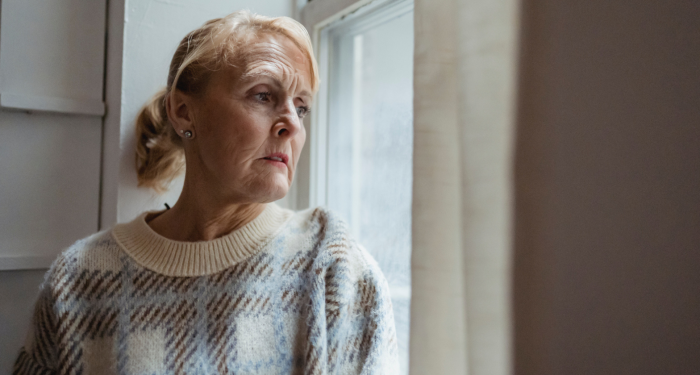
She had given thirty years to building their lives, yet now stood invisible in her own kitchen, listening to her children's laughter echo from a world she'd never had time to explore.

Add VegOut to your Google News feed. 
Last Thanksgiving, I watched my friend Susan stand alone in her own kitchen, surrounded by the laughter of her adult children in the next room.
She was arranging appetizers on a platter, the smell of sage and butter filling the air, while her grown kids swapped stories about their lives—lives she'd sacrificed everything to build.
The scene struck me with such force that I had to step outside for a moment. There's a particular kind of isolation that comes from being the foundation everyone else stands on, yet somehow becoming invisible in the process.
We don't talk enough about this phenomenon.
The parent who gave decades to raising a family often becomes a stranger at their own table, listening to conversations about worlds they never got to explore, watching connections form between siblings who no longer need their referee, their counsel, or their midnight comfort.
It's a loneliness that cuts deeper because it happens in plain sight, surrounded by the very people you love most.
When your identity becomes "mom" or "dad" and nothing else
I spent fifteen years as a single mother, and somewhere along the way, I forgot I had a first name.
Every decision I made was filtered through the lens of what my two children needed.
Would taking that evening class mean less help with homework? Could I afford new work shoes if it meant skipping their school field trip fees?
Working two jobs meant I became an expert at showing up physically while being mentally three places at once.
I'd sit at school plays calculating whether I had enough gas to make it to payday; I'd help with science projects while mentally meal-planning with whatever was left in the pantry.
The person I was before children—the one who read poetry for pleasure, who had opinions about movies, who dreamed of learning Italian—she got filed away like old tax returns, important once but now just taking up space.
The cruel irony is that this erasure of self is exactly what good parenting looked like to me then.
Every hobby abandoned, every friendship that withered, every dream deferred felt like proof of my commitment.
What I didn't realize was that I was slowly becoming a ghost in my own life, present but not really there, visible but not really seen.
The conversation gap that nobody prepared you for
Have you ever sat at a table where everyone is discussing their careers, their travels, their latest passions, and realized you have nothing to contribute? Because your stories all revolve around other people's achievements?
"Remember when you won that science fair?" doesn't quite flow in a conversation about someone's recent promotion or sabbatical in Portugal.
This gap becomes a canyon at family gatherings.
Your adult children have developed entire personalities, friend groups, and interests that you know about but haven't experienced.
They reference inside jokes from their workplaces, debate podcasts you've never heard of, discuss restaurants in neighborhoods you've never visited.
You smile and nod, genuinely happy for their full lives, while simultaneously feeling like a tourist in your own family.
The hardest part is that nobody means for this to happen.
Your children aren't trying to exclude you when they dive into discussing their shared generational experiences.
They simply can't fathom that while they were becoming themselves, you were too busy ensuring they had that opportunity to do much becoming of your own.
Now read: A true American doesn't just have a passport — they exhibit these core values
Why grown children sometimes feel like familiar strangers
Virginia Woolf once wrote, "For most of history, Anonymous was a woman," and I think about this when I see parents—especially mothers—at family gatherings.
We become anonymous in our own families, known for our functions rather than our personalities: The cook, the organizer, the one who remembers birthdays and allergies, but rarely the one whose thoughts and dreams enter the conversation.
I made the mistake of leaning too heavily on my eldest when his father left.
At twelve, he became "the man of the house," a title no child should carry.
Now, decades later, I watch him at family dinners, still feeling responsible for keeping conversations light, still checking if everyone has what they need.
I've apologized for this burden I placed on young shoulders, but apologies can't give back a childhood.
The dynamic we established in survival mode became the blueprint for our relationship, and breaking those patterns feels like trying to rebuild a house while living in it.
Your children grow into people you might not have chosen as friends, and that's okay—it's supposed to be that way.
But it can leave you feeling unmoored when you realize the people who know you best actually know only one version of you, the parent version, which was never the complete picture.
The courage it takes to become yourself again
Here's what I wish someone had told me sooner: It's not selfish to maintain your identity while raising children.
The parent who has interests, friendships, and dreams outside of their children gives those children permission to do the same.
But if you're reading this and thinking it's too late, let me stop you right there.
I took up writing seriously at sixty-six, after thirty-two years of teaching high school English.
In a previous post, I talked about how finding purpose after retirement saved me from disappearing entirely.
The same principle applies here. It's never too late to introduce your family to who you really are, who you've always been underneath the role of caregiver.
Share a memory from before they were born that has nothing to do with them.
Express an opinion about something beyond family logistics.
Admit to a dream you still harbor.
Yes, it will feel uncomfortable.
Your children might be surprised, even resistant.
They've built their understanding of you around your role in their lives, and expanding that image takes time.
Final thoughts
If you're the loneliest person at your family gathering, feeling invisible despite being surrounded by people you raised, please know you're not alone in this experience.
The love you have for your children and the loneliness you feel in their presence can coexist.
Both are real, both are valid, and neither cancels out the other.
The path forward is about seeing yourself as worthy of being known, regardless of anyone else's perception.
You spent decades building a family.
Now, it's time to rebuild yourself, not in opposition to that role, but in expansion of it.
The person who raised everyone in that room has stories worth telling, dreams worth pursuing, and a life worth living fully, not just in service to others but in celebration of yourself.