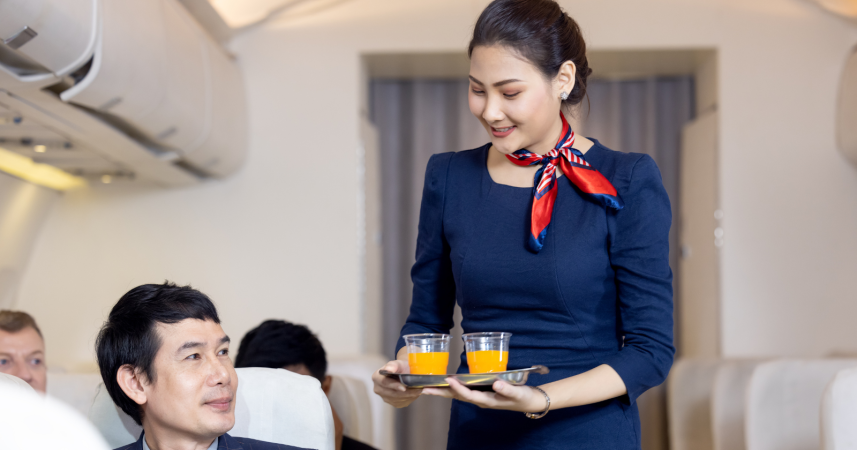
At 35,000 feet, a simple drink order can quietly change how you’re perceived. Ordering tomato juice signals familiarity with flying, body awareness, and calm competence, and flight attendants often respond to that unspoken cue with a more relaxed, attentive energy most passengers never realize exists.

Add VegOut to your Google News feed. 
I discovered this completely by accident, somewhere over the Atlantic on a long haul flight that blurred into all the others before it.
I was tired, slightly dehydrated, and already thinking about how stiff my legs would feel when we landed.
When the flight attendant reached my row and asked what I wanted to drink, I didn’t overthink it.
I said tomato juice, mostly because my body felt like it needed something savory instead of another coffee or glass of wine.
Her reaction was subtle, but unmistakable.
She smiled differently, nodded like I had just said something sensible, and replied with a relaxed “coming right up.”
It felt less like a transaction and more like a small moment of recognition.
At first, I brushed it off as nothing. But then it happened again on another flight, and then again months later on a red eye heading west.
Eventually, curiosity kicked in.
Why tomato juice tastes better in the air
There’s a scientific reason tomato juice hits differently at 35,000 feet, and it has nothing to do with nostalgia or airline tradition.
Our sense of taste changes at altitude, especially when it comes to sweetness and saltiness.
Dry cabin air, lower pressure, and background noise dull certain flavors while leaving others intact.
Umami, that savory depth found in tomatoes, holds up far better than sugar or subtle aromatics.
That’s why tomato juice tastes fuller and more satisfying on a plane than it ever does on the ground.
The salt feels balanced, the acidity wakes you up, and the whole thing just works with how your body feels mid flight.
Flight attendants know this instinctively. So do frequent flyers who have learned to listen to their bodies after years of flying.
The unspoken signal most passengers miss
Here’s where things get interesting.
When you order tomato juice without hesitation, you’re signaling something without saying a word.
You’re telling the person serving you that you’ve been here before.
Most passengers default to water, soda, coffee, or wine because those are familiar and socially reinforced choices.
Tomato juice feels oddly specific if you don’t already know about it.
That specificity matters.
To a flight attendant who serves hundreds of passengers a week, patterns become second nature.
Certain behaviors correlate with certain types of passengers, and drink orders are one of the quickest tells.
How flight attendants read the room
Flight attendants operate in a high pressure environment where safety always comes first and comfort is constantly being negotiated.
They’re trained to read people quickly and adapt on the fly.
They notice who is anxious, who is demanding, who is confused, and who is relaxed.
Over time, they build an internal map of behaviors that predict smooth flights versus difficult ones.
Ordering tomato juice often lands you in the “experienced and adaptable” category.
It suggests you understand how flying affects your body and that you won’t fight the environment.
That doesn’t mean you’ll get special favors or upgrades. It means the interaction starts from a place of ease instead of caution.
My years in hospitality made this obvious
Before I started writing full time, I spent my twenties working in luxury food and beverage. Different setting, same human psychology.
In restaurants, the guests who ordered calmly and precisely were almost always easier to serve. They didn’t need to prove anything, and they rarely caused friction.
Staff naturally relaxed around them.
It wasn’t about wealth or status. It was about awareness.
Ordering tomato juice on a plane carries that same quiet competence.
This is not a trick or a hack
Let’s get this out of the way.
This is not a guaranteed way to get better service, free drinks, or special treatment. Flight attendants are professionals, not NPCs running on scripts.
What’s happening here is subtle and human.
When someone behaves in a way that signals familiarity with an environment, others respond with less tension.
It’s an unconscious adjustment, not a calculated reward.
The juice itself is almost irrelevant. The signal is what matters.
Why frequent flyers gravitate toward it
People who fly often learn to optimize for comfort instead of indulgence.
They stop chasing novelty and start choosing what actually helps them feel human when they land.
Tomato juice hydrates better than alcohol, provides electrolytes, and doesn’t spike your energy only to crash later. It’s practical, not glamorous.
That practicality is what makes it recognizable.
When flight attendants see someone make that choice, they often assume this person knows how to take care of themselves mid flight.
That assumption changes the tone of the interaction.
The psychology of perceived competence

There’s a concept in psychology that competence reduces stress in others.
When someone appears capable and self sufficient, it lowers the mental load for everyone around them.
Flight attendants juggle safety checks, service, passenger emotions, and constant interruptions.
Anything that reduces uncertainty is welcome.
A passenger who orders tomato juice without fuss feels predictable in the best possible way.
Predictability is calming in a high responsibility environment.
This applies far beyond airplanes.
How this shows up everywhere else
Once you notice this pattern, you start seeing it everywhere.
In restaurants, it’s the guest who orders confidently and doesn’t need to scan the menu for ten minutes.
In gyms, it’s the person who wipes down equipment without being told.
In meetings, it’s the person who asks clear questions instead of performative ones.
People respond to these signals instinctively.
Tomato juice just happens to be the airline version of that behavior.
Why most people never learn this
Most passengers are focused on getting through the flight as comfortably as possible.
They’re tired, distracted, or stressed, and there’s nothing wrong with that.
They’re not observing the micro interactions between crew and travelers. They’re not looking for patterns or signals.
So this detail stays hidden.
It gets passed quietly between people who fly often, usually through offhand comments or shared moments rather than articles or guides.
What ordering tomato juice says about you
Without meaning to, you’re communicating a few things.
You’re comfortable being slightly unconventional. You’re paying attention to how your body feels. You’re not trying to impress anyone.
That combination reads as grounded and self aware.
In social situations, those traits tend to invite warmth.
This has nothing to do with being “better”
It’s important to say this clearly.
Ordering tomato juice doesn’t make you superior, enlightened, or part of a secret club. It just aligns you with the reality of flying.
You’re adapting instead of resisting.
That mindset shows up in small ways, but it compounds over time.
How I think about this now
After noticing this pattern repeatedly, I started paying attention to other moments where small choices changed the energy of an interaction.
Not to manipulate outcomes, but to understand how environments work.
Airplanes, restaurants, workplaces, and relationships all have unspoken rules. When you learn them, things get smoother without effort.
That’s not luck. It’s literacy.
If you want to try it
If you already like tomato juice, order it on your next flight and notice how it feels. Pay attention to your body and the interaction, not just the taste.
If you hate it, don’t force yourself. The point isn’t the drink.
The point is awareness.
Why this matters for living better
If you’re interested in food, wellness, and self development, this detail fits perfectly into that worldview.
It’s about choosing what actually supports you instead of what’s expected.
Living better isn’t about optimization or perfection. It’s about small adjustments that reduce friction and increase ease.
Tomato juice on a plane is one of those adjustments.
Finally, the bigger takeaway
Finally, what stuck with me most wasn’t the change in service or the quiet nod of recognition.
It was how much of our experience is shaped by things we barely notice.
Tiny signals influence how people respond to us every day. Once you start paying attention, you realize you have more agency than you thought.
Sometimes that agency looks like a confident decision or a calm question.
Sometimes it looks like a plastic cup of tomato juice at cruising altitude.
Either way, the lesson is the same.
Notice the environment, respect it, and choose accordingly. Over time, life starts meeting you with a little more ease.