The loneliest part of losing your spouse isn't the empty bed or silent dinners — it's standing in your kitchen on a random Tuesday and suddenly understanding that you're now the only person alive who remembers the hearts he drew in the steam on the windows while you made soup in 1989.

Add VegOut to your Google News feed. 
Everyone warns you about the empty chair at dinner. They tell you about the silence that fills the house, the cold side of the bed, the way holidays will never feel quite the same.
When my husband died two years ago, I was prepared for all of that. What caught me completely off guard was something else entirely: the slow, creeping realization that I had become the sole keeper of thousands of tiny, insignificant memories that suddenly felt like everything.
It happened on an ordinary Tuesday afternoon. I was making tea, and the steam from the kettle reminded me of how our kitchen used to fog up when I'd make his mother's soup recipe back in 1989.
The windows would drip with condensation, and he'd draw little hearts in the moisture while I stirred the pot. Such a nothing moment, really.
But standing there in my kitchen, I understood with crushing clarity that no one else on this planet remembered that afternoon, that soup, those hearts drawn in steam. The memory existed only in me now, and when I go, it goes too.
The weight of being the last witness
Have you ever thought about how many moments of your life exist only because someone else was there to share them? Not the big moments that get photographed and discussed at family gatherings, but the small ones.
The way you both laughed until you cried at a joke that wouldn't be funny to anyone else. The shorthand language you developed over decades. The way he knew exactly how you liked your coffee on mornings when you were running late versus lazy Sundays.
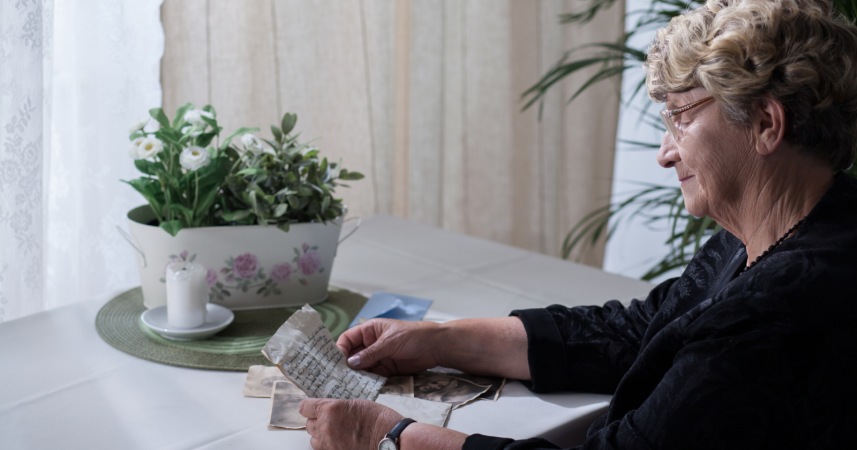
During those six months after he died when I barely left the house, I found myself cataloging these memories obsessively. I'd sit with photo albums, but the pictures only told part of the story.
They couldn't capture the conversation we had right before the camera clicked, or the restaurant we went to after, or how we got lost on the way home and ended up discovering that little park we returned to every spring for the next twenty years.
Virginia Woolf once wrote that "The past only comes back when the present runs so smoothly that it is like the sliding surface of a deep river."
But what she didn't mention is what happens when the other person who swam in that river with you is gone. The past comes back, yes, but it comes back orphaned, untethered, impossible to verify or share.
Learning to hold memories differently
The widow's support group I joined helped me understand I wasn't alone in this particular flavor of loneliness. One woman described it as becoming a "memory hoarder," desperately trying to keep every small recollection alive because letting even one slip away felt like another death.
Another called it "emotional archeology," constantly excavating the past because the present felt too empty to inhabit.
But here's what I've learned after two years of wrestling with this: trying to preserve every memory is like trying to hold water in your hands. The tighter you grip, the more slips through your fingers. Instead, I've had to learn a different way of holding these moments.
I started writing them down, not in any organized way, just fragments as they came to me. The way he always put his keys in the refrigerator when he was distracted.
How he insisted on testing every couch in the furniture store by lying down completely, mortifying me every single time. The particular way he said "I love you" when he was sleepy, different from his fully awake version.
These aren't stories for anyone else. They're just proof that these moments happened, that this specific love existed in this specific way.
The unexpected gift of shared forgetting
Do you know what's strange? Sometimes I'm grateful that certain memories are mine alone now. Not the beautiful ones, but the difficult ones.
The arguments that seemed so important at the time but were really about nothing. The ways we disappointed each other. The petty resentments that built up over decades of daily life.
There's no one left to rehash old grievances with, no one to confirm that yes, that fight about the garage renovation in 2003 really was as ridiculous as it seems now. Those memories are fading, and I'm letting them.
In some way, this forgetting feels like a final act of love, choosing which stories survive and which ones don't.
Building new containers for old memories
Recently, I've started sharing different kinds of memories with my support group friends. Not the big biographical facts, but the texture of daily life with someone.
How it felt to grocery shop as a unit, one person pushing the cart while the other read from the list. The negotiations over what to watch on TV. The way you could have an entire conversation across a crowded room with just eyebrows and slight head tilts.
These women understand because they have their own versions of these losses. We've become each other's witnesses, not to the specific memories but to the fact that they mattered, that this kind of intimate knowledge of another person is both the most ordinary and most sacred thing in the world.
I wrote once before about how grief doesn't shrink, you just grow larger around it. What I understand now is that the same is true for memories. They don't have to stay perfectly preserved to remain meaningful. They can shift and soften and still be true. They can exist in just one mind and still have happened.
Final thoughts
Last week, I made that soup again for the first time since he died. The kitchen didn't fog up the same way because I've replaced the windows, and there was no one to draw hearts in the steam. But I remembered, and that was enough. Not perfect, not complete, but enough.
If you're walking this path too, know this: you're not crazy for mourning the loss of shared memory as much as you mourn the person. You're not selfish for wanting someone, anyone, to remember what your Thursday nights looked like in 1994.
And you're not failing if some memories slip away despite your best efforts to hold onto them. You're simply human, carrying what you can, leaving the rest behind with as much grace as you can muster. That's all any of us can do.