While my grown children worry I'm clinging to the past, they don't understand that these twelve minutes of arranging placemats and lighting candles are actually my daily rebellion against a world that insists eating alone should mean eating less beautifully.

Add VegOut to your Google News feed. 
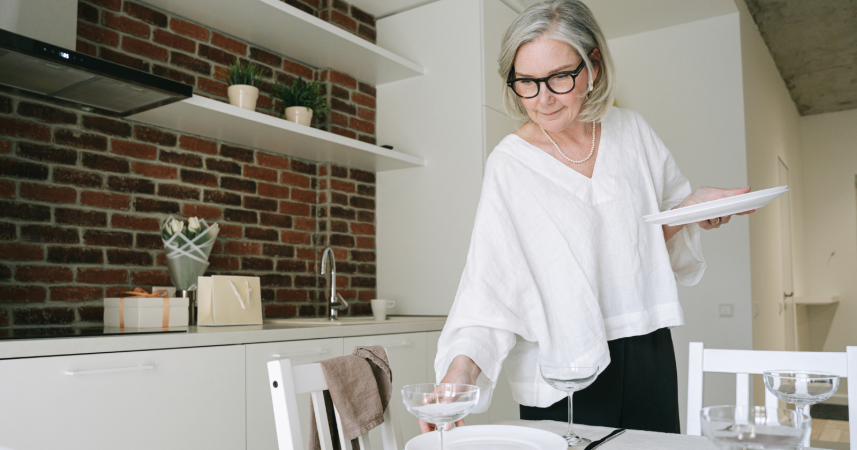
Every evening at 6:30, I pull out the woven placemats my daughter gave me fifteen years ago. They're starting to fray at the edges now, little threads catching on my fingernails as I smooth them down.
The cloth napkins come next, pressed and folded into neat triangles the way my mother taught me. I set out the good silverware, the wedding china that survived two marriages, and light the single candle that flickers in the center of my kitchen table.
The ritual takes me exactly twelve minutes. I've timed it. And for the next hour, as I sit down to whatever I've prepared that evening, something shifts. The empty chairs around me don't feel quite so empty.
The quiet doesn't press quite so hard against the windows. For that one precious hour, I'm not a widow eating alone. I'm the woman who once orchestrated dinner for five every single night, who knew exactly how much pasta to cook and which child would trade their vegetables for an extra dinner roll.
The power of keeping our rituals alive
Have you ever noticed how certain actions can transport you through time? Setting my table each night isn't about denial or pretending my life hasn't changed dramatically. It's about honoring the continuity of who I've been and who I still am. When I unfold that napkin across my lap, I'm connected to every dinner I've ever hosted, every conversation that's echoed across these dishes.
During my years teaching high school English, I often shared with my students how rituals anchor us in meaning. We read about tea ceremonies in Japanese literature, about Sabbath dinners in Jewish memoirs, about Sunday suppers in Southern novels. These weren't just meals; they were declarations of identity, moments of intentional living carved out of ordinary time.
Now I understand this truth in my bones. My evening table setting is my daily declaration that I still deserve beauty, that my solitary dinner matters as much as any feast I've ever prepared. When friends occasionally express concern about this habit, suggesting it might be "too much trouble" or wondering if it makes me sad, I want to tell them they're missing the point entirely.
This isn't burden or melancholy. This is triumph.
Why we diminish ourselves when life gets smaller
Somewhere along the way, our culture decided that effort should match audience size. Cook elaborately for guests, but heat up soup from a can when you're alone. Use the good dishes for company, but eat from paper plates when it's just you. We've internalized this strange mathematics that says one person equals minimal effort, as if our own presence at the table doesn't count.
I refuse to participate in this self-diminishment. Every Monday, I still make soup from whatever needs using up from the week before, filling my kitchen with the smell of simmering vegetables and herbs.
Sometimes I freeze portions, sometimes I share with neighbors, but often I simply enjoy it throughout the week, ladling it into my good bowls, setting it on my placemat, treating myself as the honored guest I am in my own home.
Virginia Woolf wrote about the importance of "a room of one's own," but I'd argue we also need a properly set table of our own. Not because we're trying to impress anyone or maintain appearances, but because these acts of care toward ourselves are how we stay fully human, fully present, fully alive.
Remembering without drowning in memory
People often ask if eating alone at my carefully set table makes me miss my family more. The truth is, I miss them whether I'm eating off fine china or standing at the kitchen counter with a yogurt container. Grief doesn't need table settings to find us; it knows exactly where we live.
What my evening ritual does is transform that missing into something active rather than passive. As I arrange the silverware just so, I remember teaching my children which fork goes where, their teenage eye rolls when I insisted on "proper" table manners.
When I light the candle, I think of my second husband, who I met at a school fundraiser when I accidentally outbid him on a weekend getaway package. He always dimmed the lights for dinner, said food tasted better by candlelight. Seven years of Parkinson's couldn't dim his appreciation for a beautifully set table.
These memories don't ambush me; I invite them. There's a difference between being haunted by the past and choosing to honor it. My table becomes a bridge between then and now, a place where all the versions of myself can coexist peacefully.
The unexpected freedom in maintaining standards
Here's what surprised me most about maintaining this practice: it's incredibly liberating. When you decide that you deserve the same care and attention you once lavished on others, something shifts. You stop waiting for special occasions. You stop postponing joy until someone else can witness it. You realize that you are reason enough for celebration.
Last week, I made myself a single serving of coq au vin, a dish I used to reserve for dinner parties. As I sat down to eat it, napkin in lap, wine in a proper glass, I laughed out loud at the absurdity and beauty of it all. Here I was, seventy years old, performing a daily act of rebellion against the notion that solitary equals sad, that alone means less than.
In a previous post, I wrote about finding purpose after retirement. This ritual has become part of that purpose, a daily practice that reminds me I'm still the curator of my own experience, still capable of creating beauty and meaning from the simplest materials: a plate, a napkin, a meal prepared with care.
Final thoughts
Tonight, like every night, I'll clear away my single place setting, blow out the candle, and fold my napkin for tomorrow's use. The ritual will take another twelve minutes, maybe fifteen if I move slowly, savoring the transition from dinner to evening.
Some might see an elderly woman clinging to the past, but I see something else entirely: a woman who refuses to abandon herself, who understands that self-respect is spelled out in small, daily actions, who knows that the way we feed ourselves is the way we love ourselves.
The table will be empty again until tomorrow evening, but that's alright. At 6:30, I'll return, placemats in hand, ready to honor the woman who ran a household of five by treating the woman who now lives alone with equal dignity and grace. It's not sad. It's sublime.