
Here’s what I’ve learned: These “tells” are about the strategies you built when resources were limited.

Add VegOut to your Google News feed. 
I grew up in a house where the kitchen was a tool shed for survival.
You cooked what you had, you washed what you used, and you made it work again tomorrow.
Nobody cared if the plates matched and nobody cared if the container had once held potato salad; food was the point.
Then life did that weird thing where you change ZIP codes without fully changing your nervous system.
Now I end up at dinner parties in wealthy suburbs where the kitchen looks like a showroom: Everything is coordinated, and everything has a “right” version.
The funny part is that people rarely ask where you grew up because they can often tell by what you reach for when you think nobody’s watching.
Here are seven kitchen items that have quietly exposed my working class defaults faster than any conversation ever could:
1) The repurposed margarine tub
If you grew up working class, you know this one in your bones.
It’s the butter tub that becomes the leftover tub.
The sour cream container that becomes the “do not throw away, this is a perfectly good container” container.
The first time I brought cookies to a suburban dinner party, I stacked them in a clean, reused plastic tub.
Totally normal in my world!
The host, who was genuinely sweet, paused for half a second, just a tiny mental stutter (like their brain had to re-categorize me).
In wealthier kitchens, food storage is part function, part identity: Matching glass containers, uniform lids, and labels that look like they came from a boutique.
Psychologically, it’s signaling: “I plan. I curate. I invest in systems.”
A margarine tub signals something else, like “I waste nothing, and I learned that for a reason.”
2) The mismatched plate collection
I’ve eaten off every kind of plate: Chipped diner plates, random hand-me-downs, and the “special plate” that only came out when company visited.
So, when I started going to nicer homes, it honestly surprised me that plates could be a whole aesthetic.
You know the look: One color, one shape, and one vibe.
Even the salad plates match the dinner plates, which match the bowls, which match the serving platters.
It’s like the dishes have a family tree.
At one party, I offered to help set the table.
I opened a cabinet and froze for a second because everything looked too nice to touch; I reached for the “regular plates” and realized there weren’t any regular plates because these were the plates.
I gave myself away right there with my hesitation.
People from money tend to move through their own stuff like it’s meant to be used.
Meanwhile, people who grew up without extras often handle nice things like they’re borrowed.
If your reflex is to hunt for the “okay to break” version, you probably learned that replacement costs hurt.
3) The giant pre-mixed seasoning bottle
Let me quote my childhood kitchen in one sound: The clunk of a huge plastic spice container hitting the counter.
Garlic powder in a value size, seasoning salt that went on everything, and pre-ground pepper that smelled like dust but still did the job.
When you’re feeding a family on a budget, you buy the spices that stretch.
You also buy the ones that can rescue a plain pot of beans without needing ten separate jars.
At one dinner party, I was making a quick vegan side dish and asked, “Do you have seasoning salt?”
The host blinked, then they handed me a pepper grinder the size of a small telescope and an array of tiny glass jars with labels I could barely pronounce.
Their spices were like an art gallery, while mine were like a hardware store.
Neither is morally better, but one of them screams “I learned to cook for volume.”
There’s a real psychology here: Our brains associate “variety and customization” with abundance.
One big all-purpose seasoning signals efficiency, not exploration.
4) The one sad knife that does everything
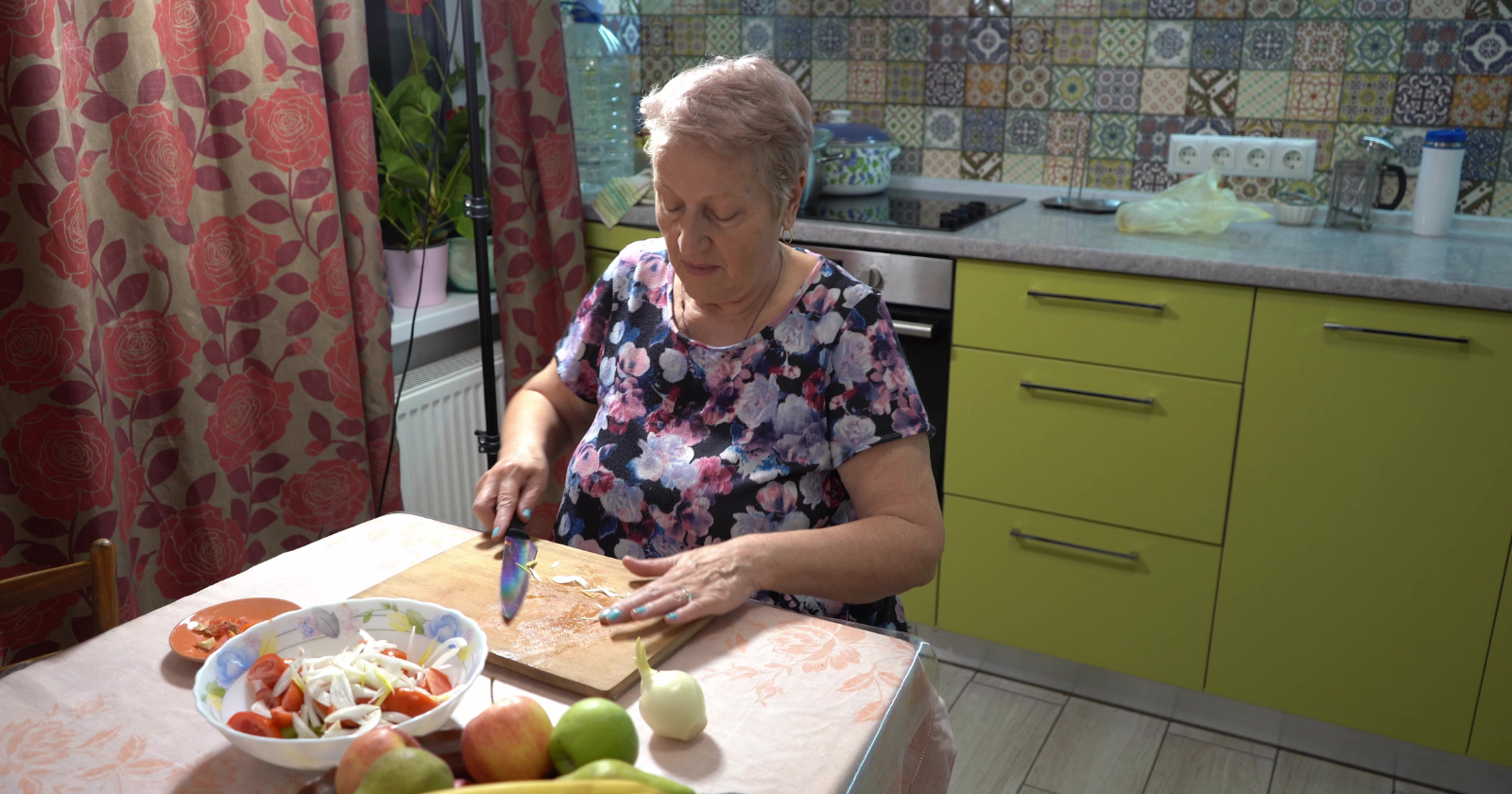
In a lot of working class kitchens, you have a knife (maybe two).
One is sharp-ish, while the other one is a serrated steak knife that somehow becomes the universal tool for tomatoes, onions, and opening Amazon boxes.
Picture me at a dinner party, trying to help prep vegetables: I open the drawer and see a full knife block situation.
Chef’s knife, santoku, paring knife, bread knife, and something that looks like it belongs in a museum.
My instinct was still to grab the smallest one and “make it work.”
That’s when I realized something: Wealth is about being socialized into using the right tool without thinking you’re being wasteful or extra.
There’s also a subtle confidence embedded in it.
When you grow up with scarcity, you try to reduce risk and you pick the safer option—the smaller knife feels safer.
The giveaway is the way you hold it like you’re borrowing it.
5) The scratched nonstick pan from 2011
I used to think a pan was a pan.
If it heated up and didn’t immediately start a fire, it was a good pan; if the coating was scratched, you just used a little more oil and kept your hopes realistic.
Then, I watched people in wealthy suburbs cook with these heavy pans that look like they could stop a burglar.
Stainless steel and cast iron; gorgeous stuff.
I realized my old nonstick pan was a symbol of how I’d learned to delay upgrades until something was basically unusable.
This one showed up when a host asked what I wanted to sauté my veggies in.
I pointed to their nicest pan and then immediately backtracked: “Actually, whatever’s easiest, I don’t want to mess it up.”
That sentence is a background check.
People who grew up working class often carry a fear of damaging expensive things, because “expensive” used to mean “catastrophic to replace.”
Even now, when you can afford it, your body remembers the old math.
If you’ve ever apologized for using someone’s pan, you know what I mean.
6) The coffee setup that feels “too much”
Coffee is one of the clearest class tells because it’s half beverage and half ritual.
In my world, coffee was fuel: Cheap drip, whatever was on sale, and sometimes instant when money was tight.
You drank it standing up because you had somewhere to be.
At one dinner party, I walked into the kitchen and saw an espresso machine that looked like it had its own Wi-Fi plan, grinder, scale, tiny cups, and a whole station.
The host asked, “Do you want a cappuccino or a pour-over?”
I said, without thinking, “Honestly, whatever’s easiest.”
I didn’t want to be high-maintenance—that’s the reflex—but in that environment, choosing a specific coffee is participating.
It’s like choosing a vinyl record at someone’s house instead of saying, “Anything is fine.”
I’m vegan, so I’ve gotten used to asking for oat milk.
That part doesn’t faze me anymore, but the “coffee ceremony” still does, because it’s leisure disguised as caffeine.
Leisure used to feel like a luxury I hadn’t earned yet.
7) The paper towel roll on the counter
This is the most innocent one, and it might be the loudest.
In a working class kitchen, paper towels are the universal problem-solver.
Wipe the counter, dry your hands, clean up a spill, wrap something, and just grab-and-go.
When I’m in a fancy kitchen and I see a roll of paper towels hidden away, and cloth towels neatly folded like hotel linens, I have to override muscle memory.
I once reached for paper towels after slicing limes.
The host gently handed me a cloth towel instead, like they were saving me from myself.
The truth is, I felt weirdly exposed!
The psychology here is simple: Paper towels are convenience, while cloth towels are continuity.
One says, “We clean as we go because life is messy.”
The other says, “We maintain the vibe.”
Again, neither is superior but the choice signals what kind of household trained you.
If your default is disposable because it saves time and reduces stress, you probably came from a home where time and stress were always tight.
The bottom line
Here’s what I’ve learned: These “tells” are about the strategies you built when resources were limited.
Keep it simple. Stretch the basics, and stay low-maintenance.
If you relate, you don’t need to erase those instincts.
They probably made you competent, resilient, and way better at feeding yourself than half the people with matching dish sets.
However, if you want to blend in a little more at those shiny suburban dinner parties, you can do it without pretending to be someone else.
Keep your values, upgrade a few defaults if you feel like it, and remember that your background is just showing up in the places you learned to be smart.
What’s Your Plant-Powered Archetype?
Ever wonder what your everyday habits say about your deeper purpose—and how they ripple out to impact the planet?
This 90-second quiz reveals the plant-powered role you’re here to play, and the tiny shift that makes it even more powerful.
12 fun questions. Instant results. Surprisingly accurate.