Hidden beneath her famous lemon squares recipe, I discovered my mother's handwritten apology on a folded scrap of paper—five words that have haunted me for eight months, reshaping everything I thought I knew about the woman who held our family together for forty-seven years.

Add VegOut to your Google News feed. 
The recipe box sat on my mother's kitchen counter for forty-seven years, its faded yellow metal corners softened by decades of use.
The hinges creaked when I finally opened it three months after her funeral, releasing the scent of vanilla extract and cinnamon that had perfumed her kitchen through countless holiday mornings.
Her careful handwriting covered index cards stained with butter and time—chocolate chip cookies, her famous chili, those lemon squares she made for every church potluck.
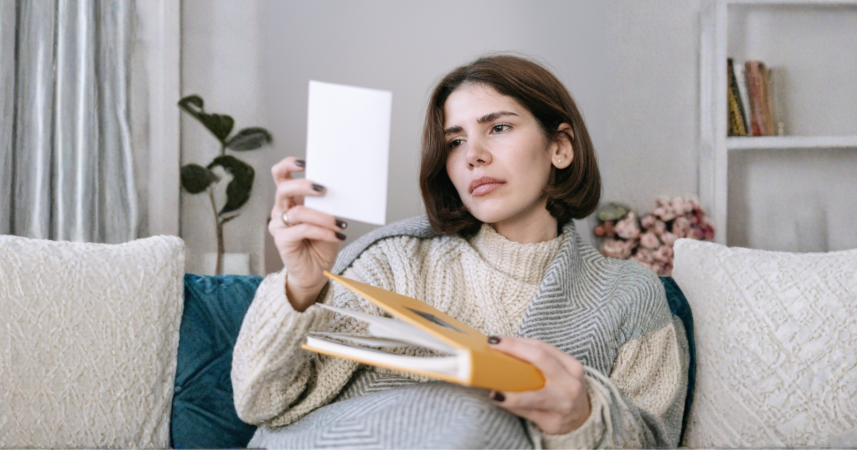
But tucked beneath the lemon squares recipe, folded into a square no bigger than a matchbook, was a note in her same careful script: "I'm sorry I wasn't more."
No date. No addressee. Just five words that have kept me awake for eight months now.
The weight of wondering
Have you ever found something that completely reshapes how you see someone you thought you knew completely? This note has become my obsession, a puzzle with pieces that don't quite fit.
The handwriting looks older, more recent than the recipes written in her younger, confident script. The paper is different too—torn from a notepad she kept by the phone in her last years, not the index cards she used for recipes.
I've turned those five words over in my mind so many times they've worn smooth as river stones. Was it meant for my brother and me?
We were young when Dad left, old enough to remember her crying in the bathroom with the water running, young enough to believe her when she said she had allergies.
She became both parents overnight, teaching my brother to shave using instructions from a library book, teaching me about periods with a clinical precision that masked her own discomfort.
She worked double shifts at the hospital while finishing her teaching degree at night.
She attended every parent-teacher conference, sewed Halloween costumes from old sheets and determination, made birthday cakes from box mix taste like celebration. If the note was for us, what "more" could she have possibly been?
Or maybe it was for her second husband. They met when she was in her forties, both of them carrying the cautious hope of people who'd been hurt before. She waited three years before introducing him to us, protecting our hearts while learning to trust her own.
They had twenty-five good years before Parkinson's took him piece by piece.
She cared for him with a tenderness that transformed duty into devotion, spooning soup into his mouth when his hands betrayed him, reading him the newspaper when his eyes clouded, singing the hymns he loved when words finally left him.
The mothers we never fully know
Perhaps the note was for her own mother. They had one of those relationships that seemed loving from the outside but was riddled with invisible wounds.
My grandmother wanted Mom to marry better the first time, stay married despite everything, focus less on her career and more on finding another husband after the divorce.
Mom spent years bringing her homemade cookies to a woman who preferred store-bought, sharing her teaching victories with someone who asked why she wasn't a principal yet.
Virginia Woolf once wrote, "We think back through our mothers if we are women." But what happens when we can't fully see who they were? The last five years of my grandmother's life, dementia stole even the possibility of resolution between them.
If that note was meant for her, it breaks my heart that Mom never got to stop apologizing for not being the daughter she wanted.
I've asked everyone who knew her well. Her sister just shook her head. Her best friend from college said Mom was the strongest person she knew, which only made the mystery deeper.
The women in her widow's support group were surprised—she was the one who held everyone else together, who brought those same lemon squares to every meeting, who listened more than she shared.
Teaching beyond the classroom
Could it have been for her students? She taught high school English for thirty-two years, keeping a notebook where she tracked not just grades but struggles—who was caring for younger siblings, who was working night shifts, who needed extra encouragement.
In one of my previous posts, I wrote about how teachers shape us in ways we don't recognize until years later. Mom was that kind of teacher.
She started a free tutoring program that still runs today. Won Teacher of the Year twice. When her knees gave out and she had to retire early, she mourned the loss of her classroom more than her mobility.
Former students still sent her Christmas cards with photos of their children, thanking her for believing in them when no one else did. If it was for them, they would tell her she was everything.
The selves we set aside
But sitting here at my own kitchen table, her recipe box open beside me, I wonder if the note was for herself.
An apology to the woman she might have been if she hadn't married at twenty-two, hadn't become a single mother at twenty-eight, hadn't spent fifteen years raising children alone on a teacher's salary.
Maybe it was for the girl who wanted to write novels, who got into Columbia but couldn't afford to go, who set aside dreams so gently that no one noticed them disappearing.
We all carry ghosts of our unlived lives, don't we? The paths we didn't take, the chances we didn't grab, the people we might have become if circumstances had been different.
I understand this more as I age myself. After decades of putting others first—as a teacher myself, as a mother, as a wife—you look back and wonder about all those small sacrifices that seemed so necessary at the time. You wonder if saying yes to everyone else meant saying no to some essential part of yourself.
Learning to live with mystery
The not knowing is what haunts me most. Because if I knew who it was for, I could refute it. I could tell her, wherever she is, that she was more than enough.
That she was the woman who taught us to budget and to be generous anyway. Who showed us that strength isn't about never falling but about getting up again and again.
But maybe that's not the point. Maybe the note wasn't meant to be found, or maybe it was meant to be found but not understood.
What if this is her final teaching moment—that we all carry secret apologies for failures only we can see? That even the people who seem most complete are fighting battles we know nothing about?
Last week, I made her lemon squares for a school fundraiser, using her recipe card with its precise measurements and timing. As I packaged them, I thought about tucking my own note underneath—not an apology, but a promise.
That I see her, all of her, not just the mother and teacher and caregiver but the woman who doubted herself despite all evidence to the contrary.
The squares sold out in an hour, just like hers always did. Someone asked for the recipe, and I shared it freely, just like she would have. But I kept the note to myself. Some inheritances are too personal to pass on, too precious to dilute with explanation.
Final thoughts
I've kept the note in my own recipe box now, beneath my attempt to recreate her lemon squares. Sometimes I take it out and unfold it carefully, running my fingers over her handwriting, wondering if she'd be horrified or relieved that I found it.
What I've come to understand is this: Whatever "more" she thought she should have been, she was already everything to those of us who loved her.
The note doesn't diminish that. It just reminds me that the people we love are always more complex than we imagine, writing apologies that may never find their intended recipient.
Perhaps we all carry these notes within us—apologies for the ways we think we've fallen short, for the people we couldn't quite manage to be.
And perhaps the gift is not in the knowing but in the loving anyway, in accepting the mysteries people leave behind, in honoring their complexity without requiring resolution.
Mom, if you can hear this somehow: You were always more. You were always enough.